Friday, July 3, 2020

Review of Undivided Witness: Jesus Followers, Community Development, and Least-Reached Communities (Regnum Books 2020)

I commend to you a new book edited by David Greenlee (who will have a chapter on movements and the “common good” in our forthcoming Motus Dei book), Mark Galpin, and executive director at OCMS Paul Bendor-Samuel (who is also part of Motus Dei), titled Undivided Witness: Jesus Followers, Community Development, and Least-Reached Communities. From the description:
Undivided Witness presents ten key principles linking community development and the emergence of vibrant communities of Jesus followers among the ‘least reached’. Twelve practitioners explore this uncharted missiological space, drawing on decades of serving and learning among communities in Africa, the Middle East, Europe, and South, Central and Southeast Asia.
‘Tribalism’ is everywhere, including in the missions community. There are people who are passionate about church planting. Others whose heart is for community development, social justice, and the poor. Then there are those who want to reach the least reached. These different tribes only occasionally speak, and, maybe more than they care to admit- view the other tribes with suspicion.

I remember feeling this tension when I started ministry twenty years ago while I was preparing for ministry in a poor, unreached Muslim country. Books on church planting and discipleship seemed to focus on responsive contexts that already had a local church. Community development practitioners rarely spoke about evangelism. And literature on the least-reached didn’t have much to say about God’s heart for the poor and marginalized. It was as if I was forced to choose my tribe in an either-or dichotomy. Doesn’t God care about all three?
To deal with this issue, a group of practitioners, missiologists, and scholars gathered at the Oxford Center for Mission Studies in 2018 to explore this unexplored space called ‘CDLR’ (Community Development Least Reached) which is the intersection between 1) community development, 2) the least reached, and 3) emerging, multiplying vibrant communities of Jesus-followers. What resulted is a list of ten principles which form the chapter structure of Undivided Witness:
  1. Understanding the Kingdom of God is crucial to understanding how and why community development and vibrant communities of Jesus followers among the least reached are connected.
  2. Our understanding of how people enter the Kingdom of God will affect how we do ministry.
  3. The gospel impacts the whole person and people’s whole contexts.
  4. Our motivation is to glorify Christ. We long for people to come to faith in him, but our vision does not stop there. We want to see the Kingdom of God impact people and the communities we live in.
  5. Spiritual warfare and prayer are an integral part of community development.
  6. Creation glorifies, praises, and witnesses to God. Caring for creation is an act of worship. Our concern for creation is an act of obedience to God and participation in his work of reconciling all things to himself.
  7. Community development will only be truly transformational if it brings a vision for vibrant communities of Jesus followers and the renewal of the whole person and community.
  8. Community development workers are committed to professional excellence.
  9. There is significant overlap between the principles of excellence in community development and working toward the formation of vibrant communities of Jesus followers.
  10. The ‘least reached’ are so for a reason, both spiritually and often in terms of poverty and development.
Undivided Witness models some of the best integrative thinking in missiology. Their ten principles of ministry on the overlap between community development, discipleship movements, and least-reached peoples are skillfully unpacked and explained with challenging case studies and deep theological reflection. This is an important conversation on perhaps the most difficult and strategic ministry context in the world today.

In the introduction, the editors share their purpose for Undivided Witness:
Our overall hope and aim in writing this book is that it will stimulate more reflection and discussion on this area of ministry, contribute to a rarely explored theme in missiology, and encourage the discovery and recognition of the links between community development and the emergence of ‘vibrant communities of Jesus followers’ in least-reached settings. By demonstrating the synergy between church planting and community development, we hope to dissolve the perceived tension between these ministry approaches and to encourage organisations that have traditionally focused on church planting and evangelism to recognise the strategic role community development can play in achieving their Kingdom objectives in least-reached contexts—never to be used merely as a platform but as an integral feature of truly holistic mission. 
In addition, we hope that our work will influence and shape the practice of those already committed to the strategy of community development as a ministry approach in least-reached contexts, enabling them to become more effective and transformative in building God’s Kingdom. 
While we have confidence in these principles, we consider them to still be under development. Input from readers is therefore welcome to both refine the principles and to develop a robust explanation and grounding for each. In turn, this will help us contribute to a missiology that guides ministry and service involving community development among the least reached.
Buy the book now on Amazon Kindle or in print from Regnum.

Thursday, July 2, 2020

Online Missiological Training: Post-Pandemic Insights and Applications

Based on "Neurobiological Data on What Online Education Could Be Doing to Our Spirituality and Our Brains: Some Augustinian/ Niebuhrian Reflections" (Ellingsten 2019) and "Makeshifting the Learning Management System: Strategies and Tactics in the Digital Classroom" (Smith 2019)  Articles Available Here

* The nature of the online world fundamentally changes the way our brains work. While accessing vast amounts of information is enhanced, "heavier online use is making us more shallow, more caught up in the present moment and its patterns, less transcendent in our thinking and behaviors" (Ellingsten 2019, 10). In short, we are less intelligent, more reactionary, and more spiritually shallow.

* Cross-cultural ministry is always more difficult, both cognitively and emotionally. Over-exposure to the internet and poor approaches to online education can have drastic effects on the missionary who will be less intellectually prepared for complex issues and impaired from the ability to love deeply.

* Increase in social media usage seems to be evidenced by those who are more depressed. Because the internet makes us less empathetic, could this be contributing to the increase in irrational online outrage/anger, the spread of conspiracy theories, and to anti-science rhetoric?

* Whether we like it or not, online training is here to stay. Things are not going back to the way they were before the pandemic.

* Learning facilitators who are more creative and involved in the online LMS (Learning Management System) tend to have higher levels of job satisfaction and also students who tend to have more transformative learning experiences (Smith 2019). Personal touches such as short videos and audio are helpful, as well as face-to-face synchronous meetings when possible.

* Online learning needs to intentionally contain elements that are offline. This includes longer stretches of reading and reflective writing while not connected to the internet. Videos and podcasts are proliferating but immersive reading needs to be maintained. Additionally, intentional offline time for the spiritual disciplines of meditation, prayer, and solitude is now MORE important in an online environment than in traditional formats.

* Online course design also needs to include the context of the learner. Learners are always in a "classroom." Especially for the missionary, the classroom is the ministry setting. Reading and writing needs to be integrated with the complicated classroom of real life. This has advantages to artificial (traditional) classrooms, but it requires more creative design from learning facilitators.

Monday, June 22, 2020

Counting Missionaries | Justin Long

Here is the latest discussion on global statistics from Justin Long in his post COUNTING MISSIONARIES published on June 3, 2020:

Globally: 425,000 missionaries (Anglican, Independent, Orthodox, Protestant and Roman Catholic)
Total in World A countries: 11,940 (3%) [World A: <50% evangelized)]
Total in World B countries: 87,000 (20%) [World B: >=50% evangelized, <60% Christian]
Total in World C countries: 326,060 (77%) [World C: >=60% Christian, of any tradition]

From the summary:

2,000 years after Christ, somewhere around 3% or less of all missionary workers are deployed amongst those who have very little chance to hear (a factor in why they have little chance to hear), while three-quarters of missionaries work in places that are over-saturated Christian countries (albeit perhaps of a different tradition than the missionaries in question). While I do not doubt that places like Germany and England and France likely need evangelistic effort, this “out of balance” situation seems to me to continue to be one in need of reformation.

Read the whole thing.

Saturday, May 23, 2020

Monday, May 11, 2020

Impact and Implications of the CoVid-19 Pandemic | Jason Mandryk

Jason Mandryk with Operation World just released a free eBook (53 pages) titled Global Transmission Global Mission: The Impact and Implications of the CoVid-19 Pandemic.

You can download the eBook here http://covid-19.operationworld.org/global-transmission-global-mission/:

CoVid-19 is proving a disruptive, distressing, and divisive force throughout the world. How do mission-minded Christians respond? What happens to the Great Commission when the world is on lockdown? In this short e-book, Jason Mandryk, the author of Operation World, takes readers through a sweeping overview of the implications of the coronavirus for the global Church, and specifically, its impact on global mission.

In compiling this analysis, the Operation World team interacted with ministry and mission leaders in every region of the world, getting input on how to pray for different nations afflicted by CoVid-19 as well as strategic considerations from a wide array of missiological contexts.

Here is the Table of Contents

  1. ACKNOWLEDGEMENTS
  2. PREFACE
  3. INTO THE UNKNOWN
  4. THE BIGGER PICTURE – SOCIOCULTURAL ISSUES
  5. BUT WHAT ABOUT THE ECONOMY?
  6. CHRISTIAN TESTIMONY IN A TIME OF PANDEMIC
  7. CHURCH LIFE DURING LOCKDOWN
  8. MISSION MOBILIZATION
  9. MISSIONARY SENDING
  10. MISSION FIELD REALITIES
  11. CHRISTIAN MEDIA
  12. PRAYER – THE LAST RESORT?
  13. REASONS FOR HOPE

Read the whole thing, available in PDF, Epub, and Mobi.

Friday, March 20, 2020

A Missiology of Social Distancing: Ministry Innovation in the Midst of Biosecurity Events

The extent to which biosecurity events like this current COVID-19 pandemic affect the world, including mission, are yet to be determined. But big changes to ministry are (probably) coming and things may never be the same again. It may leave a lasting impact on various contexts for generations to come.

We need to think through how “social distancing” will affect communities and peoples- if this Coronavirus continues off and on for 18 months, there may be a psychological crisis worldwide as well. Suicide, depression, pornography, substance abuse, etc. are likely to rise.

If infection curves do not flatten, and health care systems are stretched beyond capacity, then the Church could step up and serve (indeed many are already), but it will require personal sacrifice. Some could even die.

One relevant case study is a West African movement that was featured in Miraculous Movements. When the Ebola epidemic began in 2014, they were planting 2,000 churches per year. It decreased to 200 per year during the 18 month crisis.

But the movement met needs that the government was unable to- church planters volunteered to serve in remote areas. The radio station that was being used for evangelism and preaching began an awareness campaign to counteract the rumors that Ebola was just a CIA conspiracy. Several volunteers died after traveling to villages to teach those who had no awareness of how their burial customs were spreading the virus.

These volunteers built such goodwill with those communities that many churches were planted after the epidemic ended in 2016, and the movement continued. We could draw similar examples from the early church’s growth during the plagues in the Roman Empire.

Such a loving response requires a robust theology of suffering. We will need to learn to pray. The marginalized and the invisible in our communities will be the most vulnerable.

During social distancing, we need to examine how the use of various internet technologies will affect the "diffusion of innovations" in communities, especially as it pertains to the gospel. What will happen to large, attractional, program-driven churches? Will ecclesiology become deinstitutionalized, and could this enable discipleship movements? 

Or will oikos (social-familial) structures become less communal, and could this constrain discipleship movements? Will individualism increase?

When charitable giving dries up with the collapse of economies, what will happen with our current model of support-raising missionaries? What about churches and seminaries in the Majority World who depend on wealthy churches in the West?

Will there be more resistance to mobilizing ministers to serve in places that lack an indigenous church, often countries with weak health care systems? Will xenophobia, racism, and even theological tribalism increase? But could this simultaneously increase the number of people who care about peace-building and ecumenism?

I wonder if there should be space for biosecurity events built into many areas of missiology, whether it is research, worship and music, preaching, peace-building, teaching, strategy, training, leadership development, theological education, etc.

We are only just beginning to think through what prolonged and sporadic cycles of social distancing will mean for mission. But we have hope, and there are many opportunities ahead. For faithful followers of Christ in uncertain times, apostolic innovation is required.

Tuesday, March 17, 2020

Hills and Hiding? A Response to Travis Myers | Kevin Higgins

Below is a guest post from Kevin Higgins (President of William Carey International University) written May 1, 2019 but not previously published. It is a response to an article published at Desiring God on April 23, 2019: A City Under a Hill: Five Problems with Insider Movements. Feel free to comment below.


Hills and Hiding? A Response to Travis Myers

Kevin Higgins | May 1, 2019

I recently received the link to the article, “City Under a Hill: 5 Problems with Insider Movements” by Travis Myers (Professor, Bethlehem College & Seminary).

I will primarily use the outline of the five points he raises, however I begin from one of his major subtitles near the beginning of his paper: “When the Gospel hides”.

By highlighting this comment and framing it as a major section of his paper he tips his hand to an assumption he is making about insider movements: they are secretive and hiding the Gospel. This is of course hinted at in his title as well (city under a hill).

While I welcome questions about insider movements and feel the discussions are a healthy process, I find responding to this idea that insider brothers and sisters are hiding their faith is just covering old territory in the long discussions about IM. The claim that insider movements are secretive or silent or don’t share their faith is a claim as old as the discussion itself (back to at least 2004). This has been frequently rebutted, and the number of Muslim followers of Jesus who face persecution and death because of their faith is also witness to the erroneous nature of this straw man argument.

Does every “insider” believer stand boldly? Certainly not. Does every Christian living in Muslim countries do so? Does every Christian in the USA? Of course not.

The real question then is what do godly leaders in such contexts teach and encourage their people to do? In the case of insider movements, the expectation is that disciples of Jesus make other disciples of Jesus. They share their faith and they bear witness.

They do not hide the Gospel.

Now to Myers’ five points. I use his terms, and each of the five is followed by a direct quotation from Myers’ article.

1) Hermeneutics

“IM is predicated on the misguided idea that faith in Jesus as Lord of one’s life can “complete” and be the apex of any religious tradition or religious identity.

Two responses. First, IM is not predicated on this point. Not every IM proponent even holds this position, and in fact, if fulfillment thinking is not true it would not change anything. IM practice or approaches or principles are not dependent on this theme. IM is predicated on many other biblical principles and passages. The literature is full on this point.

Second, in my own thinking the only mentions I have made of “fulfillment” thinking were extremely guarded and tentative and quite clearly distinguished from what we mean when we refer to Old Testament fulfillment. I was raising the point merely to explain how I understood things, because it was already being asked.

My contention is that Jesus does fulfill a number of dimensions of anyone’s cultural and religious backgrounds when a person comes to faith (and personal longings and hopes as well). It is frequently the case that in Jesus people can and do see a number of beautiful aspects of their heritage, including their religious heritage, which now seem to find a new fullness and beauty in Jesus.

Myers’ argument which assumes IM bases itself in fulfillment thinking is a generalization and inaccurate.

2) Integrity and Identity

“Core Islamic doctrine explicitly denies biblical doctrines that are central, and essential, to Christian faith.”

This is true. Core Islamic doctrine does deny biblical doctrines that are essential. No argument on this point has ever been put forward by any insider advocate I know of.

Muslims who follow Jesus (not all, but a number whom I know) do argue that on the basis of the Qur’an and the Bible a number of core Islamic teachings are incorrect and they seek to reform those understandings, including Islamic teaching about Jesus, the Bible, salvation, and more.

This is not at all the same thing as suggesting that Islam does not teach incorrect things. In fact, it assumes the opposite.

3) Discipleship

“The IM approach stunts Christian discipleship and spiritual growth.”

I am guessing, perhaps wrongly, that Myers has not met insiders personally or directly. His conclusions certainly seem to indicate this. The question here really is what are IM movements doing about these issues? How do they disciple believers?

The movements I have known and been involved with are all rooted in ongoing inductive study of whole books of the Bible in community. Also, increasingly, I see leaders focused on reflection on the doctrinal history and themes Christ’s people have wrestled with historically, as these leaders in turn wrestle with issues in their contexts.

This does not mean that every answer Christ’s people have arrived at in other epochs and contexts is simply swallowed whole into such movements. I would argue we don’t do so in the west either, and would add that I don’t think we should do so.

4) Ecclesiology

“One’s identification with Christ should entail identification with all of Christ’s people in the world today and throughout time. That is more fundamental, ultimate, and significant than ethnic, cultural, linguistic, family, or local identity.”

I hear this sort of claim from time to time from critics of IM. I can sympathize with its intentions and heart. However, several things need to be said.

First, what is meant by identification with “all Christ’s people in the world today and throughout time”? How is this even possible? How many Christians identify in this way? We have Christian denominations who do not see others as Christian, will not have communion together, do not recognize one another’s ordinations, and more. We don’t even share (fully) common creeds, confessions or canon of scripture. So, to ask insider believers to hold to a standard that the Christian church has not attained seems hypocritical. I am not suggesting Myers is hypocritical as a person, but that this standard is.

Second, even when we do pursue unity and identification as Christians with others, this happens very much on a small and personal and local scale: through relationships. And this also happens between insider believers and those who we would call Christians. I have seen it and facilitated it. There is no sense among the leaders of IM’s which I know that Christians are not also brothers and sisters in Christ. They welcome thinking of all believers in Jesus as members of the Body.

Finally, I know believers who are “insiders” who also pray regular for Christians. They do so as brothers and sisters.

5) Soils and Strategy

“Though admittedly difficult in many contexts, religious identity and ethno-cultural identity can and should indeed be differentiated. The former must be given up for Jesus and the church. We should reject the conflation of social and religious identity.”

I want to point out where I agree and disagree with Myers here.

First, where I disagree. I understand Myers’ point here but it is, from many points of view, simplistic and impossible to separate religion and culture. We think we can, in the west. And maybe in a western context this may be partly the case, with our assumptions about secular and religious life, and physical and spiritual dichotomies, and assumptions that religions are easily distinguished and identified.

But in most contexts, this simply is not as easy as Myers suggests. In a Muslim context where something as normal to daily life as brushing one’s teeth and using the toilet are guided by religious teaching, what would be culture or religion? Should one brush one’s teeth differently just to show one is not keeping one’s religion? If one continues to brush teeth as they have since childhood, is that keeping their religion or their culture? These are purposely “easy” sorts of examples, in order to show that it isn’t easy.

In the simple examples above most readers will likely be thinking, “well brushing teeth doesn’t matter so even if it is guided by religion, no problem.” This already suggests we are comfortable making distinctions about what is ok and not ok to keep, even from one’s religious heritage.

Where do I agree with Myers?

The fact is that obedient discipleship will require changes. It will require replies of yes and no to all sorts of things, cultural, religious, emotional, personal, relational, attitudinal, philosophical, etc.

Thus, for me, the point is not whether one can keep culture but must jettison religion, or even whether that is a distinction we can make. The point is how do needed changes happen, how are they identified, who makes such decisions, and how do they decide, and for what reasons and motivations?

This is why we have taken great care in the movements I have been involved with to cultivate processes for handling such questions (for example, the questions of should we continue to do this or stop doing that). We have never given a blanket “yes, just keep doing everything”. Neither have we given a blanket no, on the other hand.

What we have done is asked, “what does scripture say on this issue? How do we obey? What does being faithful mean? How do we decide which aspect of our heritage is ‘ok’ and ‘not ok’?”

Conclusion

I have no expectation of being able to persuade every critic of the viability of the biblical faithfulness of IM as movements. And my aim here is not in fact to persuade. But I do hope to explain and, where possible, correct misperceptions and assumptions which result in misrepresentations. I do not for a moment suggest Myers intends to misrepresent anything about IM. But the five points do result in that at the end of the day.

To return to the title of Myers’ article, the IM examples I know of are not “cities under a hill.” They are seeking to both receive and share Christ’s light with all those around them, hoping that Jesus and His Gospel will be impossible to be hide.

Thursday, March 5, 2020

No DMMs in the USA

From https://discipleship.org/national-study-on-disciple-making-in-usa-churches/:

NATIONAL STUDY ON DISCIPLE MAKING IN USA CHURCHES: High Aspirations Amidst Disappointing Results

SPONSORED BY DISCIPLESHIP.ORG + EXPONENTIAL 

CONDUCTED BY GREY MATTER RESEARCH

The following key points are a summary of the results from this study:

1. Fewer than 5% of churches in the US have a reproducing disciple-making culture – we champion and celebrate these churches. They are a model for other churches. But, at the same time, in light of the truth that disciple making is the core mission of the church, the study found a disappointingly low percentage of churches with a culture of and strategy for reproducing disciples and disciple makers (Level 4 and 5 churches).

2. An absence of churches reflecting viral-like disciple making movements (L5 churches) – we did not find clear examples of disciple making movements (DMM) in the US. Stated differently, we did not find in the established churches that were interviewed disciple making movement churches. These churches may exist in the USA, but they are not reflected in the data uncovered. Such churches are common in various other parts of the world. We delineate them from level 4 churches (reproducing disciples) by the level 5 viral-like features – these churches reflect a special movement of the Holy Spirit as they rapidly multiply disciples and disciple makers. We look forward to finding them in the USA.

3. Lack of commonly understood definitions – there is not a clear, compelling and commonly understood set of basic definitions for terms such as discipleship, disciple, and disciple making. This makes it very difficult to assess effectiveness within local churches and within the broader church community (consistent definitions do not prevail in Protestant churches in the USA).

4. Overestimating Impact – pastors are overly optimistic in their assessment of the disciple-making cultures present in their churches, and frequently overrating their effectiveness in discipleship and disciple making.

From page 13: “The USA lacks clearly defined examples of viral-like disciple-making movements (DMM). There are some 1,000 disciple-making movements around the world that match the following character traits. They are unique movements, reflecting a revival-like culture like that found in the early chapters of the book of Acts…"

Download the whole thing.

Friday, February 28, 2020

Review of Ephesiology: A Study of the Ephesian Movement (Cooper 2020)

I’m excited to introduce you to a new book, Ephesiology: A Study of the Ephesian Movement. See also the corresponding website https://ephesiology.com with a course, blog, and podcast.

Author Michael Cooper will be presenting at Motus Dei: Movements Research Symposium later this year. His talk is tentatively titled, “Missiological Theology of Movements focused on the Study of the Gospel of John.

Ephesiology is a study of the origins of the Christian church planting movement that began in Ephesus. It presents a way to read the Bible through the glasses of first-century movement leaders which will lead you to a “missiologically theocentric” pursuit of movements today for God’s glory.

Cooper offers a robust, holistic missiological theology of church planting movements (CPM) by looking primarily at Acts 19, Ephesians, 1 Timothy, 2 Timothy, and Revelation 2-3. He exegetes these passages through what I would call a “movemental hermeneutic” of Scripture. Throughout, Cooper’s missiology engages with church history, religious studies, sociology, and current CPMs.

A unique aspect of Ephesiology is that it doesn't use strategy buzzwords such as people of peace, T4T, Insiders, DMM, generational mapping, or contextualization (although 4 Fields is used in the appendix). It is really just a biblical look at CPM, and Cooper does some creative and nuanced work to make the biblical text relevant for practitioners today.

Those who are more theologically inclined will like Ephesiology, while others might find the theology lengthy at times. Ephesiology is especially good for those who might be turned off by aspects of the DMM/T4T/CPM industry but who are still interested in movements (and New Testament theology).

Cooper might not like me using these words (perhaps for good reason), but his approach is both contextual and holistic. He engages deeply with religion and culture and also cares about social justice and transformation. Because it is filled with biblical principles, Ephesiology is meant to be applied in both the Global North and the Global South.

Here is Cooper’s missiological-theological framework of the Ephesian movement (pgs. 180-181):

  1. The early missionaries launched a movement that is missiologically theocentric, with the heart to connect God’s story with the story of culture… A proper missiological theologian will allow the identity of a movement to evolve from within a culture.
  2. Paul grounded the movement with the vision to fulfill God’s will of uniting all things in Christ.
  3. Paul and Timothy led the movement as a community of brothers and sisters determined to equip the saints for ministry.
  4. The disciples multiplied a movement by empowering leaders to use their gifts, inspiring them to join in suffering, entrusting them to teach others, and reminding them to preach the Word.
  5. The church in Ephesus sustained the movement by reengaging the works of her first love.

Overall, Ephesiology is an invaluable resource for anyone who wants to learn:

  1. how all who lived in the province of Asia heard the word of the Lord while Paul was in Ephesus for two years (Acts 19:10),
  2. the incredible movements that transformed peoples from India to Iberia in the first 250 years of the church, and
  3. how we can glorify God by joining with him to unite all things in Christ today (Eph. 1:10).

As Cooper says, “This is the story of Paul’s missiological theology situated in the grand narrative of God’s mission. It rocked the world of his time, and it can rock our world as well” (pg. 34).

Buy the book, register for the online course, or have Cooper run a workshop for your group.

Friday, January 24, 2020

Introducing “Motus Dei: DMM and the Mission of God” | Global Missiology

The online journal Global Missiology has published my essay Motus Dei: Disciple-Making Movements and the Mission of God in their January 2020 issue. Here is the abstract:

God's mission is diverse, and so are the ways missiologists discuss it. This article outlines a constructive missiology of the current "disciple-making movement" phenomenon in a way that makes creative connections between different conversations in the field of mission studies. In so doing, a new concept called motus Dei (Latin for movement of God) is situated into our understanding of the missio Dei.

Here is the main outline:

  1. Integral Mission as Both Apostolic and Indicative

  2. Towards a Missiology of Disciple-Making Movements

  3. Locating DMM in the Missio Dei

    • The Globalizing Church and the Role of West-South Partnerships

    • DBS as Translation and Inculturation

    • The Eradication of the Laity

    • Obedience-Based Discipleship and The Common Good

    • Prayer, Miracles, and Weakness

From the Conclusion:

In their passion for movements, DMM advocates tend to discuss them as if they are the primary way God is working in the world today. The same could be said for those who advocate the missio Dei with respect to holistic ministry. This article represents one bridge-building attempt to show that there is more common ground than is often recognized. Discipleship movements, occurring at the intersection of divine initiative and human responsibility, play an important role in God's mission to redeem his creation back to himself. Despite the tendency to emphasize our distinctive differences, we in the mission community need to embrace our unity in Christ and to listen more carefully to one another.

What can the wider mission community, and missiologists collectively, learn from the current DMM phenomenon? One central lesson is profoundly theological: sometimes, God moves quickly. Other times, slowly. In his sovereignty, speed and quantity is not the issue, but the quality of growth and the glory God receives. Related is that statistics should never be the sole measure of success. Furthermore, we should not expect movements to happen in every context if we just do ministry in a certain way. At the same time, this study of DMM demonstrates that there are approaches to mission and forms of ecclesiology that seem to facilitate movements better, so we are wise to inquire how they can be fostered more effectively.

God seems glad to work both inside and outside of traditional ecclesial patterns established in Christendom. However he works, God often moves in ways that defy expectations; it is his mission, after all. We might call this divine activity the motus Dei, the movement of God. In light of this motus Dei, we can - and indeed should - pray earnestly with apostolic and ecumenical passion, "that the message of the Lord may spread rapidly and be honored" (2 Thess. 3:1), just as it is with DMM.

Read the whole thing.

Friday, December 27, 2019

The “Unreached Peoples” Paradigm Under Scrutiny

If you weren’t already aware, the “Unreached Peoples Paradigm” in missiology has been under scrutiny the past several years. Here are a couple examples.

The 3 Words That Changed Missions Strategy—and Why We Might Be Wrong

And a response, Should Missionaries Focus on Unreached People Groups? Yes.

A deeper discussion is found here:

Beyond people group thinking: A critical reevaluation of unreached people groups

And a response, Beyond Groupism: Redefining Our Analysis of Ethnicity and Groups

I’ll be attending a webinar on January 9, 2020, 2:00-3:15pm EST titled: The People Group Paradigm in 2020: Relevant for Today, Relic from the Past or Something in Between? by Dave Datema with Frontier Ventures. (It is free, but you have to register with Missio Nexus- as a member of a North American mission agency you most likely get to sign up for free: https://missionexus.org/join/#join.) Here is the description:

The last ten years have witnessed an increasing number of questions and criticisms related to the people group paradigm. Is panta ta ethne really talking about people groups? Haven't the seismic forces of globalization, urbanization, migration and the digital revolution made the people group concept irrelevant? Aren't the realities on the ground simply too complex for the simplistic notion of people groups? If the people group paradigm represented the third era of mission and is over forty years old, isn't it time for the fourth one to appear? This webinar will delve into these and other questions and will attempt to give an up-to-date synopsis on the current status of the people group paradigm.

I’m looking forward to this webinar by Datema. Here are several questions I’m asking:

  1. The People Group idea was, to a large extent, built upon a modern cultural anthropology that had cultures essentialized and boundaries fixed. However, postmodern anthropology sees more value in hybridity and recognizes that people often live in more than one cultural world while juggling multiple identities. How does this impact our view of peoples?
  2. Does panta ta ethne simply mean to make disciples of everyone (Jews and Gentiles), regardless of background? If so, why did nearly all of the original disciples travel to new places? There were plenty of Jews and Gentiles right around them who didn’t know Jesus… On a related note, does the idea of church expansion or extension necessarily entail the tragic legacies of colonialism and Christendom?
  3. Is the UPG paradigm utilitarian in nature? Does viewing apostolic mission as a task necessarily mean that it is the kind of task that can be completed/finished? Is it also a task that can be analyzed and managed? Is there a balance in here that needs to be maintained? (I.e. “Don’t through the baby out with the bathwater.")
  4. Critics of the UPG paradigm claim that it diverts far too many resources away from equally important ministries. UPG paradigm proponents claim that there are not near enough resources utilized for the unreached. What does a responsible interpretation of the data reveal?

If you have any thoughts, please don’t hesitate to share.

Saturday, November 23, 2019

Our Interview on Strike the Match Podcast

From Understanding the Muslim Mosaic:

Gene Daniels and Warrick Farah are my guests on this episode of the podcast. Many of us are familiar with the Five Pillars of Islam and the faith’s generalities learned in our comparative religion classes. However, our world is comprised of a Muslim mosaic not a monolithic Islam. My guests and I talk about understanding this reality as we engage the Muslim world with the gospel.

Daniels and Farah are the editors of Margins of Islam: Ministry in Diverse Muslim Contexts. This excellent book takes readers on a global journey revealing multiple expressions of the Islamic faith. Their work–and our discussion–challenges us to know our contexts and allow such insight to shape contextualized strategies and methods.

Podcast: Play in new window | Download

Subscribe: Apple Podcasts | Android

Sunday, October 6, 2019

Review of Margins of Islam in Missiology

Here are the last two paragraphs of the review of Margins of Islam: Ministry in Diverse Muslim Contexts in the journal Missiology: An International Review, Vol 47, Issue 4, 2019 (subscription required):

Part III reflects on the case studies and provides practical application. Farah’s “Adaptive Missiological Engagement” reckons with the challenge of postcolonial studies within missiology and argues for the place of anthropological study in missiology. He encourages “supra-religious” missiological engagement (201) that challenges idolatry in all forms and focuses on making disciples rather than attempting to define an ideal Islam.

This compendium is highly recommended for seminaries, courses on Islam, and those ministering among Muslims. The book provides a particularly insightful contribution to contextualization debates among Muslims by giving concrete examples of missiological questions among diverse Muslim expressions. The four theoretical chapters in parts I and part III are worth the price of the book as missiological reflection on issues surrounding engagement to Muslims and Islam in a postcolonial age. The authors have not only described the “margins of Islam” but also shown how thoughtful engagement with these so-called margins is central to faithful witness to Muslims communities.

Read the whole thing. Buy the book.

Saturday, September 7, 2019

Warren Larson Reviews Margins of Islam | Zwemer Center

From Warren Larson at the Zwemer Center blog:


At first glance, because of its title, one might assume this slim book is about Muslims who are on the fringes of Islam. Not so. It is about ordinary, every-day Muslims, situated somewhere between “orthodox” and those who have been separated from Islam (like the Ahmadiyya). In other words, the authors are talking about the majority, or vast majority of Muslims in the world–all of whom see themselves as followers of Islam.

This review will first discuss what the book is about and move on to say why it is so valuable for Christian mission among the 1.8 billion Muslims in our world. It will close with a brief summary of my contribution (Chapter 8) on what it means to reach folk Muslims for Christ in Pakistan.

WHAT THIS BOOK IS ABOUT

The text presents fourteen case studies by scholar-practitioners. These include Sufis and folk practices in Asia and Africa, secular Muslims in Bosnia/Herzegovina, Berbers, followers of Fetullah Gulen in Turkey, Russified Muslims, Thai Muslims, Chinese Hui, and Uyghur Muslims. It talks about varied Muslims in France and the U. K. and one chapter deals with “glocal” (global and local) Muslim youth. The final chapter does an excellent job of summarizing the burden of the book: Mission to Muslims must begin at the local level, where they live, how they live, and what they say about themselves.

The contributors are addressing some fundamental questions: What, after all is Islam? Is it a religion, culture, or something else? And, who speaks for Islam? Unlike the all-too-common, prevailing assumption that views Islam as monolithic (Essentialism), these scholar-practitioners see it as a kaleidoscope. The material is a collection of representative examples of various kinds of Muslims throughout the entire world, and Kenneth Cragg’s cogent comment sums it all up, “A Muslim is what Islam tells them to be, and Islam is what a Muslim says it is.”

That is what makes this text different than most others on Islam. Generally, texts on Islam are simplistic, covering topics like the Qur’an, the five pillars, and possibly a bit of the Hadith thrown in for good measure. Yes, Islam may have its pillars and rigid rules on submission to Allah, but that is not the end of it. A “textual approach” is not completely off base, but is too narrow, viewing Islam from above. These authors see it from below.

WHY IT’S IMPORTANT

First, the book is important because it corrects some inaccurate ideas about Muslims. The chapters look at Islam as it is, not at what we imagine it to be. For example, in talking about Islam in Java, one writer explains that years ago, he was informed by a Christian speaker that Muslims in Indonesia are not “real Muslims.” “They are,” he said, “just folk practitioners.” They might be a different kind of Muslim, but they are nonetheless Muslim. And, by the way, it is no longer accurate to speak of “The Muslim World.” The “over there” has become “over here.”

Second, the book corrects unhelpful and harmful attitudes. For example, one author talks about a British pastor who categorically stated the Muslim religion is to blame for all the atrocities Muslims carry out. Perhaps he is basing this on a claim by Abu Bakr al-Bagdadi (former IS leader), who on May of 2015, in essence said: “Of course Islam is not peaceful; it was never intended to be a religion of peace, because we’re fighting against infidels all over the world.” But Abu Bakr al-Bagdadi clearly does not speak for all Muslims.

Third, it holds before us the urgent need to win more Muslims for Christ. In the past, for various reasons, missionaries used to say Islam was the greatest challenge to the church. This is still true. Even though Muslims are now coming to Christ in the tens of thousands every year, Islam is growing annually by 32 million (mostly biological growth). The point is, we are not keeping up, and must do better. This book suggests that engaging them at the local level (Adaptive Mission) will produce more fruit.

“ORDINARY” MUSLIMS IN PAKISTAN

Finally, Chapter 8 of the book (written by this reviewer) focuses on folk Muslims in Pakistan as only one example of what it means to reach them at the local level. My chapter states that in some ways, traditional and folk Muslims have things in common. Both have the idea that God predetermines everything by his white-hot power. For years, theologians of Islam have debated predestination, but as the following verses show, the Qur’an allows little room for human choice. For example, “No soul can believe except by the will of Allah” (10:100); “Ye will not except Allah wills” (76:29-31a). There are at least twenty-one statements that suggest God lets stray whom he will and guides whom he will.

Such theology pushes “ordinary” Muslims to believe that if God guides you, that is great; if not, you are doomed. In contrast, Jesus’ followers have hope and assurance. The Hebrew word barak (blessing) literally means to “bend the knee,” but it is not a matter of submitting to God as a slave. We are his beloved children, and so the true meaning of blessing is joy and trust, unmarred by fear and care. And since we are his children, we can always praise him because he is looking out for us.

I go to on to say although one would think because Pakistanis believe the overall will and control of Allah is final, and that one must trust in his sovereign will in the face of disease and death, the fact is they spend vast amounts of energy and money trying to fight it. Shrine activity is how Muslims put a human face on religion in trying to meet their felt needs. Hence, a thorough understanding of felt needs will open many doors for the spread of the gospel. If Allah is not delighted by obedience and is not displeased by sins, nor hostile to the arrogant, they must look for a way to have their needs met.

Moreover, if Allah’s hand is not close to protect and his eyes are indifferent to hostile forces, then charms, spells, curses and incantations must be used to gain peace for the soul and health for the body. Illness does not just happen, say Pakistani Muslims: it befalls victims because of hostile forces like the evil eye and other menacing forces. Ordinary Muslims need physical, emotional and spiritual healing and a Christian worker must work, not only in a scientific way, but in a spiritual manner. The gospel alone brings deliverance. And since veneration of pirs in Pakistan is done in an attempt to fulfill a deep felt need (it leaves the heart empty), the cross-cultural worker must make much of Jesus as the only one who has the power to save them from Satan, fear of evil spirits and terror of the grave. Muslims feel a great need to know God personally and the good news is that they can through Christ.

In conclusion, Margins of Islam is an extremely valuable guide for understanding and reaching Muslims in the 21st century. The contents do not provide simple answers, but the book’s strength is that it shows how we can communicate the gospel to Muslims on the local level. In the end, only God can give the kind of fruit we so desperately look for, but this book will help workers minister to Muslims through “adaptive mission.”

Buy Margins of Islam on Amazon.

Wednesday, July 24, 2019

Sacred Misinterpretation | Accad 2019

Sacred Misinterpretation: Reaching across the Christian-Muslim Divide, by Martin Accad (Eerdmans 2019). From Amazon:

Promotes gracious interfaith dialogue on sensitive theological issues

Theological issues are crucial to how Christians and Muslims understand and perceive each other. In Sacred Misinterpretation Martin Accad guides readers through key theological questions that fuel conflict and misunderstanding between Muslims and Christians. A sure-footed guide, he weaves personal stories together with deep discussion of theological beliefs.

Accad identifies trends, recognizes historical realities, and brings to light significant points of contention that often lead to break-down in Christian-Muslim dialogue. He also outlines positive and creative trends that could lead to a more hopeful future. Fairly and seriously presenting both Muslim theology and a Muslim interpretation of Christian theology, Sacred Misinterpretation is an essential guide for fostering dialogue and understanding among readers from both faiths.

Full Table of Contents for the First Three and Final Chapters:

  1. Introduction
    1. Christian-Muslim Interaction
      1. The Context of My Writing
      2. What Does Theology Have to Do with Conflict and War?
    2. The Kerygmatic Approach to Christian-Muslim Interaction
    3. The Islamic Phenomenon
      1. Islam’s Prophet in the Kerygmatic Approach
      2. The Qurʾan in the Kerygmatic Approach
      3. Muslims in the Kerygmatic Approach
      4. Purpose of Relationship with Islam and Muslims
      5. Methods Used in the Kerygmatic Approach to Islam and Muslims
      6. Expectable Outcomes
      7. A Legitimate Insider’s Knowledge of Islam
    4. The Suprareligious Approach and the “Two-Buildings” Analogy
    5. A Book Respectful Enough of Islam for Muslims to Read It
    6. A Biblical Theme: God’s Agenda
      1. Understanding the Importance of Mercy
      2. Adopting an Attitude of Humility
      3. Seeking Ways to Act Justly
      4. Mercy, Humility, and Justice in the Context of Lebanon
      5. Political Conflict and the Role of Religious Dialogue
  2. ​Hermeneutics and Dialogue
    1. Christian Misrepresentation: Reading Christian Thinking into the Qurʾan
    2. Christian Misrepresentation: Giving Primary Attention to Literary Context
    3. Muslim Misrepresentation: Reading the Bible Muhammado-centrically
    4. Comparative Observations on Textual Interpretation
    5. The Legitimate Interpretation of the Qurʾan
      1. Language and Grammar
      2. Occasions of the Revelation
      3. Interpretation Proper
      4. Stories of the Prophets and the Biography of Muhammad
      5. Identification of the Obscure
      6. The Theory of Abrogation
      7. An Argument against the Claim of Medinan Abrogation
      8. Tradition versus Opinion
    6. Legitimate Christian Interpretation of the Qurʾan
      1. The Importance of Context
      2. Interpretation and the Emergence of Doctrine
      3. Historical Context
    7. Sacred Misinterpretation and the Emergence of Religious Monologue
    8. Establishing a Hermeneutical Method for Christian-Muslim Theological Dialogue
      1. The Promise of Hermeneutics in Christian-Muslim Dialogue
      2. Study the Internal Muslim Understanding
      3. Study the Historical Dialogue
      4. Identify Historical Deadlocks
      5. Search for Hermeneutical Keys to Break the Deadlock
    9. Globalizing the Theological Conversation
    10. Closing Considerations: Continuity Rather than Discontinuity
  3. ​God in Christian-Muslim Dialogue
    1. Do Christians and Muslims Worship the Same God?
      1. Timothy George
      2. Miroslav Volf
      3. Imad Shehadeh
      4. Summarizing Reflection
    2. Islam and the One God
      1. The Qurʾan’s Vindication of Jesus
      2. “I Would Never Say What Is Not Rightfully Mine to Say!”
      3. Jesus Affirmed That “There Is No God But God”
      4. Jesus Affirmed and Practiced the Worship of God Alone
    3. God in Islam
      1. Islam’s Doctrine of Absolute Monotheism
      2. The Qurʾan’s Rebuttal of the Christian View of God
      3. The Qurʾan’s Rebuttal of Christ’s Divinity
      4. Summarizing the Metadialogue on the Doctrine of God
      5. Hermeneutical Keys in Building Bridges beyond Conflict
      6. Using Deadlocks as Assets
      7. Concluding Thoughts
      8. Further Reading and Research
  4. Who Jesus Is Not according to Muslims
  5. Who Jesus Is according to Muslims
  6. Muslim Strategies in Approaching the Bible
  7. Taḥrīf and the Corruption of Scripture
  8. Islam’s Muhammado-Centric Reading of the Bible
  9. Muhammad as Paraclete
  10. ​Beyond Conflict
    1. Legitimate Ways for Christians to View Islam
    2. A Simple Definition of Islam
      1. Two Stages of Muhammad’s Life
      2. The Meccan and Medinan Qurʾans
      3. Meccan and Medinan Muslims Historically and Today
    3. Muhammad and Early Islamic History as Paradigm
    4. A Case for Meccan Islam
    5. Muhammad in the Context of Dialogue
      1. Abraham, Moses, and Muhammad
      2. The Two-Times Theory
    6. The Status of Muhammad for a Christian
      1. Muhammad—a Bridge to Christ?
      2. A Call to Awakening for People of Faith in the Twenty-First Century
      3. Imagining a New Future
      4. A Call to Social Action
      5. A Call to Political Activism, Peacebuilding, and Courage
      6. A Call to Worship

In the introduction, Accad says that “the general Christian reader who does not wish to engage with the more technical and historical sections of the seven core chapters (3-9) can still benefit from the book by reading the opening and closing pages of each chapter.”

This important book provides a hermeneutically robust, historical-theological understanding of Islam. Highly recommended.

Friday, May 24, 2019

Review Article: “Outside In” - Margins of Islam: Ministry in Diverse Muslim Contexts

Mark Pickett of UFM Worldwide has recently written a review article of our book, Margins of Islam: Ministry in Diverse Muslim Contexts in the journal Foundations.

You can download the PDF here or read the webpage.

It is a very fair and thorough review. On Twitter he called Margins of Islam a “gem.” I like him already. Here are some quotes:

In our day, an unprecedented number of Muslims are coming to Christ. This tremendous answer to prayer should not leave us complacent, however, as the number of Muslims in the world grows by thirty-two million per year, mainly through high birth rates (204). So, the challenge of engaging the Muslim world with the gospel of the Lord Jesus Christ is undiminished.

One of the editors of Margins of Islam, Warrick Farah, argues that, “Islam is perhaps the greatest challenge the church has ever faced. Yet it is not simply that we do not know the answers; we are also unsure of the nature of the problem” (205). As we have seen in politics, so also in making disciples. This slim volume, written by seventeen reflective practitioners with significant experience of a wide variety of Muslim contexts, is a major contribution to examining that problem….

The central concern of the book is, quite simply, to aid cross-cultural workers seeking to communicate the gospel to Muslims by helping them to understand Islam better. Consider it an exploration of the following questions: what is Islam, who is a Muslim, and what difference does it make?

Most books about Islam, by Muslims as well as by evangelicals, describe normative or classical Islam and might be called “Islam from above”. Such books are not wrong. They are just inadequate to explain the huge variety of expressions of Islam one actually finds around the world.

The approach of the contributors to this book is to look at Islam from below

Paraphrasing the work of Shahab Ahmed, Farah defines Islam as “a process of ‘meaning-making’ undertaken by Muslims as they interact in their context with the revelation given to Muhammad” (14).[9] He goes on to propose that we consider viewing Islam as “one strand in the braided rope of society” (18, original emphasis), a model that makes so much sense when one reads the case studies.

Reviewing his own ministry journey, Farah suggests that the braided rope analogy has aided him in forming a missiological understanding.

I assumed Muslims believed the things I thought Islam taught. But when I started to listen and enter the challenge of exploring my Muslim friends’ faith, I discovered that the search for true Islam was not only illusive but also irrelevant. Instead, I decided to build my understanding of Islam on my friend’s understanding because that is what Islam was to him, and in the context of genuine dialogue and witness that is what is most important. (19)…

Farah argues against an essentialist view of Islam. Such a view, he argues, rightly in my view, is a product of the Orientalist movement in scholarship, that emerged in the nineteenth century (196-99). While the editors, at least, want to shun essentialism, they do accept that there are boundaries. Though they do not say so, it would seem that they prefer to view religions as, in Paul Hiebert’s terminology, centred sets rather than bounded sets.[19] Farah wants not only to avoid the false objectivity of a modern approach but also the relativism of a postmodern one (198). Religion, then, is socially constructed – “it would not exist if there were no people” (199). For this reason, we “desperately need to be alert to how we use the category ‘religion’ in mission” (199). This is a vital discussion and, for me, is worth the price of the book.

Read the whole thing.

Tuesday, April 23, 2019

Is the concept of “worldview” still useful in missiology?

Conversion (coming to faith in Christ) as a “transformation of worldview” is practically canon in evangelical missiology, especially with the publication of Paul Hiebert’s Transforming Worldviews: An Anthropological Understanding of How People Change (Baker Academic 2008).

But does contemporary anthropology still use the concept of worldview today?

In his review of Kraft’s book, Worldview for Christian Witness (William Carey Library 2008), Wheaton professor of anthropology Brian Howell said:

Although the worldview concept has become mainstream in missiological circles, it is virtually defunct in use in contemporary anthropology. Kraft uses Michael Kearney’s 1984 book on worldview as the anthropological example; however, there is no anthropological reference more recent than that. Classic anthropology can still speak to us today, but there is a great deal more current theory that is helpful for understanding culture change.

So should we move on from the concept of worldview? Is it really defunct in anthropology? David Beine, in his short research article, The end of worldview in anthropology?, (SIL Electronic Working Papers 2010) concludes with this:

The worldview concept, although no longer in vogue in the dominant paradigm of American anthropology, has remained a fruitful construct of analysis over the past decade for several other valid anthropological paradigms. There seems to be agreement among those still using worldview effectively as an analytical framework, that cultures—if I can
still use that word—do have central ideas or themes that serve to organize a wide variety of things, from material culture to political behavior. And recognizing the limitations, worldview is still a valuable construct for studying and representing these ideas. In the end, I hope the rest of
us anthropologists will not throw the baby (worldview) out with the bathwater (valid concerns of about essentialism); I would rather that those most concerned just help us change the dirty diaper.

It seems to me that the worldview concept can still be employed, but it is wise to note, as Howell reminds us in his review, that “concepts of hybridity, global ethnoscapes, and practice theory-based approaches to agency yield more nuanced understandings of cultural change.”

And yet, despite the ways they are often used in missiology, worldviews and cultures do not have discrete boundaries in today’s globalizing world.

Tuesday, April 2, 2019

Outlining a Biblical Theology of Islam: Practical Implications for Disciple Makers and Church Planting | EMQ 2019

Here is full access to my article “Outlining a Biblical Theology of Islam: Practical Implications for Disciple Makers and Church Planting,” that first appeared in EMQ in January 2019.

Taking into consideration the ambiguous nature of religion, a reconsideration of the historicity of Islamic origins, and the diversity of Muslim contexts, I discuss the important topics to consider when constructing a biblical theology of Islam. In the light of authoritative biblical revelation, my approach also illuminates the connections between theology-in-context and our practice of disciple making.

Here are the topics I have paired together:

  • Religion and Kingdom Sociology
  • Biblical Anthropology and Idolatry
  • Prophecy and Muhammad
  • Revelation and the Qur’an
  • Christocentric Doxology and Allah

It is obviously a lot to discuss in just over 3,000 words (EMQ’s limit), but these are the major themes that need consideration in our contextual theology of Islam.

Friday, March 22, 2019

We Need to Reclaim the Discourse about Islam in the Church | Martin Accad @IMES

I highly recommend reading this brief reflection of the recent massacre at Christchurch. For practical examples of biblically appropriate Christian engagement of Muslims, see Margins of Islam: Ministry in Diverse Muslim Contexts. As the Church, we need to improve how we think and talk about Islam.


We Need to Reclaim the Discourse about Islam in the Church, by Martin Accad:

By now, everyone has heard of the shootings at the two mosques of Al Noor and Linwood in Christchurch, New Zealand, that led to the deaths of 50 Muslims and the wounding of 50 others at prayer on Friday the 15th of March 2019. Sadly, this is not an isolated incident these days, with Muslims testifying to being spat at, or women telling of their hijabs being ripped off their heads, in London and other cities in the West. According to a BBC article, UK police have recorded a 40% rise in religiously-motivated hate crimes in England and Wales, from about 6,000 in 2016 to over 8,000 in 2017-2018, 52% of which were aimed at Muslims.

Bigoted attitudes, so common on social media, and the hateful discourse of politicians, may be broadly identified as contributing to this growing atmosphere of division. But in this post, I want to focus particularly on the rise of negative writing about Islam since 9/11, a large proportion of which has emerged from within Evangelical circles worldwide.

Admittedly, the attacker was not motivated by religious feelings, Christian or other. In an online manifesto published before the attack by a man under the same name as the apprehended attacker, Brenton Harrison Tarrant, he described himself as “a 28-year old Australian citizen” who “espoused far-right and anti-immigrant ideology.”

It is not my purpose here to provide a list of titles of “dangerous” books written about Islam. Indeed, it would not be appropriate to point a finger at books or authors at such a time of high emotions. What I want, however, is to provide a few pointers to readers who want to learn more about Islam, so that they might decide for themselves which writings are motivated by Christly love, which ones lead to life and redemption, and which ones might lead to more conflict, hatred, and death. I will propose here only three principles, given the limited nature of a blog post.

First, it is important to know that Islam is extremely diverse—as diverse at least as Christianity and other faiths. Diversity in religion is usually an expression of diversity in opinion on the interpretation of key texts that are often critical in the inspiration of religious practices that will contribute either to the good or to evil in society. The meaning of a religious book never exists in a vacuum but is always the outcome of a specific interpretation.

Hint number 1: if you pick up a book that seems to paint broad strokes about Islam, representing all Muslims as one thing—whether positive or negative—this should raise your first alarm of suspicion.

Second, the intentions of an author are usually reflected in the tone of writing. If the style of writing is bullish, polemical (warlike), or disparaging, chances are that the author is motivated by his or her own hurt, anger, or fear, or that they are driven by an intentionally divisive and destructive agenda. It is important to note that “polemical” writing is very different from one which is “academically critical.” You can be critical of certain elements of a religious tradition after examining them, without using your findings to discredit the entire religion or its adherents. Academic critique is complex and will generally employ a methodology that appeals primarily to the intellect rather than to emotions. If it is done well, it will give credit where it is due while discrediting some concepts through balanced rational analysis, avoiding generalizations that are disrespectful of people and certainly avoiding personal attacks.

Hint number 2: if the book you are reading employs broad stereotyping and other methods that have been employed by racist ideologies, you might as well put it down. You will not get any wiser about Islam by reading it.

Third, religious traditions are complex and therefore they are to be studied and presented through lenses that bring out their complexities. If the books you are reading about Islam are simplistic (often with simplistic and stereotypical titles), chances are that the author is not well educated in Islam and is simply repeating generalities they have heard at seminars or read in one-sided presentations of the religion. I understand that complex reading is not everyone’s cup of tea and that our social-media age has not trained us to maintain ideas in tension with each another. But the New Zealand massacre has revealed that our world is too fragile for us to accept simplistic ideas uncritically. In addition to the multi-faceted nature of all religions—including Islam—no serious scholar can avoid the fact that religions evolve and change constantly.

Hint number 3: If you are reading a book about Islam that tells you that Muslims will always behave in a certain way because Muslims have always done so throughout their history, you may conclude with confidence that the author is not seeking after the truth but is anxious to represent a certain manifestation of the religion as its eternal and unchanging manifestation. It is not yet too late to put that book down.

The age of social media is an age of citizen activism. Just as citizens have been able to organize and mobilize themselves in solidarity and support of good causes, angry and populist leaders have been able to gather support for destructive agendas leading to lethal action. The minds of this age are shaped by books and the media—whether interactive and social or more conventional. Writers, bloggers, and social media activists have a tremendous responsibility for the way that our societies and communities interact with one another. If you are a writer, God will hold you accountable for the sort of influence you have on people who are impacted by your writing, good or bad. If you are a reader and consumer, God will hold you accountable for what you choose to feed on and what you choose to reject, good or bad. As global citizens, we are responsible for the fate of our world.

Though, as mentioned above, I have chosen not to provide in this post a list of books on Islam that I consider harmful and of others I consider helpful, I will at least point you to my upcoming book, Sacred Misinterpretation: Reaching Across the Christian-Muslim Divide (Eerdmans, to appear on the 7th of May 2019). The purpose of this book is to bring out the historical and interpretive complexity of theological conversations between Christians and Muslims, and to propose ways that we can move those important conversations forward. You can pre-order it now here.
Tuesday, March 19, 2019

Discipleship Movements on the Cover of Christianity Today

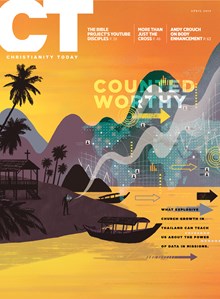
AprilThe April 2019 edition of Christianity Today features a cover story about DMM/CPM titled “Making Missions Count: How a Major Database Tracked Thailand’s Church-Planting Revival”: A movement in Southeast Asia shows how real-time reporting is building Great Commission connections.

There are some interesting observations about the oft-debated use of metrics in ministry. It seems to me that the DMMs/CPMs I am aware of are constantly measuring and documenting the growth of the movement. Among other purposes, the use of metrics seems to serve as a kind of compass and a scoreboard that deeply motivates leaders and practitioners.

I am always interested in how Christian media writes about missiology. Commenting on the dynamics of the movement, article author Kate Shellnutt said this:

Out of 13 mother churches, FJCCA has added more than 400 house churches since 2016. Its biggest challenge has been training new leaders, who are tasked with continuing the work of evangelizing and church-planting. FJCCA focuses on a simple gospel presentation, prayer, and intimate fellowship, a model that converts can adopt and take to the next unreached village.

Rinnasak and fellow FJCCA leaders remove any “Christianese” from their phrasing, saying “Jesus bless you” rather than “God bless you” to specifically name the Christian God, and referring to believers’ “life experiences” rather than the more obtuse “testimony.” The association embraces the house church setting. When people convert in far-off villages with no Christian presence, it’s awkward and impractical for them to travel to existing congregations to learn and worship. Even once more mature churches move into buildings for Sunday worship, they still meet in homes as a more familiar location for discipleship.

Evangelists travel to villages with enough people ready to stick around to start the discipleship process. They share Bible stories and personal accounts to point to Jesus. Once people put faith in Christ, they invite them to pray right away for what they need, returning within a day or two to offer further training and materials from the Thailand Bible League, another partner.

Reach A Village noticed that the most effective church planters in the region share these distinctives. In Cambodia and Myanmar, the ministry also found that evangelism is “best carried out by local, indigenous believers and leaders who rely solely on the Scripture and the Holy Spirit with minimal outside interference or restrictions,” Craft said.

“Our ministry partner leader in Myanmar, Michael Koko Maung, once said to me, ‘Christianity came to us like a potted plant. We did not realize that when we took it out of the pot that it would grow so well in native soil.’ ”

FJCCA’s strategy is working, so much that Martin added a new staff member based in Phetchabun province dedicated to managing their figures. And he can barely keep up: Already, the movement has added 11,941 new believers in the past year and a half.

Read the whole thing.

Wednesday, March 6, 2019

My Two Recent Articles in EMQ and IJFM

I currently have two articles out at the moment in EMQ and IJFM.

The first is with EMQ and if you are a member of Missio Nexus (most North American agencies are with Missio Nexus, and if your org is a member then you are too), then you have access. If not, I’ll make it available in April. It is called Outlining a Biblical Theology of Islam: Practical Implications for Disciple Makers and Church Planting and is something I wrote as a kind of promo piece for the annual Middle East Consultation in Beirut, Lebanon (I’ll be giving two keynotes this year). Here are the topics I have paired together in the EMQ article:

  • Religion and Kingdom Sociology
  • Biblical Anthropology and Idolatry
  • Prophecy and Muhammad
  • Revelation and the Qur’an
  • Christocentric Doxology and Allah

It is obviously a lot to discuss in just over 3,000 words (EMQ’s limit), but these are the major themes that need consideration in our theology of Islam.

The second article is Adaptive Missiological Engagement with Islamic Contexts at IJFM. This is also Chapter 17 in our book Margins of Islam: Ministry in Diverse Muslim Contexts. Here is my outline for the article:

Changing Understandings of Muslim Contexts

  • Postcolonial Studies: “The Muslim World” vs. “The West”
  • Cultural Anthropology: Modern Essentialism and Postmodern Relativism
  • Religious Studies and the Fog of “Religions”

A Call for Adaptive Missiology

  • Towards a Missiology of Islam(s)
  • Idolatry and Mission
  • Transforming Relationships

This is a longer article that deals with epistemology and issues which inevitably color our approaches to reaching Muslims.

Let me know what you think in the comments below.