Showing posts with label Theology. Show all posts

Friday, October 31, 2025

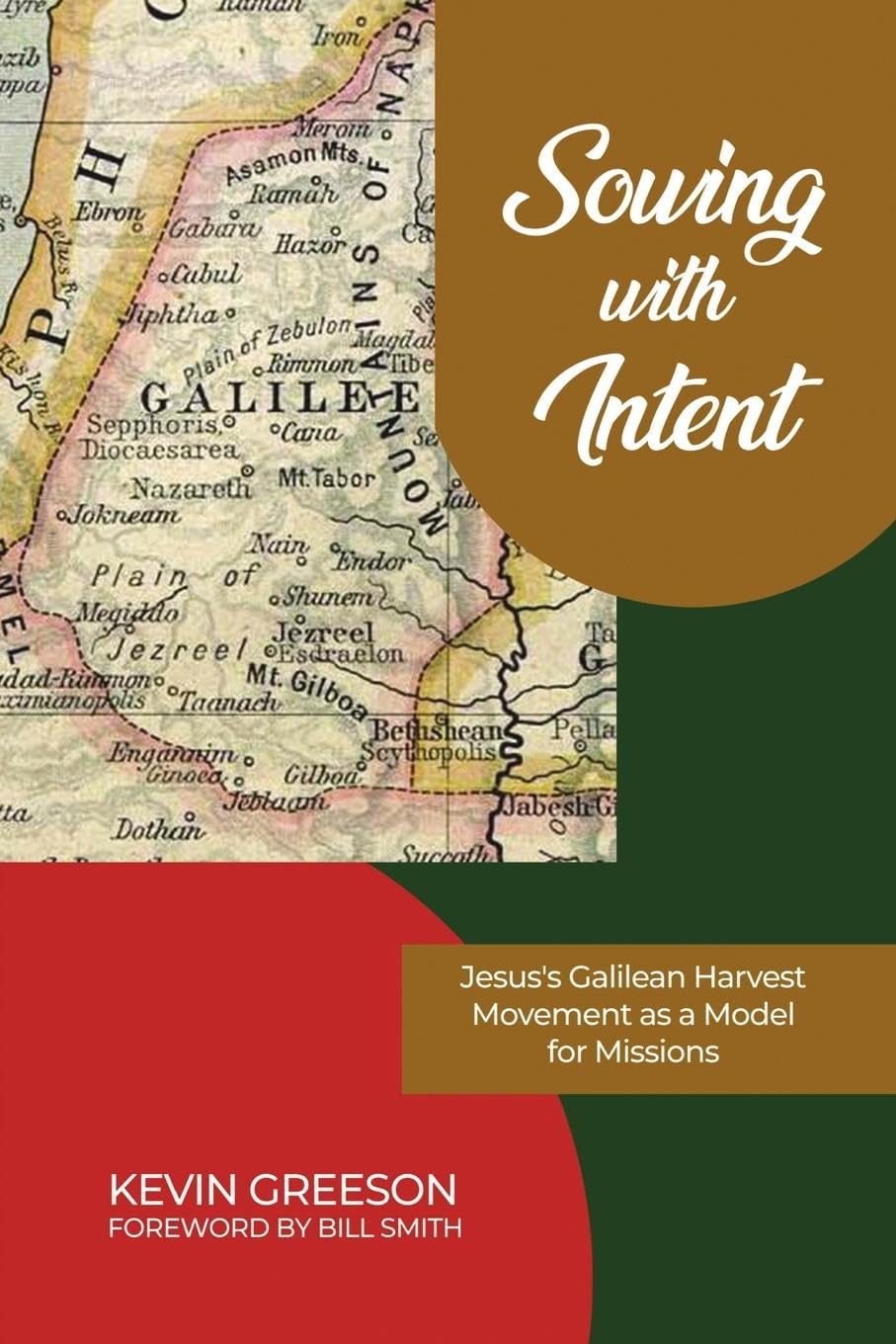
Sowing with Intent: Jesus’ Galilean Harvest Movement as a Model for Missions

I commend to you this book by Kevin Greeson, Sowing with Intent: Jesus’ Galilean Harvest Movement as a Model for Missions. The description:

Sowing with Intent offers a fresh look at Jesus's Parable of the Sower by demonstrating that the parable (a) stands above other parables, (b) represents Jesus's own approach to field ministry, (c) implicitly invites all obedient disciples to adopt Jesus's ministry approach, and (d) guides disciples to discover catalysts who ignite harvest movements.

Jesus's original intent for telling the Parable of the Sower was likely lost in the second century and remained lost until the end of the nineteenth century when scholars declared the original meaning can be known today. Using hermeneutical principles, Sowing with Intent attempts to provide churches and missionaries with Jesus's original intent for telling the Parable of the Sower and how to apply it in today's context.

Endorsement by David Garrison:

In Kevin Greeson’s masterful Sowing with Intent, the author takes us on his
personal journey to understand the missional strategy of Jesus. Greeson's book achieves a fusion of ideas between two worlds, the academic and the missionary practitioner world. Anyone intent on fulfilling the Great Commission through Jesus's own Great Plan must read this book!

Buy the book on Amazon or the eBook from Dorrance.

Friday, May 24, 2024

From Missio Dei to Motus Dei: The Recovery of Movement

We tend by a secret law of the soul to move toward our mental image of God. This is true not only of the individual Christian, but of the company of Christians that composes the Church. Always the most revealing thing about the Church is her idea of God.

-A.W. Tozer

I usually feel okay about my appearance when I look in the mirror. But when someone shares a photo of me from a different angle, I realize, “I am clearly an overweight, middle-aged man who needs hair implants.” A slight shift in viewpoint changes a lot. Sometimes painfully so.

Similarly, common ideas we believe to be “okay” can seem very different when we shift our perspective. And some theological concepts become stale over time. Might we be facing that issue now when talking about “mission”?

Keep reading…

Wednesday, February 17, 2021

Facing West: American Evangelicals in an Age of World Christianity (Swartz 2020)

If Arab Muslims are the least-reached people in the world, then American Evangelicals are the least-transformed people in the world,” retorted my Arab colleague as I was making my case for the priority of ministry among unreached people groups.

As an American Evangelical with a passion for disciple-making among the unreached, this stunned me. But then again, given all the ugliness that has been unveiled about American evangelicalism in (at least) the past five years, I have to admit, it might be painfully true.

In Facing West: American Evangelicals in an Age of World Christianity, David Swartz, professor of history at Asbury University, takes the reader on tour de force understanding of what can also sometimes be understood as “Christian Americanism” abroad. In so doing, Swartz shows how global evangelicalism does not sit comfortably in American clothes, and that American “missions” often has the dual effect of affecting the church in the United States as well. As he deals with people like McGavran, Wagner, Winter, and even Hiebert, I was most impressed with his grasp of the missiological side of the conversation. The description of the book says it best:

In 1974 nearly 3,000 evangelicals from 150 nations met at the Lausanne Congress on World Evangelization. Amidst this cosmopolitan setting and in front of the most important white evangelical leaders of the United States, members of the Latin American Theological Fraternity spoke out against the American Church. Fiery speeches by Ecuadorian René Padilla and Peruvian Samuel Escobar revealed a global weariness with what they described as an American style of coldly efficient mission wedded to a myopic, right-leaning politics. Their bold critiques electrified Christians from around the world.

The dramatic growth of Christianity around the world in the last century has shifted the balance of power within the faith away from traditional strongholds in Europe and the United States. To be sure, evangelical populists who voted for Donald Trump have resisted certain global pressures, and Western missionaries have carried Christian Americanism abroad. But the line of influence has also run the other way. David R. Swartz demonstrates that evangelicals in the Global South spoke back to American evangelicals on matters of race, imperialism, theology, sexuality, and social justice. From the left, they pushed for racial egalitarianism, ecumenism, and more substantial development efforts. From the right, they advocated for a conservative sexual ethic grounded in postcolonial logic. As Christian immigration to the United States burgeoned in the wake of the Immigration Act of 1965, global evangelicals forced many American Christians to think more critically about their own assumptions.

The United States is just one node of a sprawling global network that includes Korea, India, Switzerland, the Philippines, Guatemala, Uganda, and Thailand. Telling stories of resistance, accommodation, and cooperation, Swartz shows that evangelical networks not only go out to, but also come from, the ends of the earth.

This book will help missionaries from America see how they are viewed by evangelicals in the Majority World, but it also adds an important piece of postcolonial logic in the globalizing understanding of frontier missiology. Highly recommended.

Tuesday, October 27, 2020

Misreading Scripture with Individualist Eyes | Richards and James

Richard James is an associate editor for our upcoming Motus Dei volume and will be contributing a chapter tentatively titled, Hearing the Story of “People of Peace” in Luke-Acts.

Together with E Randolph Richards, he has coauthored a new book for InterVarsity titled Misreading Scripture with Individualist Eyes: Patronage, Honor, and Shame in the Biblical World.

From the back cover:

The Bible was written within collectivist cultures. When Westerners, immersed in individualism, read the Bible, it's easy to misinterpret important elements―or miss them altogether. In any culture, the most important things usually go without being said. So to read Scripture well we benefit when we uncover the unspoken social structures and values of its world. We need to recalibrate our vision. Combining the expertise of a biblical scholar and a missionary practitioner, Misreading Scripture with Individualist Eyes is an essential guidebook to the cultural background of the Bible and how it should inform our reading. E. Randolph Richards and Richard James explore deep social structures of the ancient Mediterranean―kinship, patronage, and brokerage―along with their key social tools―honor, shame, and boundaries―that the biblical authors lived in and lie below the surface of each text. From Abraham, Sarah, and Hagar to Peter's instructions to elders, the authors strip away individualist assumptions and bring the world of the biblical writers to life. Expanding on the popular Misreading Scripture with Western Eyes, this book makes clear how understanding collectivism will help us better understand the Bible, which in turn will help us live more faithfully in an increasingly globalized world.

Nijay Gupta, professor of New Testament at Northern Seminary, has a good review of the book at Christianity Today. Here are some highlights from his review:

Richards is a well-respected biblical scholar, bringing reliable insight and interpretation to the study of individual texts. And James (“Richard James” is a pseudonym) has been involved in church-planting ministry in the Middle East. As a team, they deftly weave in modern cross-cultural stories to demonstrate worldview factors and social values of collectivist people. And they cycle back and forth between stories and passages from the Old and New Testaments…

I wish I had been given a handbook like this 15 years ago when I was first learning how to read the Bible well…

A central assumption of this book is the idea that we all read Scripture through our own cultural lenses or “eyes.” That is not necessarily bad. We have two eyes but only one perspective. Many modern Western readers of the Bible see the world differently than the biblical writers and the many characters in our Holy Book. I am thankful that Richards and James wrote this crash course in collectivism versus individualism to help us avoid many faux pas and pitfalls.

Read the whole review. Buy the book.

Friday, February 28, 2020

Review of Ephesiology: A Study of the Ephesian Movement (Cooper 2020)

I’m excited to introduce you to a new book, Ephesiology: A Study of the Ephesian Movement. See also the corresponding website https://ephesiology.com with a course, blog, and podcast.

Author Michael Cooper will be presenting at Motus Dei: Movements Research Symposium later this year. His talk is tentatively titled, “Missiological Theology of Movements focused on the Study of the Gospel of John.

Ephesiology is a study of the origins of the Christian church planting movement that began in Ephesus. It presents a way to read the Bible through the glasses of first-century movement leaders which will lead you to a “missiologically theocentric” pursuit of movements today for God’s glory.

Cooper offers a robust, holistic missiological theology of church planting movements (CPM) by looking primarily at Acts 19, Ephesians, 1 Timothy, 2 Timothy, and Revelation 2-3. He exegetes these passages through what I would call a “movemental hermeneutic” of Scripture. Throughout, Cooper’s missiology engages with church history, religious studies, sociology, and current CPMs.

A unique aspect of Ephesiology is that it doesn't use strategy buzzwords such as people of peace, T4T, Insiders, DMM, generational mapping, or contextualization (although 4 Fields is used in the appendix). It is really just a biblical look at CPM, and Cooper does some creative and nuanced work to make the biblical text relevant for practitioners today.

Those who are more theologically inclined will like Ephesiology, while others might find the theology lengthy at times. Ephesiology is especially good for those who might be turned off by aspects of the DMM/T4T/CPM industry but who are still interested in movements (and New Testament theology).

Cooper might not like me using these words (perhaps for good reason), but his approach is both contextual and holistic. He engages deeply with religion and culture and also cares about social justice and transformation. Because it is filled with biblical principles, Ephesiology is meant to be applied in both the Global North and the Global South.

Here is Cooper’s missiological-theological framework of the Ephesian movement (pgs. 180-181):

  1. The early missionaries launched a movement that is missiologically theocentric, with the heart to connect God’s story with the story of culture… A proper missiological theologian will allow the identity of a movement to evolve from within a culture.
  2. Paul grounded the movement with the vision to fulfill God’s will of uniting all things in Christ.
  3. Paul and Timothy led the movement as a community of brothers and sisters determined to equip the saints for ministry.
  4. The disciples multiplied a movement by empowering leaders to use their gifts, inspiring them to join in suffering, entrusting them to teach others, and reminding them to preach the Word.
  5. The church in Ephesus sustained the movement by reengaging the works of her first love.

Overall, Ephesiology is an invaluable resource for anyone who wants to learn:

  1. how all who lived in the province of Asia heard the word of the Lord while Paul was in Ephesus for two years (Acts 19:10),
  2. the incredible movements that transformed peoples from India to Iberia in the first 250 years of the church, and
  3. how we can glorify God by joining with him to unite all things in Christ today (Eph. 1:10).

As Cooper says, “This is the story of Paul’s missiological theology situated in the grand narrative of God’s mission. It rocked the world of his time, and it can rock our world as well” (pg. 34).

Buy the book, register for the online course, or have Cooper run a workshop for your group.

Wednesday, July 24, 2019

Sacred Misinterpretation | Accad 2019

Sacred Misinterpretation: Reaching across the Christian-Muslim Divide, by Martin Accad (Eerdmans 2019). From Amazon:

Promotes gracious interfaith dialogue on sensitive theological issues

Theological issues are crucial to how Christians and Muslims understand and perceive each other. In Sacred Misinterpretation Martin Accad guides readers through key theological questions that fuel conflict and misunderstanding between Muslims and Christians. A sure-footed guide, he weaves personal stories together with deep discussion of theological beliefs.

Accad identifies trends, recognizes historical realities, and brings to light significant points of contention that often lead to break-down in Christian-Muslim dialogue. He also outlines positive and creative trends that could lead to a more hopeful future. Fairly and seriously presenting both Muslim theology and a Muslim interpretation of Christian theology, Sacred Misinterpretation is an essential guide for fostering dialogue and understanding among readers from both faiths.

Full Table of Contents for the First Three and Final Chapters:

  1. Introduction
    1. Christian-Muslim Interaction
      1. The Context of My Writing
      2. What Does Theology Have to Do with Conflict and War?
    2. The Kerygmatic Approach to Christian-Muslim Interaction
    3. The Islamic Phenomenon
      1. Islam’s Prophet in the Kerygmatic Approach
      2. The Qurʾan in the Kerygmatic Approach
      3. Muslims in the Kerygmatic Approach
      4. Purpose of Relationship with Islam and Muslims
      5. Methods Used in the Kerygmatic Approach to Islam and Muslims
      6. Expectable Outcomes
      7. A Legitimate Insider’s Knowledge of Islam
    4. The Suprareligious Approach and the “Two-Buildings” Analogy
    5. A Book Respectful Enough of Islam for Muslims to Read It
    6. A Biblical Theme: God’s Agenda
      1. Understanding the Importance of Mercy
      2. Adopting an Attitude of Humility
      3. Seeking Ways to Act Justly
      4. Mercy, Humility, and Justice in the Context of Lebanon
      5. Political Conflict and the Role of Religious Dialogue
  2. ​Hermeneutics and Dialogue
    1. Christian Misrepresentation: Reading Christian Thinking into the Qurʾan
    2. Christian Misrepresentation: Giving Primary Attention to Literary Context
    3. Muslim Misrepresentation: Reading the Bible Muhammado-centrically
    4. Comparative Observations on Textual Interpretation
    5. The Legitimate Interpretation of the Qurʾan
      1. Language and Grammar
      2. Occasions of the Revelation
      3. Interpretation Proper
      4. Stories of the Prophets and the Biography of Muhammad
      5. Identification of the Obscure
      6. The Theory of Abrogation
      7. An Argument against the Claim of Medinan Abrogation
      8. Tradition versus Opinion
    6. Legitimate Christian Interpretation of the Qurʾan
      1. The Importance of Context
      2. Interpretation and the Emergence of Doctrine
      3. Historical Context
    7. Sacred Misinterpretation and the Emergence of Religious Monologue
    8. Establishing a Hermeneutical Method for Christian-Muslim Theological Dialogue
      1. The Promise of Hermeneutics in Christian-Muslim Dialogue
      2. Study the Internal Muslim Understanding
      3. Study the Historical Dialogue
      4. Identify Historical Deadlocks
      5. Search for Hermeneutical Keys to Break the Deadlock
    9. Globalizing the Theological Conversation
    10. Closing Considerations: Continuity Rather than Discontinuity
  3. ​God in Christian-Muslim Dialogue
    1. Do Christians and Muslims Worship the Same God?
      1. Timothy George
      2. Miroslav Volf
      3. Imad Shehadeh
      4. Summarizing Reflection
    2. Islam and the One God
      1. The Qurʾan’s Vindication of Jesus
      2. “I Would Never Say What Is Not Rightfully Mine to Say!”
      3. Jesus Affirmed That “There Is No God But God”
      4. Jesus Affirmed and Practiced the Worship of God Alone
    3. God in Islam
      1. Islam’s Doctrine of Absolute Monotheism
      2. The Qurʾan’s Rebuttal of the Christian View of God
      3. The Qurʾan’s Rebuttal of Christ’s Divinity
      4. Summarizing the Metadialogue on the Doctrine of God
      5. Hermeneutical Keys in Building Bridges beyond Conflict
      6. Using Deadlocks as Assets
      7. Concluding Thoughts
      8. Further Reading and Research
  4. Who Jesus Is Not according to Muslims
  5. Who Jesus Is according to Muslims
  6. Muslim Strategies in Approaching the Bible
  7. Taḥrīf and the Corruption of Scripture
  8. Islam’s Muhammado-Centric Reading of the Bible
  9. Muhammad as Paraclete
  10. ​Beyond Conflict
    1. Legitimate Ways for Christians to View Islam
    2. A Simple Definition of Islam
      1. Two Stages of Muhammad’s Life
      2. The Meccan and Medinan Qurʾans
      3. Meccan and Medinan Muslims Historically and Today
    3. Muhammad and Early Islamic History as Paradigm
    4. A Case for Meccan Islam
    5. Muhammad in the Context of Dialogue
      1. Abraham, Moses, and Muhammad
      2. The Two-Times Theory
    6. The Status of Muhammad for a Christian
      1. Muhammad—a Bridge to Christ?
      2. A Call to Awakening for People of Faith in the Twenty-First Century
      3. Imagining a New Future
      4. A Call to Social Action
      5. A Call to Political Activism, Peacebuilding, and Courage
      6. A Call to Worship

In the introduction, Accad says that “the general Christian reader who does not wish to engage with the more technical and historical sections of the seven core chapters (3-9) can still benefit from the book by reading the opening and closing pages of each chapter.”

This important book provides a hermeneutically robust, historical-theological understanding of Islam. Highly recommended.

Tuesday, April 2, 2019

Outlining a Biblical Theology of Islam: Practical Implications for Disciple Makers and Church Planting | EMQ 2019

Here is full access to my article “Outlining a Biblical Theology of Islam: Practical Implications for Disciple Makers and Church Planting,” that first appeared in EMQ in January 2019.

Taking into consideration the ambiguous nature of religion, a reconsideration of the historicity of Islamic origins, and the diversity of Muslim contexts, I discuss the important topics to consider when constructing a biblical theology of Islam. In the light of authoritative biblical revelation, my approach also illuminates the connections between theology-in-context and our practice of disciple making.

Here are the topics I have paired together:

  • Religion and Kingdom Sociology
  • Biblical Anthropology and Idolatry
  • Prophecy and Muhammad
  • Revelation and the Qur’an
  • Christocentric Doxology and Allah

It is obviously a lot to discuss in just over 3,000 words (EMQ’s limit), but these are the major themes that need consideration in our contextual theology of Islam.

Wednesday, March 6, 2019

My Two Recent Articles in EMQ and IJFM

I currently have two articles out at the moment in EMQ and IJFM.

The first is with EMQ and if you are a member of Missio Nexus (most North American agencies are with Missio Nexus, and if your org is a member then you are too), then you have access. If not, I’ll make it available in April. It is called Outlining a Biblical Theology of Islam: Practical Implications for Disciple Makers and Church Planting and is something I wrote as a kind of promo piece for the annual Middle East Consultation in Beirut, Lebanon (I’ll be giving two keynotes this year). Here are the topics I have paired together in the EMQ article:

  • Religion and Kingdom Sociology
  • Biblical Anthropology and Idolatry
  • Prophecy and Muhammad
  • Revelation and the Qur’an
  • Christocentric Doxology and Allah

It is obviously a lot to discuss in just over 3,000 words (EMQ’s limit), but these are the major themes that need consideration in our theology of Islam.

The second article is Adaptive Missiological Engagement with Islamic Contexts at IJFM. This is also Chapter 17 in our book Margins of Islam: Ministry in Diverse Muslim Contexts. Here is my outline for the article:

Changing Understandings of Muslim Contexts

  • Postcolonial Studies: “The Muslim World” vs. “The West”
  • Cultural Anthropology: Modern Essentialism and Postmodern Relativism
  • Religious Studies and the Fog of “Religions”

A Call for Adaptive Missiology

  • Towards a Missiology of Islam(s)
  • Idolatry and Mission
  • Transforming Relationships

This is a longer article that deals with epistemology and issues which inevitably color our approaches to reaching Muslims.

Let me know what you think in the comments below.


Monday, October 8, 2018

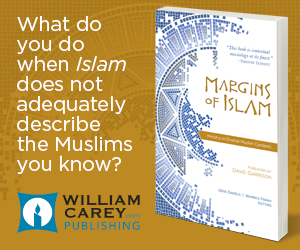
Introducing our New Book | Margins of Islam: Ministry in Diverse Muslim Contexts

On behalf of Gene Daniels, I’m excited to introduce our new book Margins of Islam: Ministry in Diverse Muslim Contexts. Here is the book description:

What do you do when “Islam” does not adequately describe the Muslims you know? Margins of Islam brings together a stellar collection of experienced missionary scholar-practitioners who explain their own approaches to a diversity of Muslims across the world. Each chapter grapples with a context that is significantly different from the way Islam is traditionally presented in mission texts. These crucial differences may be theological, socio-political, ethnic, or a specific variation of Islam in a context—but they all shape the way we do mission. This book will help you discover Islam as a lived experience in various settings and equip you to engage Muslims in any context, including your own.

One of the most succinct and descriptive endorsements comes from Timothy Tennent, President of Asbury Theological Seminary:

In a marvelous tour de force, Margins of Islam exposes the widely held, but false assumption that the house of Islam is a monolithic religious entity which either resists or responds to missiological strategies. Collectively, these authors offer up case studies and rich and textured “on the field” experience which reflects the true variegated diversity of Islam. This book is contextual missiology at its finest.

The project was the brainchild of Gene Daniels. I vividly remember sitting next to him on a bus discussing it with him on our way to a conference center from a hotel a couple years ago. His big idea was to gather missionary scholar-practitioners serving in various Muslim settings to explain how they take context seriously and how they deal with the phenomenon that we call “Islam.” I was genuinely surprised and honored when he asked me to be his coeditor!

We immediately started networking and looking for contributors. Gene already had several people in mind. My job was to help edit each chapter and then to produce a concluding chapter that explained the themes of the book. It was a rich learning experience. As I researched for the book, I found myself often disagreeing and pushing back on evangelical treatments of Islam.

My criticism began to take shape and eventually became an introductory chapter—most evangelical missiological treatments of Islam are reductionistic with what I call a “top-down” approach, meaning that Islam (and subsequently, Muslims) can be adequately understood by addressing the Qur’an, hadith, and history of Islam. From this textual understanding, it is assumed that Muslims believe what Islam teaches, and thus there is a “Muslim worldview” and strategies on how to engage it. In this framework, Muslims are often simplified as cultural and spiritual clones of one another.

Many workers have read books based on this top-down approach, but when they begin to engage Muslims in their context, they quickly discover that the Muslims they are working with believe very different things from what “Islam” teaches. While the top-down approach is incredibly valuable, it can also distort our understanding of Muslims if it is our only lens. We also need a “bottom-up” approach that explains the historical evolution of the Islamic phenomenon and the sociological perspectives that accounts for the diversity of Islam today. Ergo my chapter two: How Muslims Shape and Use Islam: Towards a Missiological Understanding.

As I was editing the chapters (which do a wonderful job of combining the top-down and bottom-up perspectives) and after I wrote the introductory chapter, I started to reflect on how recent developments in postcolonial theory, anthropology, and religious studies have influenced mission to Muslims. Gene and I later decided that I would write a theory piece again for a concluding chapter which I titled Adaptive Missiological Engagement in Islamic Contexts. Gene then did a masterful job tying the themes of the book together in the final chapter, “Conclusion: Learning from the Margins.”

Here are the contents of the book:

Foreword, David Garrison

Introduction, Gene Daniels

PART 1: CONCEPTUALIZING ISLAM

1 Who Represents Islam?, Evelyne A. Reisacher

2 How Muslims Shape and Use Islam: Towards a Missiological Understanding, Warrick Farah

PART 2: ENGAGING MUSLIMS

3 The Donkey and the Straw: Reaching South Asian Sufis with the Gospel, Kevin Higgins

4 Secular Muslims in Bosnia and Herzegovina, Ted Esler

5 Egalité, Fraternité, and Cous-cous: Ministry to Muslims in the Context of a Resurgent Islam and French Laïcité, Rick Kronk

6 Biblical Approaches to the Nurcu Gülen Movement in Turkey, Yakup Korkmaz

7 Magical Mystical Muslims: Sufi-oriented Islam and African Traditional Religion, Robin Dale Hadaway

8 Ordinary Muslims in Pakistan and the Gospel, Warren Larson

9 Ministry to Hui Muslims in China: An Approach to Dual-layered Cultural Settings, Enoch Jinsik Kim

10 Context as Flypaper: The Island of Java in Indonesia, Michael A. Kilgore

11 Liberating Liminality: Mission in the North African Berber Context, Patrick Brittenden

12 Russified Muslims of the Former Soviet Union, Gene Daniels

13 The Queen’s Muslims? Muslim Identities in the UK, Phil Rawlings

14 In the Shadow of a Buddhist Temple: Muslims in Thailand, Alan Johnson

15 Uyghurs of the Tarim Basin: Muslims in Northwestern China, CG Gordon

16 Muslim Youth in a Glocal World, Arthur Brown

PART 3: REFRAMING MISSIOLOGY

17 Adaptive Missiological Engagement with Islamic Contexts, Warrick Farah

18 Conclusion: Learning from the Margins, Gene Daniels

As our endorsements were rolling in, one from JD Payne stood out in particular that helped us identity the biggest potential takeaway from this book:

Margins of Islam takes readers on a global journey revealing the multiple expressions of the Islamic faith… We no longer have any excuse to train others to reach all Muslims in the same way.

I want to thank Gene for this incredible opportunity, and also for our excellent group of contributors who have taught me so much about the variety of Muslims and the varieties of biblical mission in the world today. Go ahead and buy the book on Amazon, and please help us spread the word—you can easily share this from the button on the bottom of the post on the blog. Thank you for considering! We feel this volume represents a significant encouragement for the mission of the church.

SM Post 1

Sunday, April 17, 2016

The W-Spectrum

Here is a pdf download of the W-Spectrum on one page:

W-Spectrum Pic

Please refer to the EMQ October 2015 article The W-Spectrum: Worker Paradigms in Muslim Contexts for more information (subscription required).

See also:

Friday, October 2, 2015

Introducing “The W-Spectrum: Worker Paradigms in Muslim Contexts” (EMQ 2015)

On behalf of Dr. Kyle Meeker, it’s my pleasure to introduce The W-Spectrum: Worker Paradigms in Muslim Contexts which is on the cover of the new issue of EMQ (Oct 2015). The article is appropriately paired with Travis’ reflections on 15 years of the C-Spectrum. As you may know, the C-Spectrum is probably the most popular article in the 50+ year history of EMQ.

The idea for the W-Spectrum began in 2006 while I was living among an unreached Muslim people group and interacting extensively with other workers who had an incredibly wide variety of approaches to reaching Muslims. One night I started to write an article I titled “Stuck at C3” which was basically my own reflections as to why some workers were unable (IMO) to get to C4. I created a table to compare the differences between C3 and C4 from the viewpoint of the worker, not the Christ centered community. (Note: a “worker” is any follower of Jesus who has an intentional witness among unbelievers.) However, at a conference a few months later, I shared this idea with some colleagues. One of them, my boss at the time, told me that the C-Spectrum was never meant to describe worker views or practices, only to describe indigenous fellowships. This prevented me from writing an article I would have deeply regretted!

With this insight, I then went and expanded my categories, renamed them from C3 to W3, etc., and reworked the table based on how I would observe workers in diverse contexts explain the reason for their approaches. This process took several years of informal research and listening on my part.

I initially toyed with the idea of having 6 paradigms, but I felt it too was complicated, and then 5 paradigms, but I was nervous people would commit the “middle ground” fallacy and thus be uncritically drawn to the moderate approach. Thus, I ended up at 4 worker paradigms, the W1-4 Spectrum (which do NOT correlate with the C-Spectrum):

  1. Triumph Model- “Christianity triumphs over Islam”
  2. Replacement Model- “Christianity replaces Islam”
  3. Transformation Model- ““Biblical faith transforms Muslims”
  4. Completion Model- “Biblical faith completes Muslims”

While the W-Spectrum was still in draft form, I told Dr. Meeker about it. We are actually cousins (biologically speaking!) and I owe him a whole lot more credit than just for giving me chicken pox when I was five years old. Kyle is basically better than me than everything except fantasy football and ping-pong. He was further able to fine tune the W Spectrum and offer many invaluable improvements.

That being said, while this is all good and nice, the W-Spectrum was still just an unscientific guess at this point in 2011: it needed validation. Meeker then took this on as a missiological project to test as part of his doctoral thesis (“Meeker, Kyle. 2014. Worker Praxis in Muslim Contexts: Discovering and Assessing Paradigms in Kingdom Witness, Talbot School of Theology, Biola.) Basically, we wanted to disprove the W-Spectrum as a tool for helping a worker discover their paradigm of witness among Muslims. Over 200 people responded to an online survey.  But when Dr. Meeker evaluated the data using quantitative statistical analysis, we found that the opposite was true. Hence the birth of the W-Spectrum. (Even if it was “disproved” though, it still would have been interesting to see why.)

Last summer we condensed Dr. Meeker’s dissertation into this EMQ article. I’m glad it took so long and that we had so much input from other workers and missiologists during the process. As you read the article, you’ll notice that we spend more time discussing the nature, usefulness, and limitations of the W-Spectrum than we do actually explaining the paradigms within the W-Spectrum itself. This is partly because we are so concerned of the potential it has to be misused, as was/is often the case with the C-Spectrum. EMQ also has a very low 3,000 word limit.

As a side note for full disclosure- that is a picture of me on the cover. The man next to me was one of the first Muslims that I ever had the privilege to walk with on his journey to following Jesus. My teammate took the picture when we attended a wedding in his village. I rarely dressed like that and only for special ceremonies/occasions (like every other local would), but sometimes also when someone would come to my house to study the Bible.

In any case, the final result of this 9 year process is the W-Spectrum. Scott Moreau says in the editorial of this issue of EMQ:

While the C-Spectrum describes the fellowships that Travis observed (and continues to observe) in Muslim settings, no one has proposed a parallel spectrum of the roles that missionaries take on in Muslim settings. Warrick Farah and Kyle Meeker propose a W-Spectrum to explore this facet.

Read the entire W-Spectrum article. (Subscription required. I’m checking with EMQ regarding what exactly I can share on this blog from the article.)

It is my hope and prayer that the W-Spectrum and the model within The Complexity of Insiderness (which is very different than the C Spectrum) will help advance our missiological discussions into the nature of ministry among Muslims.

Tuesday, May 19, 2015

Identity Formation in the NT

Here are some books I want to work through. Does anyone know of attempts to integrate these theological studies with the issues we are facing in missiology?


Monday, March 30, 2015

A Response to “Is Muhammad Also Among the Prophets?” by Talman (IJFM 2014)

IJFM<br />                          31_4I consider this a must read for those who are interested in an evangelical theology of Islam: Is Muhammad Also Among the Prophets? by Harley Talman. 

The article does an admirable job of nuancing the view of Mohammed between the (unfortunate) binary poles of 1. false prophet/evil leader and 2. final authoritative prophet of the One True God whose message supersedes and replaces all previous revelations. [In my experience, I have noted 8 ways that Mohammed has been called a prophet- see this post: Was Mohammed a prophet?]

Talman’s proposal is to allow for a positive prophetic role for Mohammed- claiming that Mohammed was “messenger” of God does not contradict biblical authority or our testimony of the Lordship of Christ. In acknowledging Mohammed as a prophet, Talman enlarges the role that general revelation plays for unbelievers and expands (reclaims?) the understanding of prophethood. Such a view of Mohammed, however, does not declare him to be as great as Moses; what it does is (according to Talman) enhance our potential for dialogue and evangelism among Muslims.

The article was very insightful and greatly enriches our understanding of “The Prophet” of Islam. Martin Accad discusses more the benefits of the article in his response. I’m not aiming for this to be only a critical post, but I don’t want to repeat what has already been said by Accad. In any case, here are some of my hesitations and questions:

1. Consistency in our Appraisals of the Emergence of Christianity and Islam

Like Talman and many others, I have serious doubts concerning the historicity of the traditional Islamic narratives of Mohammed.

Talman presents an image of Mohammed as a leader of an ecumenical movement (IMO with acute political aspirations) who sought to draw different religious sects together as “Believers” under the banner of the God of Abraham. It was Mohammed's followers who, generations later, drew a sharp, pejorative distinction between the new “Muslim” community of Islam and other religions as they began to venerate Mohammed and claim the previous Books were corrupted.

While I think this understanding of the emergence of Islam best matches the historical record, I am mindful of scholars who do the exact same thing with the emergence of Christianity. For instance see this quote from Talman (pg. 171):

Much of what is considered today as representing “orthodox” Islam likely represents an understanding that developed two or three centuries after Muhammad. The most widely accepted version of Muhammad, based upon Islamic tradition, is dubious.

Now, reread that quote and replace “Islam/Islamic” with “Christian” and “Muhammed” with “Jesus” … Sound familiar? The Jesus Seminar and Bart Ehrman come to mind. In light of this, I think our development of a theology of Islam needs to be robust in it’s critique of the primary sources. Would these same scholars of the emergence of Islam do the same thing with the same methods when applied to the early Jesus community? This is a foundational issue that needs a lot of work.

2. A Missiology of Mohammed and Mohammedolatry

Missiologically, I deeply appreciate what Talman is doing because it actually addresses Mohammed. Too much missiology tries to either ignore or demonize Mohammed; both are neither fair nor realistic. However, it strikes me as a tad ironic that the only way to allow for the “prophethood” of Mohammed is to deny the traditional Muslim understanding of said “prophethood.”

Practically speaking, in building friendships with Muslims, how easy would this conversation go? For so many who follow Mohammed, it is either all or nothing. While I think Talman’s theology could have warrant among some types of Muslims/MBBs, it is not a one-size-fits-all approach.

Instead of saying that Mohammed is in some way a prophet, wouldn’t it just be enough to agree that he was a skilled leader and wise politician who also happened to say some true and beautiful things? Do I have to go so far as to say he was a prophet in order to build relationships of trust and have meaningful dialogue? Perhaps this is true with some very traditional Muslims, but certainly not with all (in my experience).

Another issue to consider is the common practice of Mohammedolatry- where the Prophet is not only revered, but actually worshipped. I believe that there are indeed many Muslims who have formed idolatrous spiritual bonds by actually placing their ultimate faith allegiance in Mohammed’s intercession. In this same edition of IJFM, Pennington (From Prophethood to the Gospel: Talking to Folk Muslims about Jesus) touches on this issue: “the logic of salvation has everything to do with one’s relation to the Prophet Muhammad” (p. 198).

We need to take these spiritual realities seriously. The Bible deals with idolatry in various ways, but what are the consequences of Talman’s theology of prophethood with Muslims who are close to Mohammedolatry or the prophetological concept of salvation?

3. Prophethood as a Spiritual Gift for New Covenant, Regenerate Believers in the Lord Jesus Christ

While Talman starts from general revelation in this discussion (bottom-up?), I would like to start from the perspective of the New Covenant (top-down?).  This is how I think prophets in the kingdom of Jesus operate today, as I have said previously:

Some regenerate, new covenant believers are gifted by the Lord Jesus Christ as prophets (Eph. 4:11). In the New Testament, prophesy is a gift that some believers are given by the Lord Jesus for the edification of the church that will be effective until Christ returns (1 Cor. 12-14). Prophecy in this sense is not authoritative or equal to Scripture (Acts 21:4; 21:10-11; 1 Thess. 5:20-21; 1 Cor. 14:29).  “The essence of prophecy is to give a clear witness for Jesus” (Rev. 19:10 NLT).  In John’s thought, Jesus is the conquering, crucified lamb, King of kings, Lord of lords (Rev. 17:14), incarnate God-man in the flesh (John 1:1, 14) sent to save people from their sins (John 1:29), usher in the new rule of His kingdom (John 18:36; Rev. 1:6), and raise victoriously over death as the Messiah to commission His disciples to continue His mission of the forgiveness of sins (John 20) and the transformation of lives and communities.

Talman aptly demonstrates how other theologians have argued for a broader understanding of prophethood than I articulated above, so I tread very lightly here. Of course Mohammed operated in a kind of OT, pre-Pentecost type of a setting. But, as we all agree, Mohammed did not seek to advance the Kingdom of Jesus into the peoples of the Arabian Peninsula by making disciples who were zealous for the transformation of lives and communities!

Is it therefor appropriate to compare Mohammed with an OT prophet, even though he lived in the New Covenant “era”? Talman does explain the different types of prophets, but I wish there was a deeper treatment of the New Covenant as it relates to New Testament prophecy in Christ-exalting ministry. What we are left with instead is a kind of lowest common denominator type of reasoning where Mohammed plays a vague and shallow prophetic role.

By contrast, the deeper, Gospel-centered prophetic role of advancing the rule of King Jesus as savior of all peoples is obviously lacking in Mohammed’s career.  In my opinion, the Qur’anic Jesus, while wonderful and mysterious, is still irrelevant and anemic, all things considered. As as shrewd politician, was Mohammed simply trying to win over more Christians into his ecumenical political movement?

While it is definitely true that many Muslims are influenced to embrace biblical faith by the Qur’an, as Talman notes, it is not therefore corollary that MBBs continue to see it as a source of divine authority in their growth in Christ (more on this later). For many MBBs, the Qur’an points to the Bible. All truth is indeed God’s truth, but only the Bible (with the HS) has the power to transform. I’m sure Talman would agree. 

However, sometimes I feel this deeper aspect of New Covenant prophethood can easily become obscured in this complex discussion. But at least this is a discussion that avoids simplistic and binary solutions! Yet I am still nervous about extending the limits of general revelation and prophecy in the manner Talman does, because it seems to me then that practically anyone who says something nice about Jesus and the Bible can be considered a prophet.

So, was Mohammed a prophet? At the least, I think we can say there are other ways to view Mohammed other than as a false prophet- and that is the strength of this article. Despite my reservations, I commend Talman’s article to you as a fine piece of missiology, theology, and scholarship. As Martin Accad shows in his response to Talman, we are moving towards a more helpful evangelical theology of Islam, and that is reason to keep moving this conversation forward.

Friday, November 21, 2014

A Biblical and Contextual Grid for Understanding Dreams and Visions in the Context of MBB Conversions

From my own research on Arab MBB conversions, about 1/3 of the 50 participants had a dream or vision that they remarked was a factor that facilitated their journeys to faith in Jesus. Tom Doyle says the same thing below, 1/3.  There are actually many other factors that occur more frequently for different MBBs in their coming to faith experience (more on this later), but dreams are happening.

I have blogged on this topic before: Thinking Missiologically About Dreams.

Also, in a previous article I said this (footnote 8):

The influence of dreams in MBB conversions to Christ has been well-documented, with many popular level books being published such as Dreams and Visions: Is Jesus Awakening the Muslim World? (Doyle 2012). Tom Doyle postulates that “about one out of every three Muslim-background believers has had a dream or vision prior to their salvation experience” (2012, 127), although he does not cite the study he refers to. Dreams may be more spiritually significant for (non-Western) Muslims because their worldview is more attune to the supernatural world than the Western worldview (Musk 1988; cf. K. 2005). Greenlee notes that dreams tend to occur at the introductory stage of the conversion process, not at a later stage of confirmation or validation of the decision to convert (Greenlee 1996, 129). Anthony Greenham found that dreams among Palestinian converts did occur, but were not perceived to be significant factors by the MBBs who had them (2004, 174). It might be possible that MBBs’ dreams may be more significant to Western Christians than they are to MBBs themselves. Nevertheless, dreams are an important psychological and supernatural factor to consider in research. Doyle concludes, “Dreams alone aren’t enough. No one goes to sleep a Muslim and wakes up a Christian. Jesus’ personal appearances are an incredible work, but He still uses godly people to share the gospel that brings salvation” (2012, 241).

Now I want to point you to a helpful resource on the topic (HT: David Greenlee), Dreams and Visions: Muslims' Miraculous Journey to Jesus by Rick Kronk.  He says dreams have the potential for “non-literary personal revelation.” Here is an excerpt where he summarizes “a biblical grid for understanding dreams and visions in the context of conversion” (pgs. 134-35):

  1. “Dream and vision events are the product of the unconscious exercise of physiological faculties that may be used of God to communicate to an individual, even to bring that person to the brink of conversion.
  2. Dream and vision events used of God (of the Old and New Testaments) for spiritual ends do not require previous faith in God nor agreement with biblical truth. Such is the case for the dreams and visions experienced by Abimelech (see Gen. 20:1-18), Nebuchadnezzar (see Dan. 2:1-45, 4:4-37), Pilate’s wife (see Matt. 27:19), and Saul (see Acts 9:1-19).
  3. Dream and vision events use of God for spiritual ends are comprised of directives and symbolic content that are in agreement with the Scriptures.
  4. Dream and vision events intended to bring an individual to faith in Christ do not include complete gospel content. Instead, they motivate the dreamer to consider his spiritual need by heightening his perception of ultimate issues –life, death, judgment, etc. –with regard to Christ, the gospel, and biblical information in general. A review of dream and visions accounts suggest that the greater the previous exposure to Christian religious information, the greater the specificity of the dram or vision event.
  5. Dream and vision events intended to bring an individual to faith in Christ are not direct causes of salvation. Therefore, in order for salvation of an individual to result from a dream or vision experience, a third-party messenger ‘outside’ the dream or vision event must provide the gospel content that the dream or vision experience has suggested.
  6. Dream and vision events used of God for spiritual purposes are non-ordinary means by which God communicates to an individual. That is, dreams and vision events intended to convey spiritual content occur irregularly and without noticeable pattern. The Bible offers no indication that they may be induced, coerced, or otherwise produce by either the dreamer or an enterprising missionary.”

One important observation, so we don’t slip into paganism as we examine dreams, either in Muslims’ lives or even our own lives:

Christians must realize that not all dreams are revelatory, either in actuality or potentially so (92).

Why are dreams seemingly so important for Muslims? Why do Muslims get excited when they have dreams of Mohammed, Jesus, or something other that is spiritually significant? Here is one last quote from the book that is worth chewing on (Kindle 1033ff):

Not only are dreams and visions considered to be vehicles of divine communication, but Mohammad himself noted that though his death would signal the end of Koranic revelation, God would continue to reveal Himself through dreams and visions to the Muslim community. In this way then, dreams and visions have become a successor of sorts to the revealed Koranic message. As such, dream interpretation, for the Muslim, serves as a form of unmediated access to God.10

Following the eventual death of the prophet and the ending of Koranic revelation, dreams and visions grew in importance as means of hearing directly from God. As a result, the science of dream interpretation developed and prompted the compilation of interpretation manuals to assist in decoding the meanings of recurring symbols in the dream and vision events. What is remarkable is to what extent these dream manuals played a role in the religious life of the Muslim in the succeeding centuries following the death of Mohammad—an indication of just how prominent the phenomenon of dreams and visions had become.

Lamoreaux remarks, “…to judge from the number of dream manuals alone, one would have to conclude that the interpretation of dreams was as important to these Muslims as the interpretation of the Koran. Some sixty dream manuals were composed during the first four and a half centuries of the Muslim era. During that same period, very nearly exactly the same number of Koranic commentaries were composed.”11 Clearly, dreams and visions played a central role in Muslim religious life. A historical review of the development of the rise of interpretation manuals and dream experts leads us to conclude that for a Muslim, “…to reject dream interpretation, is to reject the Prophet and his commands. …it is [therefore] incumbent on good Muslims to attend to their dreams and their prophetic significance.”12

[Quotes from Lamoreaux, The Early Muslim Tradition of Dream Interpretation (2002)]

Wednesday, April 2, 2014

A Basic Theology of the Relationship between Gospel and Culture

Initially adapted but modified significantly from The Gospel in Human Contexts, pages 31-32:

  1. The gospel, as revealed truth, is distinct and separate from all human cultures.
  2. Culture is simultaneously a reflection of divine creativity and human rebellion.
  3. Gospel and culture are interrelated realities: it is impossible to express the gospel apart from culture.
  4. The gospel transforms people, and transformed people transform societies.

I reserve the right to modify this in the future. Winking smile

Saturday, December 14, 2013

Theology, Gospel Missions, and Insider Movements, by Nabeel Jabbour

[UPDATE: Jabbour is not the only writer of the document. See Joel’s comment below.]

Here is a resource that is worth perusing for a while (HT: MH).  230 pages long.

A CALL TO FAITHFUL WITNESS
-PART TWO –
THEOLOGY, GOSPEL MISSIONS, AND INSIDER MOVEMENTS

A PARTIAL REPORT (PART TWO OF TWO PARTS)
OF THE AD INTERIM STUDY COMMITTEE ON INSIDER MOVEMENTS
TO THE FORTY-FIRST GENERAL ASSEMBLY OF THE
PRESBYTERIAN CHURCH IN AMERICA
MARCH 20, 2013

By Nabeel Jabbour (See also www.nabeeljabbour.com)

Nabeel JabbourAmong his other works are The Crescent Through the Eyes of the Cross: Insights from an Arab Christian and The Rumbling Volcano: Islamic Fundamentalism in Egypt.

Thursday, May 2, 2013

Contextual Theology-making and ex-Muslim Christians: Abstract

From Duane Alexander Miller:

This is the abstract to my doctoral thesis, Living among the Breakage: Contextual Theology-making and ex-Muslim Christians, which I will be submitting in a few days and defending this summer:

Abstract

Since the 1960’s there has been a marked increase in the number of known conversions from Islam to Christianity. This thesis asks whether certain of these ex-Muslim Christians engage in the process of theology-making and, if so, it asks what these theologies claim to know about God and humans’ relation to God.

Utilizing the dialectic of contextuality-contextualization of Shoki Coe, and the sociology of theological knowledge of Robert Schreiter, the thesis seeks to answer these questions by the use of two case studies and an examination of some of the texts written by ex-Muslim Christians. Lewis Rambo’s theory of religious conversion and Steven Lukes’ theory of power will be used to clarify the changing dynamics of power which have helped to foster modern contexts wherein an unprecedented number of Muslims are both exposed to the Christian message and, if they choose to do so, able to appropriate it through religious conversion.

The two case studies are of a Christian community which founded a Muslim-background church in the Arabophone world and some Iranian Christian congregations in the USA and UK Diaspora.

Aspects of the contexts of these believers are investigated in some detail, including motives for religious conversion, numbers and locations of the converts, how apostates may be treated by Muslims, changes in migration and communications, and the Christian concept of religious conversion. The concept of inculturation which helps to describe the meeting of a specific community with the Christian message will aid in analyzing the communities and individuals being studied.

The final chapter brings together the various threads which have been raised throughout the thesis and argues that ex-Muslim Christians are engaged in theology-making, that areas of interest to them include theology of the church, salvation and baptism, and that the dominant metaphor in these theologies is a conceptualization of love and power that sees the two divine traits as inseparable from each other; they represent a knowledge about who God is and what he is like, which, in their understanding, is irreconcilable with their former religion, Islam.

(End)

To read the present draft (XIII) click HERE.

Tuesday, November 20, 2012

Wolfgang Simson’s 15 Theses (in English and Arabic)

Wolfgang Simson is known for being a pioneer of the house church movement. His “The House Church Book” is a brief summary of his philosophy.  I mostly agree with him, but because I believe in the principle of the irreducible ecclesiological minimum, I think the Bible prefers some flexibility in the form of the church according to the context (though I think the NT is quite clear on the leadership structure).  Simson argues that the church must be formed around the oikos.  In any case, I think his proposal is correct for pioneer settings, and especially helpful for new MBBs who, for some reason or another, think they need to do church the way CBBs do church.

To that end, here are Simson’s Fifteen Theses towards a Re-Incarnation of Church (read the whole thing, below are just the main points):

  1. Church is a Way of Life, not a series of religious meetings
  2. Time to change the system
  3. The Third Reformation
  4. From Church-Houses to house-churches
  5. The church has to become small in order to grow big
  6. No church is led by a Pastor alone
  7. The right pieces – fitted together in the wrong way
  8. God does not leave the Church in the hands of bureaucratic clergy
  9. Return from organized to organic forms of Christianity
  10. From worshipping our worship to worshipping God
  11. Stop bringing people to church, and start bringing the church to the people
  12. Rediscovering the “Lord's Supper” to be a real supper with real food
  13. From Denominations to city-wide celebrations
  14. Developing a persecution-proof spirit
  15. The Church comes home

And here is a pdf of the 15 Theses in Arabic. (HT: Jens Barnett)

Sunday, November 18, 2012

How many “pillars” in Biblical faith?

We all know Islam has 5 pillars.  Recently I’ve told a couple young (in the faith) MBBs that there are 2 pillars in the Injeel: baptism and communion (they were asking what those are so I used the word “pillars” as an analogy).  I didn’t plan on explaining it that way, it just kind of slipped out and I don’t know how to feel about it.  I think they got the point, but…

…are there more than 2?  Is it a bad idea to call these things “pillars?”  Is there a better way to explain to MBBs in unreached areas who have never met a near-culture CBB what baptism and communion are?  These are not rhetorical questions. 

Go ahead and weigh in in the comments below.  If you have any good resources on this topic (explaining baptism and communion to MBBs, esp. in Arabic) please link to them.

Thursday, November 8, 2012

One of my fears…

I have no shame in sharing that I’m a wannabe missiologist.  I suspect most readers of this blog are too, and we even have some official missiologists who subscribe to Circumpolar (Missiology is a dynamic academic discipline which examines the theories and practices of Christian mission as it relates to Biblical theology, history, and the behavioral and social sciences.). 

In any case, one of my fears is that my missiology will reflect the following (pg. 175) criticism of it, which is unfortunately descriptive of most evangelical missiology today:

[Missiology is] the marriage of mediocre anthropology and shallow theology.

No Lord, may it never be!