Showing posts with label Identity. Show all posts

Thursday, October 17, 2024

On the Side Effects of Polemics

In attending conferences recently, I’ve noticed a trend gaining traction among some ministries to Muslims. I sometimes meet individuals who are part of Muslim Background Believer (MBB) networks claiming to have access to ancient Qur'anic manuscripts that, they argue, differ significantly from the standardized Qur'an.

When I inquire further, it becomes clear that the hope behind these efforts is that new scholarship will expose the Qur'an’s flaws, ultimately undermining the foundation of Islam itself.

This approach raises some critical missiological concerns for me.

Firstly, I do not need Islam to be a priori disproven for Jesus to be Lord. My faith rests in the perfect revelation of Christ — there is no one like Him, and no one has done more for me. Whether or not Islam is polemically dismantled has no bearing on Christ’s Lordship, and it shouldn't for any of us, including Muslims.

I am deeply interested in Islamic studies, and understanding Islam’s emergence is essential for missiology. However, recognizing that many elements of Islam’s traditional narrative are mythological should not make us triumphalistic, but empathetic. We can sympathize with Muslims who are navigating their faith in a complex, real-world context. For example, I sometimes reflect on my own identity as an “Evangelical” — a term that carries its own set of contested meanings! Just as Muslims wrestle with internal questions of faith and identity, so do we as Christians.

Secondly, there has been extensive scholarly work in this area already. I am shocked when leaders in these groups are unfamiliar with key scholars like Gabriel Said Reynolds, Martin Accad, or Daniel Brown, whose work extensively explores the complexities of Qur'anic manuscripts (see also various sections in The Religious Other).

This kind of oversight suggests that such MBB-driven research, while earnest, may not be engaging with the broader academic landscape. Any attempt to dismantle “Islam” through textual criticism needs to reckon with this body of existing scholarship.

Finally, a strong focus on polemics reveals a fundamental misunderstanding of what sustains Islam. Biblical faith is grounded ontologically in the person of Jesus Christ and His Kingdom. Yet Islam, like all other religious traditions, is a socially constructed reality – without Muslims there would be no Islam. Islam does not rest simply on a textual foundation or a reality outside the realm of experience. Instead, it is Muslims themselves who decide what Islam is, and they continue to shape, evolve, and contest its meaning.

Even if one were to discredit the Qur'an academically, Islam as a lived religion would persist. In fact, polemics often have the unintended consequence of solidifying group identities. Though it’s true that some Muslims convert to Christianity through these debates, such conversions are exceptions rather than the norm. The broader impact of polemics on the Muslim ummah (community) often serves to reinforce, not weaken, religious boundaries.

If a medical treatment has severe side effects that make the patient worse than the illness being treated, one might say the treatment is worse than the disease. Let’s be discerning with our use of polemics in ministry to Muslims.

Sunday, February 18, 2018

The Atheist Muslim (Rizvi 2017)

Interesting interview of an atheist Muslim who attempts to retain a Muslim identity while rejecting Islamic ideology. He nuances between extremes on how to define something as Islamic/Muslim. Also helpful is how he describes the errors of the left which conflate legitimate criticism of Islam with Islamophobia and the errors of the right which demonize Muslims. This kind of book nicely illustrates the incredible diversity in the so-called ‘Muslim world’ today.

Here is the interview on Vox: An atheist Muslim on what the left and right get wrong about Islam

Saturday, September 12, 2015

Introducing “The Complexity of Insiderness” (IJFM 2015)

IJFM<br />                          32_2An exciting new issue of IJFM was just released themed “Debating Insiderness” and with it the article “The Complexity of Insiderness.”

I want to point out a couple of features of the article:

  • It is a response to Farrokh and Abu Jazz’s articles in the issue (but also to missiology in general). Both have different understandings of the nature of insiderness. While I think Abu Jazz has a more sensible/realistic/healthy approach, both are still treating the issue in way that I feel is too basic. Thus, I’m advocating to at least recognize the complexity of insiderness. Yet it is actually more complex than I have described!
  • I also wrote the article as an introduction to the phenomenon of insiderness, so that someone with a basic understanding of the issues could quickly see what is happening in the world of mission today.
  • One could think of the model as an I-Scale (Insiderness) à la the C-Scale, but I would prefer that not be the case.
  • I also don’t intend for anyone to say, “This is as far as we contextualize…” and then to refer to one of the expressions listed in this model as a kind of limit, because that would be betray the idea I tried to explain in the conclusion: “Since every context is different, we cannot assess all insiders with broad strokes nor evaluate all insiderness with the same criteria. What we say in hermeneutics also applies in missiology: “context is king.””
  • I tried to be as descriptive and neutral as possible, and then to put the “meat” in the footnotes. I think there are some good ideas in the footnotes. But still, I have been too brief and much more can be said. I’m looking forward to your feedback.

Read the whole thing: The Complexity of Insiderness (2015 IJFM 32:2)

Tuesday, May 19, 2015

Identity Formation in the NT

Here are some books I want to work through. Does anyone know of attempts to integrate these theological studies with the issues we are facing in missiology?


Tuesday, July 8, 2014

The Significance of the Naja Case Study

IJFM recently released Sixteen Features of Belief and Practice in Two Movements among Muslims in Eastern Africa: What Does the Data Say? by Ben Naja.  I think the publication of the empirical study is highly significant. 

Obviously, just because something is happening doesn’t automatically mean God is blessing it. However, this Naja case study shows, regardless of our positions or opinions, that the Holy Spirit (apart from a postmodern expatriate missionary!) is birthing emerging expressions of “church” in frontier settings where MBBs retain, to some degree or another, a “Muslim” identity.  (Whether or not they will always have a “Muslim” identity is another issue.)

Followers of Jesus in these movements:

  1. trust in Jesus alone for salvation, forgiveness, blessing and protection
  2. believe that Jesus is the Son of God who died on the cross for
    their sins
  3. have been baptized
  4. pursue a dual identity (social and cultural insider, spiritual outsider)
  5. do not acknowledge Muhammad as a true prophet nor trust in his power to intercede
  6. no longer consider the Qur’an as their sole and highest authority
  7. pursue diverse practices with regard to mosque attendance
  8. feel that they are a part of the worldwide family of God
  9. attend ekklesia meetings at least once a week
  10. read or listen to the Bible frequently
  11. share their faith
  12. have family members who also follow Jesus
  13. have been persecuted
  14. experience the supernatural power of God
  15. are frequently from a Sufi or other non-Wahabi background
  16. grow into more biblical expressions of faith and practice over time.

Here is an extended quote from the article:

My research provides empirical evidence that Jesus movements are a God-given way in which many Muslims are coming to saving faith in Christ. In addition, two features of these movements—pursuit of a dual identity and regular ekklesia gatherings within the Muslim community— are not simply theoretical possibilities, but actual reality.

In the literature on insider movements, supporters and opponents are divided as to whether such movements are a modern theoretical construct concocted by Western missiologists or whether they are actually happening as a God-given phenomenon in the Muslim world today. My research on these two Jesus movements in Eastern Africa seems to suggest the latter. These movements appear to have been divinely initiated and are not the result of a new strategy developed by a few mission strategists from the West. In fact, no Western gospel worker even knew about them at first. Only at a later stage, as more things were happening, were these movements brought to the attention of field practitioners. These practitioners then sought to find biblical guidelines and answers to the missiological questions these believers were asking.

Whatever their origin, the data make it clear that Jesus movements among Muslim communities are happening; they are an undeniable reality today.

My findings show that many followers of Jesus in these two movements pursue a dual identity. Culturally and socially, these believers are Muslim, while spiritually they are disciples of Jesus. They are still part of the wider Muslim community, even though their thinking diverges theologically and spiritually from that of mainstream orthodox Muslims. Their Muslim communities do not seem to mind that much what these disciples actually believe and practice, as long as they do not bring shame or offense to the community.

Within the wider umbrella of at least some expressions of Islam, there seems to be room for many deviant views, practices, and opinions. This is true not only for members of Jesus movements, but also for the very numerous members of Sufi orders or other Muslim sects.

The findings presented here show discreet gatherings of disciples of Jesus within a wider Muslim community to be a reality (and one that can now be carefully documented). The existence of “visible/invisible” informal groups of disciples (ekklesia) who regularly gather in the midst of Muslim communities might be one of the most important findings of my research.

These informal ekklesia are “invisible,” in that they do not actively seek public recognition by displaying Christian symbols or engaging in practices generally connected with Christianity (such as large buildings, loud music, or full-time clergy). But they are nonetheless very real or “visible” fellowships because actual people are meeting at actual times in actual places on a regular, at least weekly, basis.

Structurally, these ekklesias usually follow the lines of natural family and other pre-existing social networks. Rather than extracting members from their networks into an aggregate church, the kingdom of God and its values are implanted into them.

Given the rather authoritarian character of Islam, open or normal ekklesia gatherings do not seem to be an option. Nevertheless, my research shows that—however unlikely on a theoretical level—a new redemptive community within the old is an actual reality.

Saturday, December 14, 2013

Theology, Gospel Missions, and Insider Movements, by Nabeel Jabbour

[UPDATE: Jabbour is not the only writer of the document. See Joel’s comment below.]

Here is a resource that is worth perusing for a while (HT: MH).  230 pages long.

A CALL TO FAITHFUL WITNESS
-PART TWO –
THEOLOGY, GOSPEL MISSIONS, AND INSIDER MOVEMENTS

A PARTIAL REPORT (PART TWO OF TWO PARTS)
OF THE AD INTERIM STUDY COMMITTEE ON INSIDER MOVEMENTS
TO THE FORTY-FIRST GENERAL ASSEMBLY OF THE
PRESBYTERIAN CHURCH IN AMERICA
MARCH 20, 2013

By Nabeel Jabbour (See also www.nabeeljabbour.com)

Nabeel JabbourAmong his other works are The Crescent Through the Eyes of the Cross: Insights from an Arab Christian and The Rumbling Volcano: Islamic Fundamentalism in Egypt.

Tuesday, October 15, 2013

Conversion in Layers of Identity (Part 5 in the “How are Muslims coming to Christ?” Series)

Previous posts in this series: How are Muslims coming to Christ? Introduction, Part 1: Conversion is a Contextual Process, Part 2: The Prominence of the Affective Dimension, Part 3: The Silent Witness of Love and Integrity, and Part 4: A Patron – Client View of the Gospel.

This next theme in MBB conversion factors is probably the most significant missiological breakthrough in the last few years. The question, “Can a someone be a Muslim and a follower of Christ?” is overly-simplistic. We shouldn’t be surprised that this wrong question has led to a polarized (and politicized) debate. There is  better way at look at the issues (from this article):

5. Conversion in Layers of Identity

image

Rebecca Lewis argues that we should “free people groups from the counter-productive burden of socioreligious conversion and the constraints of affiliation with the term “Christianity” and with various religious institutions and traditions of Christendom” (2007, 76). Georges Houssney disagrees, “You cannot claim to be a follower of Christ and deny being a Christian. This would be dishonest, confusing and not true. To follow Christ is to be a Christian” (2011). This debate concerning socioreligious identity often seems to be more based around semantics and one’s view of “Islam” than actual Biblical exegesis and theology.

Muslims who consider embracing Biblical faith and MBBs themselves often feel torn between the ill-defined, binary categories of “Muslim” and “Christian.” In light of this struggle, the sociological theories of identity put forth by Kathryn Kraft[i], Jens Barnett, and Tim Green in Longing for Community (Greenlee 2013) have the potential to significantly reduce the polarization of views in the current debates. (These theories are summarized in Greenlee’s article in this issue). Identity is far more complex and dynamic than is unfortunately portrayed by many evangelicals on all sides of the issues. Layers of identity abound for people in every culture, and belonging to multiple traditions is a reality in today’s globalized world.

As the research seems to show, identity is multidimensional, the titles “Christian” and “Muslim” mean various things to different audiences, and new MBBs, especially in unreached contexts, inevitably need time and space for their identities to transition. Dissatisfaction with and rejection of “creedal” Islam precedes most MBB conversions, but many of these same MBBs remain in “cultural” Islam.[ii]

Implications?

Conversion in Layers of Identity – There are two twin errors I see being made in mission praxis when it comes to the identity issue. The first error is to ask Muslims who are considering embracing Biblical faith to identify as “Christians.” The other error is to insist that MBBs continue to call themselves “Muslims.” Both errors over-assume the role of the Kingdom worker in local theologizing. And both errors also point MBBs to socio-religious identity, when we should instead be making sure MBBs are grounded in the Christ of the Bible.

Do you think this helps us move beyond the so-called “insider” debate?

[A side note: I think identity is more complicated than these layers portray. See here, for example – more research is needed...]

Next: Part 6, The Congruence of Cultural Values.

Thursday, October 3, 2013

“Conversion and Belonging” IJFM issue now available

IJFM<br />                          30_1The new edition of IJFM is now available, and in my opinion, it’s one of the best issues in a while. Read the two page editorial by Brad Gill for an introduction.

The “Naja Case Study” below is an example of an indigenously-led Jesus movement (PLEASE don’t think “insider” or C5) where the Bible is followed, ekklesia are formed, and most believers still identify in some sense as Muslims, but do not hold to foundational Islamic beliefs. They are still thought of as Muslims, but they also identify with the institutional church. This is the case study that we have been waiting for, and more analysis by Naja will be forthcoming. It will be important that additional research is conducted 5-10 years from now. We need more longitudinal studies, as movements and missiological phenomenon are always in dynamic transition. Where will this movement go?

Here is the issue line-up:

TITLE AUTHOR SIZE
From the Editor’s Desk Brad Gill 107k
Living Out an “In
Christ” Identity: Research and Reflections Related to Muslims
Who Have Come to Faith in Jesus Christ
David Greenlee
268k

Emerging Missiological Themes in MBB Conversion Factors

Warrick Farah
226k
Heart Allegiance and Negotiated Identity Eric Adams
198k
A Jesus Movement Among Muslims: Research from Eastern Africa Ben Naja
117k
Power and Pride: A Critical
Contextual Approach to Hui Muslims in China

Enoch Jinsik Kim
301k
Book Reviews
H. L. Richard, Duane Alexander Miller Botero
325k
In Others' Words IJFM Staff   75k

Friday, May 3, 2013

Longing for Community: Church, Ummah, or Somewhere in Between? (2013) now available

Update: Longing for Community now available on Kindle.

Longing for CommunityYou can now order Longing for Community: Church, Ummah, or Somewhere in Between? edited by David Greenlee from William Carey Library:

Understanding the strength and unity of the ummah— the worldwide Muslim community—and its role in an individual’s identity is essential in comprehending the struggles that Muslims undergo as they turn to faith in Jesus Christ. It has been a place of security, acceptance, protection, and identity; turning away from it entails great sacrifice. Where, then, will Muslims who choose to follow Jesus find their longing for community fulfilled: ummah, church, or somewhere in between?

Longing for Community compiles the research and reflection of twenty missiologists, sociologists, anthropologists, and linguists—among them Muslims who have become believers in Jesus Christ— presented at the second Coming to Faith Consultation in February 2010. The contributors explore the multiple levels and hybrid nature of social identity, pointing to the need to free our discussions from single- dimensional scales, which are far from adequate to describe the complex nature of conversion and lived-out faith. Beyond the issue of identity, the contributors offer important lessons from mission history, explore liturgy as an appropriate vehicle for teaching, discuss appropriate means of communication, and point to both the need and contextually appropriate possibilities of greater involvement of women in training and ministry.

Earlier this year I reviewed Longing for Community for EMQ and it’ll be in their July 2013 issue.  Here is part of what I said:

… By moving beyond sterile arguments and using real-life case studies, Longing for Community has the potential to significantly reduce the polarization of views concerning the Insider Movement… This is an invaluable resource documenting the “grace of God” (Acts 11:23) among Muslims which proves again that missiological research can be accessible, exciting, and edifying… All who desire to see Muslims transformed in Christ and in community with His people (Eph. 2) should study this game-changing book with their colleagues. We owe David Greenlee a debt of gratitude for his continued efforts in respectfully challenging our various missiological theories of conversion.

Buy the book. (I wish it were available in digital format. Is there a reason it isn’t?)

Wednesday, May 1, 2013

“Narrative, Identity, and Discipleship” by Jens Barnett (2009)

Barnett, Jens. (2009), “Narrative, Identity and Discipleship”, in Musafir: A Bulletin of Intercultural Studies, 3:2, Dec 2009, pp3-5. DOWNLOAD

Narrative, Identity, and Discipleship is a brief article which examines our epistemological assumptions of discipleship among MBBs with special reference to socio-religious identity.

I appreciate Barnett’s willingness to grapple with the complexity of conversion and identity for MBBs while avoiding simplistic models and conclusions.

See also:

Sunday, February 10, 2013

Another nail in the C Spectrum’s coffin?

Here is presentation from Jens Barnett called “Refusing to Choose” from the Coming to Faith in Christ Consultation II in 2010.  Barnett has recently modified it and allowed us to post it on Circumpolar with the hopes of furthering the discussion on socio-religious identity as it relates to our beloved MBB brothers and sisters.

Barnett has two chapters in the upcoming book Longing for Community: Church, Ummah, or Somewhere in Between?  The presentation is a preview of these chapters and includes some very helpful diagrams that enable us to think in terms of identity outside the confines of the C Spectrum.  Barnett’s contributions to MBB discipleship involve the theories of hybridity and multiple belonging, and need to be considered by anyone with an opinion on the Insider Movement.

(See the continuing discussion with evangelical leaders weighing in after the CT Cover Story.)

Download “Refusing to Choose” here and be sure to comment below.  Barnett will be following the comments.  Is this another nail in the C Spectrum’s coffin?

Monday, January 28, 2013

Longing for Community: Church, Ummah, or Somewhere in Between?

[UPDATE: Longing for Community now available on Kindle.]

One book you’ll want to read in 2013 is Longing for Community: Church, Ummah, or Somewhere in Between? forthcoming. Edited by David Greenlee. Pasadena, CA: William Carey.  I’ll link to it when it releases later this year.  It’s a collection of essays from the second “Coming to Faith Consultation” in 2010. The first consultation in 2004 also resulted in a book: From the Straight Path to the Narrow Way: Journeys of Faith (2006) which is a key contribution to the field of MBB conversions in missiological research.  

David Greenlee wrote an article detailing the highlights of the 2010 conference which gives a glimpse into the themes and topics covered in Longing for Community.  Here it is below from this source.


Identity, Discipling Women, and Diversity:

Highlights from the Second Coming to Faith Consultation
One of the major themes of Paul’s letter to the Ephesians is centered on the phrase “in Christ.” To list a few of Paul’s expressions, we are blessed, chosen, and included in Christ. We hope in Christ and are marked in Christ in accord with God’s plan purposed in Christ to bring all things in heaven and earth together under Christ. We were once far away but now in Christ are brought near to God, Gentiles together with Israel sharers in the promise in Christ.
Six years ago, at the first “Coming to Faith Consultation” (CTFC) the focus of research and reflection tended to be on the processes and factors involved in how our Muslims neighbors are coming to faith in Jesus Christ. As presented in From the Straight Path to the Narrow Way (Authentic 2006, and just released in Korean), three key, typical factors emerged: those Muslims who come to faith in Jesus Christ have generally experienced a touch of God’s love, seen a sign of his power, and encountered the truth of God’s Word.

Early in 2010 a similar consultation, CTFC2, was held, both events having a focus on understanding what “coming to faith in Christ” means from the perspective of the believers. At CTFC2, Dudley Woodberry helped us to see how this “emic” approach complements the approach of the Fruitful Practice Research (described in the article by John Becker in this journal), in which the emphasis is on understanding the fruitful approaches and attitudes of those witnessing among Muslims. Combining their findings, as Woodberry has done, gives a fuller picture of how God is at work.

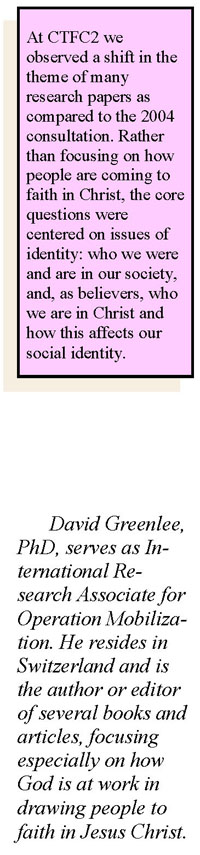
At CTFC2 we observed a shift in the theme of many research papers as compared to the 2004 consultation. Rather than focusing on how people are coming to faith in Christ, the core questions were centered on issues of identity: who we were and are in our society, and, as believers, who we are in Christ and how this affects our social identity.

Selected papers from CTFC2 are now being compiled and will be published in 2011 - notice will be given in this journal. However, as a preview, let me point to the themes of some papers that will appear in that book.

Social identity is multi-dimensional. The one-dimensional C-Scale is helpful to describe a range of practices of communities of believers. However, it is not adequate when we try to extend it to describe the complexities of human identity - corporate or individual.

Jens Barnett suggests that we describe identity in terms of dialogue or multiple narratives.

This is true not only of those who suggest that ‘converts’ should be fully identified with the established churches as well as those who argue for new believers to remain, to the extent possible, within their birth community. As he notes,

In practice then, a purely Muslim ‘insider’ identity, free from all other cultural influences is both an impossible and a misguided ideal. Every believer has internalised a unique combination of narratives from multiple cultural sources. Each of these narratives contains its own scripts, roles, and belongings, and each of these in turn, can appear as a voice of identity within the dialogical self.

The son of a prosperous Muslim businessman added to the discussion, reflecting on the experience he and other Indian believers have shared in attempts to assimilate into the Christian community.

Understanding the strength and unity of the Umma and the role of the Umma in an individual’s identity is essential to understand the struggles that a Muslim seeker will undergo. His life within the Umma has been a place of security, acceptance, protection, and identity. For a seeker it is an enormous sacrifice to lose his place in the Umma. As a Muslim seeker moves into fellowship with the Christian community, it is important that his sacrifice should be acknowledged and understood. The community of Christian believers should become a new place of belonging and inclusion.

In comparison, Enoch Kim noted the changes among the urban Hui of China who, through the impact of modernization and social network changes, have developed multiple identities or “faces” that grant more freedom to make individual choices.

The most important and ultimate decision-maker in [China’s] modern world is “I.” The Hui used to make decisions by what “we” or “others” want, but now it is by what “I” want. . . . the community pressure that the Muslim individual feels has lightened up because now “I” have more rights and abilities than before. As community pressure lessens, individuals will choose what they want.

Discipling women. Often we have emphasized the limitations on women in Muslim societies, perceptions that affect our approaches in evangelism and contributions to teaching and discipling. Mary Davidson noted, however, the important role of women both in private as well as in da’wa, in their homes, at shrines, in rites of passage, and even in impromptu Qur’an recitations she observed on the Cairo metro! Such religious gatherings have many roles, including community and connection, an acceptable reason chance to get out, as an opportunity for leadership, finding blessing and God’s power, and maintaining or challenging community norms. Davidson’s work concludes with questions and suggestions of how such existing social roles for women should be recognized and built on in our evangelism and discipleship.

Complementing Davidson’s insights, writing from Bangladesh Christine Shepherd relates her surprise when several rural women told her that they could freely travel to a village some two hours from their home on a regular basis - “We will just tell people we are visiting relatives,” they explained. Shepherd draws our attention to “the alarming fact that women followers of Jesus … are not typically receiving training through intentional discipleship programs.” Given their important role in leading their children as well as women friends to faith in Jesus Christ, not giving women adequate honor, discipling, and opportunity to fulfill their important role as followers of Jesus, she says, “may lead to a disastrous future for the Muslim background church.”

Shepherd concludes with the words of a Bangladeshi women, nothing that change can take place,

  • As men and women, based on biblical teaching, recognize women’s value from Jesus’ teaching and from his example;
  • As male leaders give the opportunity for women to take an important part in the jamaat; and,
  • As women are taught that they are created in the image of God and that they have an important role in the kingdom of God-they need to know they are necessary to the life of the jamaat. When they are aware of their identity in Christ through receiving proper Bible teaching, men will refrain from oppressing them and women will be able to share their opinions in appropriate ways.

Diverse, and yet one in Christ.

John Kim updated us on the story of “Anotoc,” one situation in which God is at work among “insiders.” (The original story told first in From the Straight Path to the Narrow Way while the updated paper appeared in an earlier edition of this journal.) Others described situations in which the new believers express their faith as part of the existing community of Christians.

While we rejoice in the variety of positive responses to the gospel, we were concerned as an Azerbaijani told us of his research among university students who, though evangelized, have not yet believed. While many Muslims of this region would consider Jesus to be “the God of Russians” this writer notes other reasons for their failure to come to faith, some of them factors that apply to youth in many settings, not just among Muslims.

Traditions of strong family bonds, respect for parents and elders, as a part of local culture, make embracing Christianity costly and troublesome for Azeri youth. Other non-theological hindrances are their indifference, their love of secular and sinful lifestyles and a belief in their own security. . . . The greatest challenge is that they do not want to believe some facts in the Qur’an and in the Injil regarding Christ, the message and authenticity of the Bible, interpreting them as it suits them.

We celebrate our diversity, but remember that it is not an undefined variety. Our identity, whatever outward expression is given, is grounded and deeply rooted in Christ that we might be “to the praise of his glory,” living carefully and wisely as children of light (Ephesians 1: 12-14; 5:15-16).

As Jean-Marie Gaudeul observed,

As we discover the many ways in which Christ, ‘lifted up from the earth, draws everyone to himself’ (John 12:32), we are struck by the extraordinary variety of the ways in which people, finding new faith in Him, discover their new identity: they are changed and yet the same. And we know that this diversity is only a small part of God’s infinite skill in leading us to His house where Unity will combine with the fulfilment of each person's originality.(AFMI)

Monday, September 24, 2012

Identity Issues for Ex-Muslim Christians, Tim Green

Identity issues for ex-Muslim Christians, with particular reference to marriage, by Tim Green  at St. Francis Magazine.

Here is a very thoughtful critique of the C-Scale, as the hot button issue these days revolves around the issue of identity.  In this respect, the C-Scale is too one-dimensional as it marks a simplistic change of identity between C4 and C5.  But identity issues are really complex, and we need to move beyond the dualistic thinking that has characterized much of the “insider movement” debate (i.e. you’re either a Muslim or a Christian).  [Note: even in 1 Cor. 9, we have Paul arguing that he’s not a Jew, nor Greek, but in a genuine third way, the gospel way.  And Paul didn’t have a Western postmodern individualistic worldview.] 

Green’s theory of the layers of identity: 

image

Here is how Green frames the stalemate in the debate:

In this paper I have sought to demonstrate that issues of identity for Christ’s followers from Muslim background are too complex to be condensed to a one-dimensional line called the C-spectrum. Reducing options still further to the stark polarity of “C4 vs. C5” or “Insider Movement vs. Historic Position” has led to an impasse which will not and cannot be broken until the model itself is changed.

His conclusions:

- In the realm of core identity, true disciples of Christ will know themselves to be securely and unambiguously rooted in him (whatever terminology they use for that), will seek to prioritize his values over all rival values, and will increasingly demonstrate this in their speech and behaviour;

- In the realm of social identity, most believers will relate to both old and new communities simultaneously even if not equally. To expect them to retain just one social identity, whether Muslim or Christian, is neither realistic nor biblically appropriate;

- In the realm of collective identity, however, dual belonging is not normally possible. Whether they like it or not believers from Muslim background may be forced into one label or the other, “Muslim” or “Christian”, until their numbers grow sufficiently for them to form a new collective identity of their own. They know their own available options and should be given space to try to find a way around the formidable constraints of such issues as identity cards and community labels;

- These considerations of identity, by disentangling previously fused issues and examining them from a new perspective, may perhaps provide a way for proponents and opponents of Insider Movements to step out of their dug-in positions and seek constructive ways forward;

- Crucially, both sides should examine carefully the factors that vary from one Muslim context to another, particularly with respect to the local relationship between Muslim and Christian communities, rather than assuming all situations are alike;

- Ex-Muslim Christians form a stream of growing significance in the world Christian movement and should be allowed to make their contribution to it without being patronised or “owned” by either side.

Read the whole thing.

We need to change the model, change the debate, and make room for “identity transition” in MBB conversion experiences. 

I’ve met too many fellow cross-cultural workers who claim that they’re neither “insider” nor “traditionalists.”  I think a genuine third way has emerged, but hasn’t been labeled yet.  More on that later.

Saturday, November 19, 2011

“I am an Atheist and a Muslim”

How can these identities coexist?  I’ll tell you my tentative conclusions at the end of the post.  (Please note that many Atheist Muslims are not postmodern.)

First, read this excerpt interview of Hamed Abdel-Samad in Spiegel Online (HT: JS William):

SPIEGEL: You advocate a milder form of Islam. What remains of the core of the religion?

Abdel-Samad: My dream, in fact, is an enlightened Islam, without Sharia law and without jihad, without gender apartheid, proselytizing and the mentality of entitlement. A religion that is open to criticism and questions. As far as I'm concerned, I converted from faith to knowledge some time ago.

SPIEGEL: You became an atheist.

Abdel-Samad: No.

SPIEGEL: You might as well admit it. Being an atheist is nothing to be ashamed of.

Abdel-Samad: But it isn't true.

SPIEGEL: Not a single imam, Catholic priest or rabbi would believe you. Believing in God means accepting that something exists beyond knowledge. If you don't share this belief, why do you insist on calling yourself a Muslim?

Abdel-Samad: Believing in God can also mean being at odds with him. I don't pray regularly, and I don't fast during Ramadan. In that sense, I'm not religious. But I perceive myself as a Muslim. It's my cultural community. For me, Islam is also my homeland and my language, and my Arabic can't be separated from all of that. You can distance yourself from Islam but remain within the heart of Islam. I don't want to yield to the fundamentalists who preach violence. They are on the rise.

Next, see these quotes from a very interesting paper from Paul Froese called “I am an Atheist and a Muslim: Ideological Competition and Accommodation in Central Asia.”  The study shows how Central Asian Muslims retained and accommodated their Islamic beliefs and identity during the era of Soviet Communism.  During this era:

“Muslims were not willing to disown their religious members for publicly advocating atheism. As one committed Kazakh communist explained, “I am an atheist but also a Muslim, because all Kazakhs are Muslims and I cannot deny my forefathers”” (25).

“Muslims… differ from Christians in terms of how they understand their religion and their religious identities. The doctrine of Islam is more flexible in terms of how it defines true believers than most Christian churches” (31).

Finally, Malise Ruthven also notes the existence of Atheist Muslims:

The label Muslim indicates their ethnicity and group allegiance, but not necessarily their religious beliefs. In this limited context (which may apply to other Muslim minorities in Europe and Asia), there may be no contradiction between being Muslim and being atheist or agnostic…

So what does it means to be a Muslim?  Islam allows a lot of diversity.  It seems to me that Western Christians think of the terms “Islam” or “Muslim” primarily in theological categories, but many Muslims themselves understand the terms primarily in cultural categories.

So what?