Showing posts with label Mohammed. Show all posts

Tuesday, April 2, 2019

Outlining a Biblical Theology of Islam: Practical Implications for Disciple Makers and Church Planting | EMQ 2019

Here is full access to my article “Outlining a Biblical Theology of Islam: Practical Implications for Disciple Makers and Church Planting,” that first appeared in EMQ in January 2019.

Taking into consideration the ambiguous nature of religion, a reconsideration of the historicity of Islamic origins, and the diversity of Muslim contexts, I discuss the important topics to consider when constructing a biblical theology of Islam. In the light of authoritative biblical revelation, my approach also illuminates the connections between theology-in-context and our practice of disciple making.

Here are the topics I have paired together:

  • Religion and Kingdom Sociology
  • Biblical Anthropology and Idolatry
  • Prophecy and Muhammad
  • Revelation and the Qur’an
  • Christocentric Doxology and Allah

It is obviously a lot to discuss in just over 3,000 words (EMQ’s limit), but these are the major themes that need consideration in our contextual theology of Islam.

Wednesday, March 6, 2019

My Two Recent Articles in EMQ and IJFM

I currently have two articles out at the moment in EMQ and IJFM.

The first is with EMQ and if you are a member of Missio Nexus (most North American agencies are with Missio Nexus, and if your org is a member then you are too), then you have access. If not, I’ll make it available in April. It is called Outlining a Biblical Theology of Islam: Practical Implications for Disciple Makers and Church Planting and is something I wrote as a kind of promo piece for the annual Middle East Consultation in Beirut, Lebanon (I’ll be giving two keynotes this year). Here are the topics I have paired together in the EMQ article:

  • Religion and Kingdom Sociology
  • Biblical Anthropology and Idolatry
  • Prophecy and Muhammad
  • Revelation and the Qur’an
  • Christocentric Doxology and Allah

It is obviously a lot to discuss in just over 3,000 words (EMQ’s limit), but these are the major themes that need consideration in our theology of Islam.

The second article is Adaptive Missiological Engagement with Islamic Contexts at IJFM. This is also Chapter 17 in our book Margins of Islam: Ministry in Diverse Muslim Contexts. Here is my outline for the article:

Changing Understandings of Muslim Contexts

  • Postcolonial Studies: “The Muslim World” vs. “The West”
  • Cultural Anthropology: Modern Essentialism and Postmodern Relativism
  • Religious Studies and the Fog of “Religions”

A Call for Adaptive Missiology

  • Towards a Missiology of Islam(s)
  • Idolatry and Mission
  • Transforming Relationships

This is a longer article that deals with epistemology and issues which inevitably color our approaches to reaching Muslims.

Let me know what you think in the comments below.


Monday, April 6, 2015

Talman Responds to My Response of “Is Muhammad Also Among the Prophets?”

Harley Talman graciously responded to my response of his article. Here are the chain of articles in case you’re interested in following this discussion:

Below is Talman’s response of my response.


Warrick, thanks for your gracious engagement with my study, affirming it while respectfully posing questions, cautions and concerns (which I have put in bold font italics below under the headings of your three major concerns and after which I share my responses):

1. Consistency in our Appraisals of the Emergence of Christianity and Islam

Sound familiar? The Jesus Seminar and Bart Ehrman come to mind….Would these same scholars of the emergence of Islam do the same thing with the same methods when applied to the early Jesus community?

I appreciate the concern for fairness and consistency in raising this question. I’m not aware of efforts by these Islamic historical revisionists to critique Christian history, but yes, one should expect honest, sincere scholars to be consistent in applying their methodologies. However, Christian historiography has already been subjected to such examination and survived—though not entirely unscathed. One example, the Byzantine influence in shaping Christianity in the Western tradition has been shown to also have a dark side. But Christians who are able to embrace this reality are more open to greater diversity of expression in Christian faith as well as putting an even greater reliance upon the scriptures than on our theological traditions.

Many Jesus Seminar scholars are extremely subjective in their judgments of which verses in the gospels were original. Bart Ehrman is an expert in his field of knowledge, but seems quite willing to mislead readers. (Daniel Wallace, biblical textual critic at Dallas Seminary, refers to these two faces of Erhman as “Good Bart” and “Bad Bart”). I acknowledge the need for judicious acceptance of revisionist historians as some of the most radical proposals are not widely accepted. But “their research does discredit the traditional and popular narrative at a number of points” because it is so much of it is based not on subjectivity, but numerous historical documents and material evidence from archeology. To be sure, the Muslims have been largely unwilling to permit such scholarly explorations and they will strongly react to them. I agree with you that “This is a foundational issue that needs a lot of work.”

2. However, it strikes me as a tad ironic that the only way to allow for the “prophethood” of Mohammed is to deny the traditional Muslim understanding of said “prophethood.”

But my proposals likewise challenge the traditional Christian understandings of prophethood as well, do they not? But there is no escaping the need to confront traditional Muslim views of prophethood at some point—for example, the common Islamic belief in the protection of a prophet from mistakes/sin (ma’sum min al-khata’) must be denied (a denial that is in accord with the Quran).

For so many who follow Mohammed, it is either all or nothing. While I think Talman’s theology could have warrant among some types of Muslims/MBBs, it is not a one-size-fits-all approach.

Instead of saying that Mohammed is in some way a prophet, wouldn’t it just be enough to agree that he was a skilled leader and wise politician who also happened to say some true and beautiful things? Do I have to go so far as to say he was a prophet in order to build relationships of trust and have meaningful dialogue? Perhaps this is true with some very traditional Muslims, but certainly not with all (in my experience).

Such a minimal affirmation may be enough in some cases, but as you acknowledge, it is unlikely to get you very far with traditional Muslims (who often represent the majority in Islamic societies). Moreover, most Christians who view Muhammad as a false prophet (i.e. agent of Satan) will have difficulty communicating sincere respect for him; their inner attitude will likely surface eventually—especially in cultures that read non-verbal communication better than Westerners.

But I did not intend to convey (and I do not think I did) that this was a “silver bullet” for evangelism or Muslim-Christian dialogue—but it hopefully is a step forward. To be sure, the possible alternative views of prophethood do not resemble most Islamic views, but they should be viewed considerably more favorably than the “false prophet” view that has prevailed among Christians.

More importantly, I would agree with Martin Accad who observes that my article is of more value to Christians in providing some resources for rethinking their theology of religions and prophethood. This will hopefully have positive effects on their attitudes toward Muhammad, Islam and Muslims.

What are the consequences of Talman’s theology of prophethood with Muslims who are close to Mohammedolatry or the prophetological concept of salvation?

Muhammad veneration is certainly a widespread phenomenon/problem, though even many Muslims reject it. But given the existence of a similar phenomenon of Mariolatry in Christianity, is it not better addressed by showing appropriate respect and honor of Mary, instead of denying her any special honor or esteem (as Protestants tend to do)? You will recall I stated that all the prophets point to Jesus; they are merely signposts to “the Way” (Jn. 14:6). Signs have great value to the traveler, especially when he does not know the road to his the final destination. Prophets likewise are thus respected, but their ultimate value is in their Christocentric function. This of course, requires a worldview change for our Muslim friends.

3. Prophethood as a Spiritual Gift for New Covenant, Regenerate Believers in the Lord Jesus Christ

…Mohammed did not seek to advance the Kingdom of Jesus into the peoples of the Arabian Peninsula by making disciples who were zealous for the transformation of lives and communities!

It would be much easier for us as Christian theologians to make room for Muhammadan prophethood if his mission and message conformed more to that of the NT apostles or prophets, or within our traditional categories, expectations or desires. However, the fact that Muhammad did not launch a church planting movement does not necessarily preclude his having some sort of divine mission. (Cyrus, God’s “anointed”, exemplifies that fact that God anoints people in political realms for his redemptive purposes).

As I mentioned in the article, apart from the dubious Islamic historical sources, our knowledge of Muhammad is quite limited. But I think it probable that his attitude and portrayal of Christ was stronger than is usually granted him by Christians. Christian presence in Arabia was likely much greater than the traditional Islamic narrative presents it. Contemporary scholarship is increasingly viewing the quranic context as having considerable Christian presence and a biblical subtext. There was familiarity with biblical narratives and presence of rival Christian factions who were divided over details of philosophical theology, while neglecting the weightier matters of faith. In this regard, Muhammad’s movement was “extremely zealous for transformation of lives and community”, by promoting righteousness, piety (prayer, charity, fasting), and eschatological exhortation to prepare for the Day of Judgment. But his mission, as I view it, was apparently not an exclusivist approach focused on only one Abrahamic tradition; rather, his more inclusive aims seem closer to those of Jerry Falwell’s hopes for the Moral Majority in restoring biblical values to American society to preserve the nation.

In Muhammad’s case his efforts to promote righteousness was orthopraxic. His message seems to me to have a lot of parallels with James’ epistle which focused on righteous living as the test of true faith with very little mention of Christological doctrine.

Furthermore, we should not minimize his insistence on calling Jesus the Messiah (‘Isa al-Masih) when Arab Jewish tribes submitting to his leadership could scarcely have been ignorant of the significance of this claim. Moreover, he countered their boast they that had killed Christ Jesus and finished with him with the retort that it was God who had killed him and raised him up alive to himself (an-Nisa 4:157,158). So there was an important witness to the exaltation of Christ. At the same time, Muhammad did mark out some parameters that Christian theologizing ought not to exceed.

In my opinion, the Qur’anic Jesus, while wonderful and mysterious, is still irrelevant and anemic, all things considered. As as shrewd politician, was Mohammed simply trying to win over more Christians into his ecumenical political movement?

I would agree with you that if one only reads the Quran and neglects the prior scriptures, his understanding of Christ will be quite “anemic.” But the dozens of verses that affirm the biblical scriptures and the repeated enjoining to believe in and even consult those who read them, indicate that the Quran was supplemental, not a replacement for the biblical testimony to Christ (later Islamic doctrinal developments that run counter to this, notwithstanding).

“Trying to win Christians over” may be asking the wrong question or assuming too much. A number of scholars regard Waraqa ibn Nawful, the Christian priest, as the paramount spiritual influence on Muhammad. Joseph Azzi thinks Waraqa was grooming Muhammad to fill his sandals as the leader of his Jewish Christian sect. Block considers it likely that Khadija was a Christian and that other Christian groups spoke of Muhammad’s movement using the same kind of terms they used of other branches of Christianity (e.g., Monophysites & Nestorians) that had alternative Christological views. Muhammad seemed to view his calling as having a wider scope—to call the Arabs back to the monotheism of their ancestor Abraham (Abdul-Haqq) and even to claim the land promised to his descendants (Sebeos).

Yet I am still nervous about extending the limits of general revelation and prophecy in the manner Talman does, because it seems to me then that practically anyone who says something nice about Jesus and the Bible can be considered a prophet.

I hope you are exaggerating or else referring to the way some other people might use “prophet.” I do not think that I, nor any of the theologians that I cite, espouse such an inconsequential view of prophethood. For example:

Tennent embraces Charles Ledit’s designation of two kinds or prophecy: “theological” and “directive”. The former pointed to, and ceased at, the coming of Christ. Taking a cue from Aquinas, Ledit labeled as “directive prophecy” those instances where God sovereignly enlists persons outside the covenant to accomplish his purposes, such as giving guidance to people or even correcting the covenant people. In this vein, Muhammad united the Arabs and turned them from paganism and idolatry to monotheism and an ordered society, also preparing a potential bridge to the gospel of Christ.

I hope my responses reflect a correct understanding of your questions, but recognize that even where they do, they may not fully satisfy you or others. We are greatly handicapped by our lack of accurate knowledge of Muhammad apart from the historical narrative of Islamic tradition. Thus my proposals are somewhat tentative and await confirmation or correction from the results of future historical and quranic studies. While we may not be able to agree on all of issues that you have raised, I am united with you in the effort to move “towards a more helpful evangelical theology of Islam, and that is reason to keep moving this conversation forward.”

Blessings on you and your blogging,

Harley Talman


One final question ;-), for everyone who has read this far. I want to know if we can simultaneously affirm these two claims:

  1. The traditional Islamic version of Muhammed—as the final Messenger of the One, True God who received direct revelation that supersedes and replaces all previous revelations and whose life should be emulated as the authoritative and salvific model for all people everywhere—it is possible to call this specific version of Muhammed a false prophet on biblical grounds.
  2. The actual Muhammed of history, as an ecumenical political leader with a strong vision of Monotheism, is not a false prophet but a regular guy who had a positive effect on his society (according to the moral norms of his day) and could be seen as one who potentially prepares a bridge to the gospel of Christ.

I know I’m getting into deeper issues of epistemology and ontology here, but, at least to me, it seems me plausible that these two claims might subsist in paradox (but don’t quote me)…

The first image of Muhammed exists epistemologically and leads many Muslims away from faith in Christ. The second image exists ontologically and does not seem to contradict any biblical witness. The two images can be held in tension as long as qur’anic historicity, which is denied in the second image, is not subsequently used to refute the first image (i.e. it is inconsistent to deny the trustworthiness of the Qur’an/Hadith and then use it to defend a version of the Prophet).

For me, this paradox partially explains how people can talk past each other on this issue.

What are your thoughts?

Monday, March 30, 2015

A Response to “Is Muhammad Also Among the Prophets?” by Talman (IJFM 2014)

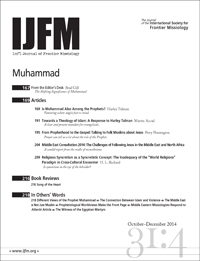
IJFM<br />                          31_4I consider this a must read for those who are interested in an evangelical theology of Islam: Is Muhammad Also Among the Prophets? by Harley Talman. 

The article does an admirable job of nuancing the view of Mohammed between the (unfortunate) binary poles of 1. false prophet/evil leader and 2. final authoritative prophet of the One True God whose message supersedes and replaces all previous revelations. [In my experience, I have noted 8 ways that Mohammed has been called a prophet- see this post: Was Mohammed a prophet?]

Talman’s proposal is to allow for a positive prophetic role for Mohammed- claiming that Mohammed was “messenger” of God does not contradict biblical authority or our testimony of the Lordship of Christ. In acknowledging Mohammed as a prophet, Talman enlarges the role that general revelation plays for unbelievers and expands (reclaims?) the understanding of prophethood. Such a view of Mohammed, however, does not declare him to be as great as Moses; what it does is (according to Talman) enhance our potential for dialogue and evangelism among Muslims.

The article was very insightful and greatly enriches our understanding of “The Prophet” of Islam. Martin Accad discusses more the benefits of the article in his response. I’m not aiming for this to be only a critical post, but I don’t want to repeat what has already been said by Accad. In any case, here are some of my hesitations and questions:

1. Consistency in our Appraisals of the Emergence of Christianity and Islam

Like Talman and many others, I have serious doubts concerning the historicity of the traditional Islamic narratives of Mohammed.

Talman presents an image of Mohammed as a leader of an ecumenical movement (IMO with acute political aspirations) who sought to draw different religious sects together as “Believers” under the banner of the God of Abraham. It was Mohammed's followers who, generations later, drew a sharp, pejorative distinction between the new “Muslim” community of Islam and other religions as they began to venerate Mohammed and claim the previous Books were corrupted.

While I think this understanding of the emergence of Islam best matches the historical record, I am mindful of scholars who do the exact same thing with the emergence of Christianity. For instance see this quote from Talman (pg. 171):

Much of what is considered today as representing “orthodox” Islam likely represents an understanding that developed two or three centuries after Muhammad. The most widely accepted version of Muhammad, based upon Islamic tradition, is dubious.

Now, reread that quote and replace “Islam/Islamic” with “Christian” and “Muhammed” with “Jesus” … Sound familiar? The Jesus Seminar and Bart Ehrman come to mind. In light of this, I think our development of a theology of Islam needs to be robust in it’s critique of the primary sources. Would these same scholars of the emergence of Islam do the same thing with the same methods when applied to the early Jesus community? This is a foundational issue that needs a lot of work.

2. A Missiology of Mohammed and Mohammedolatry

Missiologically, I deeply appreciate what Talman is doing because it actually addresses Mohammed. Too much missiology tries to either ignore or demonize Mohammed; both are neither fair nor realistic. However, it strikes me as a tad ironic that the only way to allow for the “prophethood” of Mohammed is to deny the traditional Muslim understanding of said “prophethood.”

Practically speaking, in building friendships with Muslims, how easy would this conversation go? For so many who follow Mohammed, it is either all or nothing. While I think Talman’s theology could have warrant among some types of Muslims/MBBs, it is not a one-size-fits-all approach.

Instead of saying that Mohammed is in some way a prophet, wouldn’t it just be enough to agree that he was a skilled leader and wise politician who also happened to say some true and beautiful things? Do I have to go so far as to say he was a prophet in order to build relationships of trust and have meaningful dialogue? Perhaps this is true with some very traditional Muslims, but certainly not with all (in my experience).

Another issue to consider is the common practice of Mohammedolatry- where the Prophet is not only revered, but actually worshipped. I believe that there are indeed many Muslims who have formed idolatrous spiritual bonds by actually placing their ultimate faith allegiance in Mohammed’s intercession. In this same edition of IJFM, Pennington (From Prophethood to the Gospel: Talking to Folk Muslims about Jesus) touches on this issue: “the logic of salvation has everything to do with one’s relation to the Prophet Muhammad” (p. 198).

We need to take these spiritual realities seriously. The Bible deals with idolatry in various ways, but what are the consequences of Talman’s theology of prophethood with Muslims who are close to Mohammedolatry or the prophetological concept of salvation?

3. Prophethood as a Spiritual Gift for New Covenant, Regenerate Believers in the Lord Jesus Christ

While Talman starts from general revelation in this discussion (bottom-up?), I would like to start from the perspective of the New Covenant (top-down?).  This is how I think prophets in the kingdom of Jesus operate today, as I have said previously:

Some regenerate, new covenant believers are gifted by the Lord Jesus Christ as prophets (Eph. 4:11). In the New Testament, prophesy is a gift that some believers are given by the Lord Jesus for the edification of the church that will be effective until Christ returns (1 Cor. 12-14). Prophecy in this sense is not authoritative or equal to Scripture (Acts 21:4; 21:10-11; 1 Thess. 5:20-21; 1 Cor. 14:29).  “The essence of prophecy is to give a clear witness for Jesus” (Rev. 19:10 NLT).  In John’s thought, Jesus is the conquering, crucified lamb, King of kings, Lord of lords (Rev. 17:14), incarnate God-man in the flesh (John 1:1, 14) sent to save people from their sins (John 1:29), usher in the new rule of His kingdom (John 18:36; Rev. 1:6), and raise victoriously over death as the Messiah to commission His disciples to continue His mission of the forgiveness of sins (John 20) and the transformation of lives and communities.

Talman aptly demonstrates how other theologians have argued for a broader understanding of prophethood than I articulated above, so I tread very lightly here. Of course Mohammed operated in a kind of OT, pre-Pentecost type of a setting. But, as we all agree, Mohammed did not seek to advance the Kingdom of Jesus into the peoples of the Arabian Peninsula by making disciples who were zealous for the transformation of lives and communities!

Is it therefor appropriate to compare Mohammed with an OT prophet, even though he lived in the New Covenant “era”? Talman does explain the different types of prophets, but I wish there was a deeper treatment of the New Covenant as it relates to New Testament prophecy in Christ-exalting ministry. What we are left with instead is a kind of lowest common denominator type of reasoning where Mohammed plays a vague and shallow prophetic role.

By contrast, the deeper, Gospel-centered prophetic role of advancing the rule of King Jesus as savior of all peoples is obviously lacking in Mohammed’s career.  In my opinion, the Qur’anic Jesus, while wonderful and mysterious, is still irrelevant and anemic, all things considered. As as shrewd politician, was Mohammed simply trying to win over more Christians into his ecumenical political movement?

While it is definitely true that many Muslims are influenced to embrace biblical faith by the Qur’an, as Talman notes, it is not therefore corollary that MBBs continue to see it as a source of divine authority in their growth in Christ (more on this later). For many MBBs, the Qur’an points to the Bible. All truth is indeed God’s truth, but only the Bible (with the HS) has the power to transform. I’m sure Talman would agree. 

However, sometimes I feel this deeper aspect of New Covenant prophethood can easily become obscured in this complex discussion. But at least this is a discussion that avoids simplistic and binary solutions! Yet I am still nervous about extending the limits of general revelation and prophecy in the manner Talman does, because it seems to me then that practically anyone who says something nice about Jesus and the Bible can be considered a prophet.

…

So, was Mohammed a prophet? At the least, I think we can say there are other ways to view Mohammed other than as a false prophet- and that is the strength of this article. Despite my reservations, I commend Talman’s article to you as a fine piece of missiology, theology, and scholarship. As Martin Accad shows in his response to Talman, we are moving towards a more helpful evangelical theology of Islam, and that is reason to keep moving this conversation forward.

Tuesday, February 14, 2012

Mohammad as a Valentine

rasulullah-saw-300x276In order to learn how Mohammad-centric Islam is, it’s important to understand the depth of Muslims’ love for their Prophet.  Here is the summary of the post today at Muslim Matters, Love the Prophet – Follow Him:

Let's follow the Prophet ṣallallāhu 'alayhi wa sallam (peace and blessings of Allāh be upon him) to prove that we love him. Let's celebrate him every day. Let's engrave those beautiful stories of his life, which we memorize and narrate, on our actions. Let's check if our deeds are compatible with our claims of love towards him. In following him, lies the secret of Allāh's love, mercy and forgiveness for us.

Say, [O Muhammad], ''If you should love Allāh, then follow me, [so] Allāh will love you and forgive you your sins. And Allāh is Forgiving and Merciful.'' [Al-Qur'ān 3:31]

Muslims are commanded in the Qur’an to follow Mohammed and God will love them and forgive their sins.

Watch this short video from the post (talk about revisionist view of Islamic history!) that explains why anyone would want to follow Mohammed:

For Muslims to consider following someone other than Mohammed is a radical idea.

Wednesday, February 1, 2012

Aquinas on Islam

Here is Thomas Aquinas' take on Islam in a nutshell.  What do you think?

The point is clear in the case of Mohammed. He seduced the people by promises of carnal pleasure to which the concupiscence of the flesh goads us. His teachings also contain precepts that were in conformity with his promises, and he gave free rein to carnal pleasure. 
In all this, as is not unexpected, he was obeyed by carnal men. As for proofs of the truth of his doctrine, he brought forward only such as could be grasped by the natural ability of anyone with a very modest wisdom. Indeed, the truths that he taught he mingled with many fables and with doctrines of the greatest falsity. He did not bring forth any signs produced in a supernatural way, which alone fittingly gives witness to divine inspiration; for a visible action that can be only divine reveals an invisibly inspired teacher of truth. On the contrary, Mohammed said that he was sent in the power of his arms—which are signs not lacking even to robbers and tyrants. 
What is more, no wise man, men trained in things divine and human, believed in him from the beginning. Those who believed in him were brutal men and desert wanderers, utterly ignorant of all divine teaching, through whose numbers Mohammed forced others to become his followers by the violence of his arms. . . . he perverts almost all the testimonies of the Old and New Testaments by making them into fabrications of his own, as can be seen by anyone who examines his law. It was, therefore, a shrewd decision on his part to forbid his followers to read the Old and New Testaments, lest these books convict him of falsity. 
It is thus clear that those who place any faith in his words believe foolishly. 
Thomas Aquinas, Summa Contra Gentiles, Book 1, Chapter 6 (trans. Anton C Pegis, University of Notre Dame Press, 1975, pp. 73-75)
I have long said that the best way to know that Islam is a man-made religion is to ask any man to sit down and dream up his perfect system/religion - the result would look a lot like Islam.  This hypothesis is helped even more when picturing men in 7th century Arabia.  Think al-wecht al-Jahaliyya "the times of Ignorance" (i.e. before the coming of Islam supposedly brought knowledge to heretofore uneducated desert tribes).  A similar argument could be made for Mormonism and Joseph Smith - another good deal  if you are a man.

Related Post: Islam and Mormonism

Monday, March 28, 2011

Mohammed as the Only Mediator

I like to present Jesus to my Muslim friends as the only mediator between God and man (1 Tim. 2:5-6).  But the response I usually hear is, “Mohammed is our mediator.”  This idea is not found in the Qur’an but in the Hadith, which are seen by many Muslims to be just as authoritative as the Qur’an.

The Qur’an states that no one may mediate unless God permits him: “Who is he that can intercede with Him except with His Permission?”  (2:254-5).  This question is answered by the Bukhari collection of the Hadith 6:60:3:

Narrated Anas:

The Prophet said, "On the Day of Resurrection the Believers will assemble and say, 'Let us ask somebody to intercede for us with our Lord.'

So they will go to Adam and say, 'You are the father of all the people, and Allah created you with His Own Hands, and ordered the angels to prostrate to you, and taught you the names of all things; so please intercede for us with your Lord, so that He may relieve us from this place of ours.'

Adam will say, 'I am not fit for this (i.e. intercession for you).' Then Adam will remember his sin and feel ashamed thereof. He will say, 'Go to Noah, for he was the first Apostle, Allah sent to the inhabitants of the earth.'

They will go to him and Noah will say, 'I am not fit for this undertaking.' He will remember his appeal to his Lord to do what he had no knowledge of, then he will feel ashamed thereof and will say, 'Go to the Khalil--r-Rahman (i.e. Abraham).'

They will go to him [Abraham] and he will say, 'I am not fit for this undertaking. Go to Moses, the slave to whom Allah spoke (directly) and gave him the Torah .'

So they will go to him [Moses] and he will say, 'I am not fit for this undertaking.' and he will mention (his) killing a person who was not a killer, and so he will feel ashamed thereof before his Lord, and he will say, 'Go to Jesus, Allah's Slave, His Apostle and Allah's Word and a Spirit coming from Him.

Jesus will say, 'I am not fit for this undertaking, go to Muhammad the Slave of Allah whose past and future sins were forgiven by Allah.'

So they will come to me [Muhammad] and I will proceed till I will ask my Lord's Permission and I will be given permission. When I see my Lord, I will fall down in Prostration and He will let me remain in that state as long as He wishes and then I will be addressed.' (Muhammad!) Raise your head. Ask, and your request will be granted; say, and your saying will be listened to; intercede, and your intercession will be accepted.' I will raise my head and praise Allah with a saying (i.e. invocation) He will teach me, and then I will intercede. He will fix a limit for me (to intercede for) whom I will admit into Paradise. Then I will come back again to Allah, and when I see my Lord, the same thing will happen to me. And then I will intercede and Allah will fix a limit for me to intercede whom I will let into Paradise, then I will come back for the third time; and then I will come back for the fourth time, and will say, 'None remains in Hell but those whom the Quran has imprisoned (in Hell) and who have been destined to an eternal stay in Hell.' " (The compiler) Abu 'Abdullah said: 'But those whom the Qur'an has imprisoned in Hell,' refers to the Statement of Allah: "They will dwell therein forever." (16.29).

Bases on this hadith, I believe many of my Muslim friends actually place their faith and trust in Mohammed.  They hope Mohammed will find them to be a good Muslim on Judgment day.

HT: Abdul Musloob

Monday, January 24, 2011

Islam and Mormonism

Recently in the country where I live in the Middle East, I have noticed some Mormons who are here as missionaries.   Most Muslims in this country have never heard of Mormonism or Joseph Smith.  Thus I have had several chances recently to discuss the fact that they believe in another "final" prophet from God.   My Muslim friends don't like that.  When I tell them more about Mormonism, I ask them if it is from God or from Satan.  They always say it is from Satan.  But when they hear about the similarities between their own religion and Mormonism, it often leaves them scratching their heads! 

For those of you who aren't familiar with Abu Daoud's blog, Islam and Christianity, I heartily recommend it as a wealth of knowledge.  I found this article there.  And I re-post it below for your perusal...
Islam and Mormonism
by C. Fletcher
In studying world religions, I have noticed several similarities between Mormonism and Islam. Sure, there are significant differences as well (Monotheistic Islam vs. Polytheistic Mormonism for example), and I would not suggest that they are theologically compatible, but the foundings of both religions are surprisingly similar and worth noting.

Here are 12 of the parallels that have been noted (this list is by no means exhaustive):

1. Both claimed that the original meaning of the teachings of Jesus and those who preceded him had either been forgotten or corrupted.
2. Both prophets are reported to have come from humble beginnings with no formal education and were barely literate.
3. Holy Books: Both prophets wrote a new holy book that was apparently inspired by God, and both claimed that their holy book was the most correct and perfect book on earth. Also, they both claimed that their holy books were based upon a record stored in heaven. Both religions claim that their Holy Books have been preserved and are accurate to what was originally recorded by their prophets.
4. Both prophets claimed to have had visions and to have been visited by angels. For Muhammad it was the angel Gabriel, and for Smith it was the angel Moroni. Both visions revealed many new teachings that contradict the Bible.
5. Both believed that no true religion existed on Earth and they were there to restore God’s truth. Islam claims that Adam and Abraham were truly Muslim and that it is restoring 'the true faith of Abraham'. Mormons claim to have restored 'the true faith/church' that was on the earth during and after the time of Jesus, before the supposed "Great Apostasy".
6. Both prophets were practicing polygamists and advocated polygamy (and condemn polyandry) by supposed revelation from God. Additionally, both men married very young girls.

Sunday, January 2, 2011

Was Mohammed a prophet?

What makes someone a prophet?  Well, it depends what you mean by the word “prophet.”  (I’m not going to get into the “apostleship” of Mohammed (رسول الله) in this post.)

I can recall 8 ways I have heard people, be they Muslims or Christians, affirm the “prophethood” of Mohammed.  Here they are below.

Could it be argued that Mohammed was a “prophet” in the sense that…?

  1. he was not a taxi-driver; his vocation was prophethood.  Although it could also be said that Mohammed was a false prophet (1 Jn. 4:1) in this sense. See also Titus 1:12.
  2. all people receive general revelation from God (Rom. 1:20), and some receive special prompting (revelation?) from God to follow Christ (Acts 10:30-33). In this sense one could say that Mohammed’s cave experience was actually a dream from God when he was half-asleep, but in the end the dream was (horribly) misinterpreted.
  3. Gandhi was a prophet. Gandhi was an unbeliever who nevertheless fought against tyranny and sparked a worldwide movement for biblical values such as peace, justice, and dignity.  Ghandi communicated some very true things.
  4. Martin Luther King Jr. was a prophet.  He was a Christian minister and follower of Jesus who, despite some moral failures, preached a biblical and much needed message of racial reconciliation that inspired millions. Martin Luther King Jr. communicated truth.
  5. Balaam was a prophet (2 Pet. 2:15-16; Num. 23ff). Balaam was called a prophet in 2 Peter (!), although he did not know the Lord and was ultimately judged (Num. 31:8, 16).
  6. King David was a prophet.  Keep in mind, morally speaking, David and Mohammed have much in common. David looked forward to the Lord, who was the Messiah (Ps. 110; Matt. 10:41-46). Some have argued that Mohammed “pointed” to Christ as well (e.g. Surah 43:61).
  7. some regenerate, new covenant believers are gifted by the Lord Jesus Christ as prophets (Eph. 4:11).  In the New Testament, prophesy is a gift that some believers are given by the Lord Jesus for the edification of the church that will be effective until Christ returns (1 Cor. 12-14).  Prophecy in this sense is not authoritative or equal to Scripture (Acts 21:4; 21:10-11; 1 Thess. 5:20-21; 1 Cor. 14:29).  “The essence of prophecy is to give a clear witness for Jesus” (Rev. 19:10 NLT).  In John’s thought, Jesus is the conquering, crucified lamb, King of kings, Lord of lords (Rev. 17:14), incarnate God-man in the flesh (John 1:1, 14) sent to save people from their sins (John 1:29), usher in the new rule of His kingdom(John 18:36; Rev. 1:6), and raise victoriously over death as the Messiah to commission His disciples to continue His mission of the forgiveness of sins (John 20).
  8. Islam believes he was the final authoritative prophet of the One True God whose message supersedes and replaces all previous revelations.

Some evangelicals have argued that affirming the “prophethood” of Mohammed greatly enhances witness and dialogue with Muslims.

Could or should Mohammed’s prophethood be affirmed in any of the senses above?  Why or why not?  If you think it is wise to affirm any of the above, what kind of qualifiers would you need to communicate in order to clarify what you believe about the nature of prophecy and the rule of King Jesus?

Monday, December 6, 2010

Three Journeys: Jesus, Constantine, and Mohammed

An interesting essay by David Shenk called Three Journeys: Jesus - Constantine - Muhammad.  The essay addresses three different views of peace in our world today. (Shenk writes from the Anabaptist perspective.  One of my favorite comparative books is his Journeys of the Muslim Nation and the Christian Church.) 

The real value of the essay is in contrasting the journey Jesus took to the Cross with the journey Mohammed took to become a Statesman.  The kingdom of God is so radically different from the kingdoms of this world!

HT: Daniel S.

Sunday, July 4, 2010

Surah al-Mulk

From Islam Future:

The Messenger of Allah said: “There is a Surah in the Quran which contains thirty ayaat which kept interceding for a man until his sins are forgiven. This Surah is ‘Blessed is He in Whose Hand is the dominion.’ (Surah Mulk)” [At-Tirmidi & Abu Dawood]

Another example of an duty in Islam providing forgiveness of sins.  (See the posts below for other examples.)  Although it is possible that the argument of Surah al-Mulk 67 provides the motivation (hellfire) to keep one from sinning.

In any case, forgiveness of sins is definitely a concern in the Islamic worldview.

Related posts:

Tuesday, May 25, 2010

“You Should Know This Man”

You should know this man (Discover Islam)

You may be an atheist or an agnostic; or you may belong to any of the religious denominations that exist in the world today. You may be a Communist or a believer in democracy and freedom.
No matter who you are, and no matter what your ideological and political beliefs, personal and social habits happen to be. You must still know this man.

Encyclopedia Britannica confirms: “…a mass of detail in the early sources shows that he was an honest and upright man who had gained the respect and loyalty of others who were likewise honest and upright men.” (Vol: 12)

Bernard Shaw said about him: “He must be called the Savior of Humanity. I believe that if a man like him were to assume the dictatorship of the modern world, he would succeed in solving its problems in a way that would bring it much-needed peace and happiness”. (The Genuine Islam, Singapore, Vol. 1, No. 8, 1936)

He was by far the most remarkable man that ever set foot on this earth. He preached a religion, founded a State, built a nation, laid down a moral code, initiated numerous social and political reforms, established a powerful and dynamic society to practice and represent his teachings and completely revolutionized the worlds of human thought and behavior for all times to come. His name is Muhammad (P.B.U.H) .

Born in Arabia in the year 570 CE, he started his mission of preaching the religion of Truth, Islam (submission to One God) at the age of forty and departed from this world when he was sixty-three.

During this short period of 23 years of his prophethood, he changed the entire Arabian peninsula from paganism and idolatry to the worship of One God; from tribal quarrels and wars to national solidarity and cohesion; from drunkenness and wickedness to sobriety and piety; from lawlessness and anarchy to disciplined living; from utter bankruptcy to the highest standards of moral excellence. Human history has never known such a complete transformation of people or a place before or since – and imagine all these unbelievable wonders took place in just over two decades…

Keep reading…

Here is the conclusion.

We invite you to make a discovery of this wonderful man, Muhammad (P.B.U.H), , the like of whom never walked on the face of this earth.

It seems to me that Muslims talk much more about Mohammed than they do about God.

Tuesday, February 2, 2010

Short Video on Mohammed for Christians

From Dar al Masih:  “Crescent Project has created this great little video about some of the positive things Muhammad did that Christians can appreciate. These are great talking points you can use with your Muslim friend that will not offend him or her and will create common ground and positive feelings without denying the Christian position. I can't wait for more of Crescent Project's video resources!”


[Click through to Circumpolar if you can’t see the video.]

Related: Twelve Proofs that Mohammed is a True Prophet

Sunday, January 17, 2010

The Islamic View of the Transmission of the Qur’an

Below is a concise, accurate presentation about how the Qur’an was written down, according to majority Islamic belief:

Question

There were many versions of the Qur’an all of which were burnt by Uthman (R.A.) except for one. Therefore is it not true that the present Qur’an is the one compiled by Uthman (R.A.) and not the original revelation of God?
quran-old

Answer

One of the most common myths about the Qur’an, is that Hazrath Uthman (R.A.), the third Caliph of Islam authenticated and compiled one Qur’an, from a large set of mutually contradicting copies. The Qur’an, revered as the Word of Allah (swt) by Muslims the world over, is the same Qur’an as the one revealed to Prophet Muhammad (Pbuh). It was authenticated and written under his personal supervision. We will examine the roots of the myth, which says that Uthman (R.A.) had the Qur’an authenticated.

1. Prophet Muhammad (Pbuh) himself supervised and authenticated the written texts of the Qur’an

Whenever the Prophet received a revelation, he would first memorise it himself and later declare the revelation and instruct his Companions who would also memorise it. The Prophet would immediately ask the scribes to write down the revelation he had received, and he would reconfirm and re-check it himself. Prophet Muhammad (Pbuh) was an Ummi who could not read and write. Therefore, after receiving each revelation, he would repeat it to his Companions. They would write down the revelation, and he would re-check by asking them to read what they had written. If there was any mistake, the Prophet would immediately point it out and have it corrected and re-checked. Similarly he would even re-check and authenticate the portions of the Qur’an memorised by the Companions. In this way, the complete Qur’an was written down under the personal supervision of the prophet (Pbuh).

2. Order and sequence of Qur’an divinely inspired

The complete Qur’an was revealed over a period of 23 years portion by portion, as and when it was required. The Qur’an was not compiled by the Prophet (Pbuh) in the chronological order of revelation. The order and sequence of the Qur’an too was Divinely inspired and was instructed to the Prophet (Pbuh) by Allah (swt) through Archangel Gabriel. Whenever a revelation was conveyed to his companions, the Prophet (Pbuh) would also mention in which Surah (chapter) and after which ayat (verse) this new revelation should fit.

Every Ramadan, all the portions of the Qur’an that had been revealed, including the order of the verses, were revised and reconfirmed by the Prophet (Pbuh) with Archangel Gabriel. During the last Ramadan, before the demise of the Prophet (Pbuh), the Qur’an was rechecked and reconfirmed twice.

It is therefore clearly evident that the Qur’an was compiled and authenticated by the Prophet (Pbuh) himself during his lifetime, both in the written form as well as in the memory of several of his Companions.

3. Qur’an copied on one common material

The complete Qur’an, along with the correct sequence of the verses, was present during the time of the Prophet (Pbuh). The verses however, were written on separate pieces, scrapes of leather, thin flat stones, leaflets, palm branches, shoulder blades, etc. After the demise of the Prophet (Pbuh), Abu Bakr (R.A.), the first caliph of Islam ordered that the Qur’an be copied from the various different materials on to a common material and place, which was in the shape of sheets. These were tied with strings so that nothing of the compilation was lost.

4. Uthman (R.A.) made copies of the Qur’an from the original manuscript

Many Companions of the Prophet (Pbuh) used to write down the revelation of the Qur’an on their own whenever they heard it from the lips of the Prophet (Pbuh). All the verses revealed to the Prophet (pbuh) may not have been heard personally by all the Companions. There were high possibilities of different portions of the Qur’an being missed by different Companions. This gave rise to disputes among Muslims regarding the different contents of the Qur’an during the period of the third Caliph Uthman (R.A.).

Uthman (R.A.) borrowed the original manuscript of the Qur’an, which was authorised by the beloved Prophet (Pbuh), from Hafsah (may Allah be pleased with her), the Prophet’s (Pbuh) wife. Uthman (R.A.) ordered four Companions who were among the scribes who wrote the Qur’an when the Prophet (Pbuh) dictated it, led by Zaid bin Thabit (R.A.) to rewrite the script in several perfect copies. These were sent by Uthman (R.A.) to the main centres of Muslims.

There were other personal collections of the portions of the Qur’an that people had with them. These might have been incomplete and with mistakes. Uthman (R.A.) only appealed to the people to destroy all these copies, which did not match the original manuscript of the Qur’an in order to preserve the original text of the Qur’an. Two such copies of the copied text of the original Qur’an authenticated by the Prophet are present to this day, one at the museum in Tashkent in erstwhile Soviet Union and the other at the Topkapi Museum in Istanbul, Turkey.

5. Diacritical marks were added for non-Arabs

The original manuscript of the Qur’an does not have the signs indicating the vowels in Arabic script. These vowels are known as tashkil, zabar, zair, paish in Urdu and as fatah, damma and qasra in Arabic. The Arabs did not require the vowel signs and diacritical marks for correct pronunciation of the Qur’an since it was their mother tongue. For Muslims of non-Arab origin, however, it was difficult to recite the Qur’an correctly without the vowels. These marks were introduced into the Qur’anic script during the time of the fifth ‘Umayyad’ Caliph, Malik-ar-Marwan (66-86 Hijri/685-705 C.E.) and during the governorship of Al-Hajaj in Iraq.

Some people argue that the present copy of the Qur’an that we have along with the vowels and the diacritical marks is not the same original Qur’an that was present at the Prophet’s time. But they fail to realise that the word ‘Qur’an’ means a recitation. Therefore, the preservation of the recitation of the Qur’an is important, irrespective of whether the script is different or whether it contains vowels. If the pronunciation and the Arabic is the same, naturally, the meaning remains the same too.

6. Allah Himself has promised to guard the Qur’an

Allah has promised in the Qur’an: “We have, without doubt, sent down the Message; and We will assuredly Guard it (from corruption).” The Holy Qur’an, Chapter 15, Verse 9

Dr. Zakir Naik

Related

Wednesday, December 23, 2009

Why do Muslims Send Prayers on the Prophet Mohammed?

You can read about it here (I tried to make it more readable):

Of the greatest blessings that Allah (ta’ala) has given to mankind is sending the Prophet (sal Allahu alayhi wa sallam) as our guide and the Qur’an as our Book.

With the exception of Muhammad (sal Allahu alayhi wa sallam), every Prophet and Messenger sent by Allah (azza wa jal) was sent to a specific nation for a specific time period. Allah (ta’ala) chose Muhammad (sal Allahu alayhi wa sallam) as the Messenger for all the worlds and raised his status and mention among all of mankind.

Allah (ta’ala) describes this bounty that He gave to the Prophet (sal Allahu alayhi wa sallam) in the Qur’an,

وَرَفَعْنَا لَكَ ذِكْرَكَ

and We have raised for you your mention. (94:4)

We bear witness five times a day that he is the Messenger of Allah, we send peace upon him during our prayers, we open our gatherings with his mention after the mention of Allah (azza wa jal) and we ask Allah to bless him before we make a duaa [prayer request]. All of these acts show that we bear witness that he (sal Allahu alayhi wa sallam) delivered the message. Bearing witness that he delivered the message necessitates his love, his obedience and sending salah when he is mentioned, sal Allahu alayhi wa sallam.

Allah (azza wa jal) says,

إِنَّ اللَّهَ وَمَلَائِكَتَهُ يُصَلُّونَ عَلَى النَّبِيِّ يَا أَيُّهَا الَّذِينَ آمَنُوا صَلُّوا عَلَيْهِ وَسَلِّمُوا تَسْلِيمًا

Allah and His angels send blessings on the Prophet: O you that believe! Send your blessings on him, and salute him with all respect. (33:56)

The ayaat in the Qur’an that commands the believers to do good deeds or refrain from evil actions begins with “Ya ayyuhal latheena aamano”, “O you who have believed” however this ayah does not begin in this way. Rather, Allah (ta’ala) mentions that He and His Angels send blessings and greetings on the Prophet (sal Allahu alayhi wa sallam) first before calling the Believers to follow. Allah (subhanahu wa ta’ala) calls the believers, because of your emaan [faith], send salah and salaam on the Messenger. The Scholars of tafseer [interpretation] state that this is to show the honorable and elevated status of the Prophet (sal Allahu alayhi wa sallam) as well as to show the honor in the act of sending salah on him. If Allah and His Angels do this action, it should motivate the Believers to do so as well…

Why do we Send Salawat [Prayers] on the Prophet?

If a close relative of ours passed away, such as a parent or a sibling, we would vehemently ask Allah to forgive them, to grant them security, and to enter them into Jannah [paradise]. The Believers are those who love the Prophet (sal Allahu alayhi wa sallam) more than their family, wealth and their own selves so just as we would ask Allah to forgive and bless our relative, we should send prayers upon our Messenger (sal Allahu alayhi wa sallam) who, by the bounty and mercy of Allah, has taught us our faith. Allah azza wa jal says,

هُوَ الَّذِي بَعَثَ فِي الْأُمِّيِّينَ رَسُولًا مِّنْهُمْ يَتْلُو عَلَيْهِمْ آيَاتِهِ وَيُزَكِّيهِمْ وَيُعَلِّمُهُمُ الْكِتَابَ وَالْحِكْمَةَ وَإِن كَانُوا مِن قَبْلُ لَفِي ضَلَالٍ مُّبِينٍ وَآخَرِينَ مِنْهُمْ لَمَّا يَلْحَقُوا بِهِمْ وَهُوَ الْعَزِيزُ الْحَكِيمُ ذَ‌ٰلِكَ فَضْلُ اللَّهِ يُؤْتِيهِ مَن يَشَاءُ وَاللَّهُ ذُو الْفَضْلِ الْعَظِيمِ

It is He Who has sent amongst the unlettered a Messenger from among themselves, to rehearse to them His Signs, to purify them, and to teach them the Book and Wisdom (Sunnah),- although they had been, before, in manifest error;-As well as (to confer all these benefits upon) others of them, who have not already joined them: And He is exalted in Might, Wise. Such is the Bounty of Allah, which He bestows on whom He wills: and Allah is the Lord of the highest bounty. [62:2-4]

We send salawat on the Prophet (sal Allahu alayhi wa sallam) to acknowledge the great blessing that Allah has given us by sending the Messenger to us. Just as prayer is a manifestation of our love, gratitude and obedience to Allah (azza wa jal), sending salawat on the Prophet (sal Allahu alayhi wa sallam) shows our love for him, our respect for him, and our obedience to him.

We must also remember that Rasul [the Messenger of] Allah (sal Allahu alayhi wa sallam) was only a man who does not possess any power to harm or benefit us. Many from amongst our Ummah have taken their love of the Prophet (sal Allahu alayhi wa sallam) to an extreme that is not only forbidden in our religion, but does the exact opposite of their intended goal. Worship is exclusive for Allah (azza wa jal) and obeying and loving the Prophet (sal Allahu alayhi wa sallam) falls under the worship of Allah…

Read the whole thing, especially the “Benefits and Virtues of Salawat.”

Wednesday, November 18, 2009

Hajj Paves Way to Paradise

The Prophet (peace and blessings be upon him) said: Hajj Paves Way to Paradise: "Abu Hurayrah (may Allah be pleased with him) reported that the Prophet (peace and blessings be upon him) said: "The performance of `Umrah is expiation for the sins committed between it and the previous ones. And the reward for Hajj Mabrur (pilgrimage accepted by Allah) is nothing but Paradise." (Sahih Al-Bukhari, Vol. 3, Book 27, hadith no. 1)"

I want to look up the Arabic word for "expiation" in this verse- does anyone know of a good online Hadith viewer that shows Arabic-English?

Thursday, June 11, 2009

Twelve Proofs that Mohammed is a True Prophet

A short article on the prophethood of Mohammed by Shaykh `Abdul Rahman `Abdul Khaliq (head of the Heritage Revival Committee in Kuwait):

"My brothers and sisters everywhere! With this essay, I am not singling out the adherents of Islam - to which I ascribe - but rather I am writing this essay to every man and woman throughout the whole world.

I ask Allah that He facilitates (tat) this essay reaches every ear, falls under the sight of every eye, and is understood by every heart...

Muhammad the son of `Abdullah is Allah's Prophet and the Final Messenger Sent by Allah to the Inhabitants of Earth.

My brothers and sisters everywhere! You should know that the Messenger, Muhammad the son of `Abdullah (may Allah's blessings and peace be upon him) is Allah's Messenger in reality and truth. The evidences that show his veracity are abundant. None but an infidel, who out of arrogance alone, could deny these signs."

These are listed in the article as proofs that Mohammed is a true prophet:

1. The fact that Mohammed was illiterate
2. The prophecies of the Qur'an
3. The literary eloquence of the Qur'an
4. The perfect life of Mohammed
5. The extreme love Muslims have for Mohammed
6. The worldwide influence of Mohammed to this day (the most influential person who ever lived)
7. The way all Muslims everywhere seek to live like Mohammed
8. The uniqueness of Mohammed
9. The fact that people from every ethnic group and social status follow Mohammed today despite persecution
10. The beauty and majesty of the Qur'anic description of Allah and the perfection of Islam
11. The good manners of Mohammed
12. The fact that the law and creed of Islam defies imitation

Read the whole article.

Is it a fair question to ask, "Do Muslims worship Mohammed?" Of course most do not, and it would be blasphemous in Islam to do so, but the affections many Muslims have of Mohammed seems very close to idolatry.