Showing posts with label Islam. Show all posts

Thursday, October 17, 2024

On the Side Effects of Polemics

In attending conferences recently, I’ve noticed a trend gaining traction among some ministries to Muslims. I sometimes meet individuals who are part of Muslim Background Believer (MBB) networks claiming to have access to ancient Qur'anic manuscripts that, they argue, differ significantly from the standardized Qur'an.

When I inquire further, it becomes clear that the hope behind these efforts is that new scholarship will expose the Qur'an’s flaws, ultimately undermining the foundation of Islam itself.

This approach raises some critical missiological concerns for me.

Firstly, I do not need Islam to be a priori disproven for Jesus to be Lord. My faith rests in the perfect revelation of Christ — there is no one like Him, and no one has done more for me. Whether or not Islam is polemically dismantled has no bearing on Christ’s Lordship, and it shouldn't for any of us, including Muslims.

I am deeply interested in Islamic studies, and understanding Islam’s emergence is essential for missiology. However, recognizing that many elements of Islam’s traditional narrative are mythological should not make us triumphalistic, but empathetic. We can sympathize with Muslims who are navigating their faith in a complex, real-world context. For example, I sometimes reflect on my own identity as an “Evangelical” — a term that carries its own set of contested meanings! Just as Muslims wrestle with internal questions of faith and identity, so do we as Christians.

Secondly, there has been extensive scholarly work in this area already. I am shocked when leaders in these groups are unfamiliar with key scholars like Gabriel Said Reynolds, Martin Accad, or Daniel Brown, whose work extensively explores the complexities of Qur'anic manuscripts (see also various sections in The Religious Other).

This kind of oversight suggests that such MBB-driven research, while earnest, may not be engaging with the broader academic landscape. Any attempt to dismantle “Islam” through textual criticism needs to reckon with this body of existing scholarship.

Finally, a strong focus on polemics reveals a fundamental misunderstanding of what sustains Islam. Biblical faith is grounded ontologically in the person of Jesus Christ and His Kingdom. Yet Islam, like all other religious traditions, is a socially constructed reality – without Muslims there would be no Islam. Islam does not rest simply on a textual foundation or a reality outside the realm of experience. Instead, it is Muslims themselves who decide what Islam is, and they continue to shape, evolve, and contest its meaning.

Even if one were to discredit the Qur'an academically, Islam as a lived religion would persist. In fact, polemics often have the unintended consequence of solidifying group identities. Though it’s true that some Muslims convert to Christianity through these debates, such conversions are exceptions rather than the norm. The broader impact of polemics on the Muslim ummah (community) often serves to reinforce, not weaken, religious boundaries.

If a medical treatment has severe side effects that make the patient worse than the illness being treated, one might say the treatment is worse than the disease. Let’s be discerning with our use of polemics in ministry to Muslims.

Friday, January 29, 2021

Introducing Hermeneutical Hinges: How Different Views of Religion and Culture Impact Interpretations of Islam | The Religious Other (Langham 2020)

I’m excited to let you know about our new book, The Religious Other: A Biblical Understanding of Islam, the Qur'an and Muhammad which released in December 2020. Here is the book description:

We live at a time when religious diversity has become a fact of life in our globalized societies. Yet Christian engagement with Muslims remains complex, complicated by fear, misunderstanding and a history fraught with political and cultural tensions. These essays, drawn from the 2018 and 2019 Middle East Consultations hosted by the Arab Baptist Theological Seminary's Institute of Middle East Studies, engage the need for a carefully developed theological understanding of Islam, its origins and its sacred text. Weaving together the work of Christian scholars of Islam, the Bible, theology and missiology, along with the insights of ministry practitioners, this book combines scholarly exploration with pertinent ministry practice, offering a rich framework for the church to continue its conversation about its engagement with Muslim communities and its proclamation of Christ worldwide.

I have contributed three chapters in the volume; two of them are new. In this post I would like to highlight my essay in section 5.3, “Hermeneutical Hinges: How Different Views of Religion and Culture Impact Interpretations of Islam.” Here is my introduction.

As Martin Accad has proposed, “Your view of Islam will affect your attitude to Muslims. Your attitude will, in turn, influence your approach to Christian-Muslim interaction, and that approach will affect the ultimate outcome of your presence as a witness among Muslims.” I would like to add a more foundational layer to this proposal, namely, that your understanding of religion and culture will affect your view of Islam. In other words, your view of Islam inevitably hinges upon your approach to religion and culture, and specifically, the relationship between the two.

In this article, I would like to show how these ideas play out in the missiological discourse of ministry to Muslims. In the interest of space, I will not focus on a theology of religion (although the discerning reader will see hints of it throughout). Instead, I will focus on the more basic concepts of religion and culture. As we will see, the contemporary debate concerning approaches of ministry to Muslims is complex, and different presuppositions about culture and religion can lead to drastically different understandings of Islam.

The chapter continues with the following sections:

  • Culture: Secular, Evil or Theological?
  • Religion: Western Invention, Belief System, or Subset of Culture?
  • Epistemological Perspective: Top-Down or Bottom-Up?
  • Form and Meaning: Equated, Separate, or Corresponding?
  • Islam: Cultureligion or Religiolatry?

My approach in this essay offers examples from missiology where different answers to the above questions will take you in diverse directions as you interpret “Islam.”

Here is my final section, Concluding Reflections: Getting Comfortable with Ambiguity:

We are unlikely ever to reach a consensus on a proper biblical theology of religion and culture. With the publication of Christ and Culture in 1951, Niebuhr called this issue an “enduring problem” for the Church through the ages. While we can make some general clarifications, as I have done here, it seems to me that many of these issues can’t be solved at the abstract, theoretical level. There is simply too much knowledge rooted in experience and context making the issues extremely difficult to evaluate in a historically “Western” way, i.e. in the realm of ideas.

Interestingly, during the infamous Jerusalem Council in Acts 15, the assembled reflected on the experience of God’s work among them. A next step in this discussion would be to put approaches of ministry to Muslims in dialogue with the Muslim and MBB experience of Islam (religion? culture? both?), which, as we already know, varies. I am very sympathetic to the charge that this discussion has been dominated by Western voices. And yet I find that non-Westerners and MBBs have similar discussions and similar disagreements around these concepts as well.

Still, we may offer some concluding critiques of the discussion. Many of the approaches to contextualization surveyed here assume that Muslims are practicing, not nominal, Muslims. In my experience, however, many Muslims, if they are practicing at all, use Islamic piety to keep God at a distance, either because they are afraid of punishment or because he is seen as unknowable. A Muslim friend once told me he was looking forward to eternity in Paradise, because in heaven, there “was no more worship.” For him, heaven was a man-centered place of sensual indulgence; God was present only in theory.

Additionally, Muslims do not all share the same attachment to Islam. It should go without saying, that, depending on the context, sometimes you do not have to do anything according to the context! Many Muslims do not desire to follow Christ in ways that are culturally or religiously familiar to them, although some indeed do. And yet, the Gospel has all too often been presented in Western forms, causing it to be rejected as foreign. While this may partially explain some of the tension in our discourse, it does not explain all the historical reasons for the resistance to the gospel in Muslim lands. In some Muslim contexts, there is often a very strong connection between form and meaning. For many Muslims and MBBs, some of the forms are linked with meanings that are nearly impossible to modify.

On the other hand, the automatic equation of form and meaning practically villainizes particular Islamic cultures. For mission in a postcolonial world, we must ensure that our theology of Islam does not speak pejoratively of Muslims and Islamic cultures. Unfortunately, Evangelicals have a long history of failing to obey the Golden Rule of Ethics, “Do to others what you would have them do to you” (Matt 7:12). If we understand Christianity as a religious system, we can also demonstrate that “Christianity” has (at numerous times throughout history) done evil things seemingly rooted in the demonic. Does this also mean that “Christianity” has a demonic source? Furthermore, if God saves us from our culture (as some maintain), to what culture do we turn? What is “Christian” culture? Answers only add to the ambiguity.

So, how can we understand Islam? Islam is a process of “meaning-making,” undertaken by Muslims as they interact in their context with the revelation (according to their tradition) given to Muhammad. Islam includes diverse cultural traditions, access to social networks, a sense of belonging with others, and rituals and ceremonies. Phrases such as “leaving Islam” or “remaining in Islam” are often too vague to be meaningful and can actually be confusing in discipleship. For some, “leaving Islam” could mean that a Muslim who comes to Christ must also leave his culture and community, while for others, “remaining in Islam” could mean it is automatically permissible to participate in Islamic rituals. Issues of socioreligious identity are not always clear either. What does a “Muslim” or a “Christian” identity mean within a specific setting? Answers vary with contexts. When we look at Muslim contexts, Islam is not all we see; it is one strand in the braided rope of Muslim societies.

Finally, we haven’t discussed other important issues, such as the nature of the Kingdom of God, the Church, and the gospel. These are also disputed concepts in evangelical missiology. Although we might not agree, and although we need to become more comfortable with ambiguity and messiness, we should still strive for as much Christocentric clarity as possible as we witness to Muslims in diverse contexts. Let us not forget the command to love one another and to love the religious other as we make disciples of Jesus among all nations.

Buy the book and read the whole chapter here.

Wednesday, July 24, 2019

Sacred Misinterpretation | Accad 2019

Sacred Misinterpretation: Reaching across the Christian-Muslim Divide, by Martin Accad (Eerdmans 2019). From Amazon:

Promotes gracious interfaith dialogue on sensitive theological issues

Theological issues are crucial to how Christians and Muslims understand and perceive each other. In Sacred Misinterpretation Martin Accad guides readers through key theological questions that fuel conflict and misunderstanding between Muslims and Christians. A sure-footed guide, he weaves personal stories together with deep discussion of theological beliefs.

Accad identifies trends, recognizes historical realities, and brings to light significant points of contention that often lead to break-down in Christian-Muslim dialogue. He also outlines positive and creative trends that could lead to a more hopeful future. Fairly and seriously presenting both Muslim theology and a Muslim interpretation of Christian theology, Sacred Misinterpretation is an essential guide for fostering dialogue and understanding among readers from both faiths.

Full Table of Contents for the First Three and Final Chapters:

  1. Introduction
    1. Christian-Muslim Interaction
      1. The Context of My Writing
      2. What Does Theology Have to Do with Conflict and War?
    2. The Kerygmatic Approach to Christian-Muslim Interaction
    3. The Islamic Phenomenon
      1. Islam’s Prophet in the Kerygmatic Approach
      2. The Qurʾan in the Kerygmatic Approach
      3. Muslims in the Kerygmatic Approach
      4. Purpose of Relationship with Islam and Muslims
      5. Methods Used in the Kerygmatic Approach to Islam and Muslims
      6. Expectable Outcomes
      7. A Legitimate Insider’s Knowledge of Islam
    4. The Suprareligious Approach and the “Two-Buildings” Analogy
    5. A Book Respectful Enough of Islam for Muslims to Read It
    6. A Biblical Theme: God’s Agenda
      1. Understanding the Importance of Mercy
      2. Adopting an Attitude of Humility
      3. Seeking Ways to Act Justly
      4. Mercy, Humility, and Justice in the Context of Lebanon
      5. Political Conflict and the Role of Religious Dialogue
  2. ​Hermeneutics and Dialogue
    1. Christian Misrepresentation: Reading Christian Thinking into the Qurʾan
    2. Christian Misrepresentation: Giving Primary Attention to Literary Context
    3. Muslim Misrepresentation: Reading the Bible Muhammado-centrically
    4. Comparative Observations on Textual Interpretation
    5. The Legitimate Interpretation of the Qurʾan
      1. Language and Grammar
      2. Occasions of the Revelation
      3. Interpretation Proper
      4. Stories of the Prophets and the Biography of Muhammad
      5. Identification of the Obscure
      6. The Theory of Abrogation
      7. An Argument against the Claim of Medinan Abrogation
      8. Tradition versus Opinion
    6. Legitimate Christian Interpretation of the Qurʾan
      1. The Importance of Context
      2. Interpretation and the Emergence of Doctrine
      3. Historical Context
    7. Sacred Misinterpretation and the Emergence of Religious Monologue
    8. Establishing a Hermeneutical Method for Christian-Muslim Theological Dialogue
      1. The Promise of Hermeneutics in Christian-Muslim Dialogue
      2. Study the Internal Muslim Understanding
      3. Study the Historical Dialogue
      4. Identify Historical Deadlocks
      5. Search for Hermeneutical Keys to Break the Deadlock
    9. Globalizing the Theological Conversation
    10. Closing Considerations: Continuity Rather than Discontinuity
  3. ​God in Christian-Muslim Dialogue
    1. Do Christians and Muslims Worship the Same God?
      1. Timothy George
      2. Miroslav Volf
      3. Imad Shehadeh
      4. Summarizing Reflection
    2. Islam and the One God
      1. The Qurʾan’s Vindication of Jesus
      2. “I Would Never Say What Is Not Rightfully Mine to Say!”
      3. Jesus Affirmed That “There Is No God But God”
      4. Jesus Affirmed and Practiced the Worship of God Alone
    3. God in Islam
      1. Islam’s Doctrine of Absolute Monotheism
      2. The Qurʾan’s Rebuttal of the Christian View of God
      3. The Qurʾan’s Rebuttal of Christ’s Divinity
      4. Summarizing the Metadialogue on the Doctrine of God
      5. Hermeneutical Keys in Building Bridges beyond Conflict
      6. Using Deadlocks as Assets
      7. Concluding Thoughts
      8. Further Reading and Research
  4. Who Jesus Is Not according to Muslims
  5. Who Jesus Is according to Muslims
  6. Muslim Strategies in Approaching the Bible
  7. Taḥrīf and the Corruption of Scripture
  8. Islam’s Muhammado-Centric Reading of the Bible
  9. Muhammad as Paraclete
  10. ​Beyond Conflict
    1. Legitimate Ways for Christians to View Islam
    2. A Simple Definition of Islam
      1. Two Stages of Muhammad’s Life
      2. The Meccan and Medinan Qurʾans
      3. Meccan and Medinan Muslims Historically and Today
    3. Muhammad and Early Islamic History as Paradigm
    4. A Case for Meccan Islam
    5. Muhammad in the Context of Dialogue
      1. Abraham, Moses, and Muhammad
      2. The Two-Times Theory
    6. The Status of Muhammad for a Christian
      1. Muhammad—a Bridge to Christ?
      2. A Call to Awakening for People of Faith in the Twenty-First Century
      3. Imagining a New Future
      4. A Call to Social Action
      5. A Call to Political Activism, Peacebuilding, and Courage
      6. A Call to Worship

In the introduction, Accad says that “the general Christian reader who does not wish to engage with the more technical and historical sections of the seven core chapters (3-9) can still benefit from the book by reading the opening and closing pages of each chapter.”

This important book provides a hermeneutically robust, historical-theological understanding of Islam. Highly recommended.

Tuesday, April 2, 2019

Outlining a Biblical Theology of Islam: Practical Implications for Disciple Makers and Church Planting | EMQ 2019

Here is full access to my article “Outlining a Biblical Theology of Islam: Practical Implications for Disciple Makers and Church Planting,” that first appeared in EMQ in January 2019.

Taking into consideration the ambiguous nature of religion, a reconsideration of the historicity of Islamic origins, and the diversity of Muslim contexts, I discuss the important topics to consider when constructing a biblical theology of Islam. In the light of authoritative biblical revelation, my approach also illuminates the connections between theology-in-context and our practice of disciple making.

Here are the topics I have paired together:

  • Religion and Kingdom Sociology
  • Biblical Anthropology and Idolatry
  • Prophecy and Muhammad
  • Revelation and the Qur’an
  • Christocentric Doxology and Allah

It is obviously a lot to discuss in just over 3,000 words (EMQ’s limit), but these are the major themes that need consideration in our contextual theology of Islam.

Wednesday, March 6, 2019

My Two Recent Articles in EMQ and IJFM

I currently have two articles out at the moment in EMQ and IJFM.

The first is with EMQ and if you are a member of Missio Nexus (most North American agencies are with Missio Nexus, and if your org is a member then you are too), then you have access. If not, I’ll make it available in April. It is called Outlining a Biblical Theology of Islam: Practical Implications for Disciple Makers and Church Planting and is something I wrote as a kind of promo piece for the annual Middle East Consultation in Beirut, Lebanon (I’ll be giving two keynotes this year). Here are the topics I have paired together in the EMQ article:

  • Religion and Kingdom Sociology
  • Biblical Anthropology and Idolatry
  • Prophecy and Muhammad
  • Revelation and the Qur’an
  • Christocentric Doxology and Allah

It is obviously a lot to discuss in just over 3,000 words (EMQ’s limit), but these are the major themes that need consideration in our theology of Islam.

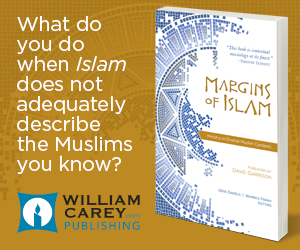
The second article is Adaptive Missiological Engagement with Islamic Contexts at IJFM. This is also Chapter 17 in our book Margins of Islam: Ministry in Diverse Muslim Contexts. Here is my outline for the article:

Changing Understandings of Muslim Contexts

  • Postcolonial Studies: “The Muslim World” vs. “The West”
  • Cultural Anthropology: Modern Essentialism and Postmodern Relativism
  • Religious Studies and the Fog of “Religions”

A Call for Adaptive Missiology

  • Towards a Missiology of Islam(s)
  • Idolatry and Mission
  • Transforming Relationships

This is a longer article that deals with epistemology and issues which inevitably color our approaches to reaching Muslims.

Let me know what you think in the comments below.


Monday, October 8, 2018

Introducing our New Book | Margins of Islam: Ministry in Diverse Muslim Contexts

On behalf of Gene Daniels, I’m excited to introduce our new book Margins of Islam: Ministry in Diverse Muslim Contexts. Here is the book description:

What do you do when “Islam” does not adequately describe the Muslims you know? Margins of Islam brings together a stellar collection of experienced missionary scholar-practitioners who explain their own approaches to a diversity of Muslims across the world. Each chapter grapples with a context that is significantly different from the way Islam is traditionally presented in mission texts. These crucial differences may be theological, socio-political, ethnic, or a specific variation of Islam in a context—but they all shape the way we do mission. This book will help you discover Islam as a lived experience in various settings and equip you to engage Muslims in any context, including your own.

One of the most succinct and descriptive endorsements comes from Timothy Tennent, President of Asbury Theological Seminary:

In a marvelous tour de force, Margins of Islam exposes the widely held, but false assumption that the house of Islam is a monolithic religious entity which either resists or responds to missiological strategies. Collectively, these authors offer up case studies and rich and textured “on the field” experience which reflects the true variegated diversity of Islam. This book is contextual missiology at its finest.

The project was the brainchild of Gene Daniels. I vividly remember sitting next to him on a bus discussing it with him on our way to a conference center from a hotel a couple years ago. His big idea was to gather missionary scholar-practitioners serving in various Muslim settings to explain how they take context seriously and how they deal with the phenomenon that we call “Islam.” I was genuinely surprised and honored when he asked me to be his coeditor!

We immediately started networking and looking for contributors. Gene already had several people in mind. My job was to help edit each chapter and then to produce a concluding chapter that explained the themes of the book. It was a rich learning experience. As I researched for the book, I found myself often disagreeing and pushing back on evangelical treatments of Islam.

My criticism began to take shape and eventually became an introductory chapter—most evangelical missiological treatments of Islam are reductionistic with what I call a “top-down” approach, meaning that Islam (and subsequently, Muslims) can be adequately understood by addressing the Qur’an, hadith, and history of Islam. From this textual understanding, it is assumed that Muslims believe what Islam teaches, and thus there is a “Muslim worldview” and strategies on how to engage it. In this framework, Muslims are often simplified as cultural and spiritual clones of one another.

Many workers have read books based on this top-down approach, but when they begin to engage Muslims in their context, they quickly discover that the Muslims they are working with believe very different things from what “Islam” teaches. While the top-down approach is incredibly valuable, it can also distort our understanding of Muslims if it is our only lens. We also need a “bottom-up” approach that explains the historical evolution of the Islamic phenomenon and the sociological perspectives that accounts for the diversity of Islam today. Ergo my chapter two: How Muslims Shape and Use Islam: Towards a Missiological Understanding.

As I was editing the chapters (which do a wonderful job of combining the top-down and bottom-up perspectives) and after I wrote the introductory chapter, I started to reflect on how recent developments in postcolonial theory, anthropology, and religious studies have influenced mission to Muslims. Gene and I later decided that I would write a theory piece again for a concluding chapter which I titled Adaptive Missiological Engagement in Islamic Contexts. Gene then did a masterful job tying the themes of the book together in the final chapter, “Conclusion: Learning from the Margins.”

Here are the contents of the book:

Foreword, David Garrison

Introduction, Gene Daniels

PART 1: CONCEPTUALIZING ISLAM

1 Who Represents Islam?, Evelyne A. Reisacher

2 How Muslims Shape and Use Islam: Towards a Missiological Understanding, Warrick Farah

PART 2: ENGAGING MUSLIMS

3 The Donkey and the Straw: Reaching South Asian Sufis with the Gospel, Kevin Higgins

4 Secular Muslims in Bosnia and Herzegovina, Ted Esler

5 Egalité, Fraternité, and Cous-cous: Ministry to Muslims in the Context of a Resurgent Islam and French Laïcité, Rick Kronk

6 Biblical Approaches to the Nurcu Gülen Movement in Turkey, Yakup Korkmaz

7 Magical Mystical Muslims: Sufi-oriented Islam and African Traditional Religion, Robin Dale Hadaway

8 Ordinary Muslims in Pakistan and the Gospel, Warren Larson

9 Ministry to Hui Muslims in China: An Approach to Dual-layered Cultural Settings, Enoch Jinsik Kim

10 Context as Flypaper: The Island of Java in Indonesia, Michael A. Kilgore

11 Liberating Liminality: Mission in the North African Berber Context, Patrick Brittenden

12 Russified Muslims of the Former Soviet Union, Gene Daniels

13 The Queen’s Muslims? Muslim Identities in the UK, Phil Rawlings

14 In the Shadow of a Buddhist Temple: Muslims in Thailand, Alan Johnson

15 Uyghurs of the Tarim Basin: Muslims in Northwestern China, CG Gordon

16 Muslim Youth in a Glocal World, Arthur Brown

PART 3: REFRAMING MISSIOLOGY

17 Adaptive Missiological Engagement with Islamic Contexts, Warrick Farah

18 Conclusion: Learning from the Margins, Gene Daniels

As our endorsements were rolling in, one from JD Payne stood out in particular that helped us identity the biggest potential takeaway from this book:

Margins of Islam takes readers on a global journey revealing the multiple expressions of the Islamic faith… We no longer have any excuse to train others to reach all Muslims in the same way.

I want to thank Gene for this incredible opportunity, and also for our excellent group of contributors who have taught me so much about the variety of Muslims and the varieties of biblical mission in the world today. Go ahead and buy the book on Amazon, and please help us spread the word—you can easily share this from the button on the bottom of the post on the blog. Thank you for considering! We feel this volume represents a significant encouragement for the mission of the church.

SM Post 1

Friday, May 18, 2018

What is sharia law?

From The Sociology of Islam: Knowledge, Power and Civility (p. 79-80):

Based on a Qur’anic keyword meaning the “straight path,” the sharia was first elaborated by Muslim scholars as a philosophical and theological rather than a strictly legal concept (W.C. Smith 1962).

Yet over time and by virtue of the force represented by the rising importance of Sufism as a discipline stressing the inner truth, the sharia, as much as it was seen as the manifestation of divine Will (shar`), also came to represent the outer dimensions of the ethico-religious code of Islam. The sharia happened to be identified with the more systematic dimension of the Islamic normativity, the one that could be formulated in terms of legal norms which, in turn, would be liable – to a not yet exclusive extent – to be enforced. Apart from this technically legal dimension, the sharia covered a comprehensive concept of norm, which included ritual and dietary rules, as well as rules about family, commerce, and social relations more in general. However, this normative idiom, reflecting basic values of humanity, justice, and equality, never became a code in the sense of a closed (and univocally ‘searchable’) text. It rather preserved an inherent, inner pluralism and contestability in the form of a cumulative tradition articulated in translocal schools and local, contextualized sets of practices variably drawing from most pre-Islamic customs.

This is why the understandings of sharia and related practices have been historically dependent on the types of knowledge and the varieties of culture prevalent on a local scale, as well as on the degree of social contention and reconstruction that they authorized. The convergence between concretely practiced Islamic jurisprudence and the idea of sharia was therefore a diversified, gradual, and (at least till the colonial era) never fully accomplished process… Modern attempts to systematize and implement sharia, whether associated with ‘liberal’ and ‘reformist’ or with ‘fundamentalist’ and ‘puritan’ interpretations (all labels that, originating in Western history, should be taken with a grain of salt), have been hardly able to extinguish its historic dynamism. Yet they certainly contributed to obfuscate the consciousness of this dynamism among a mass public, which in the colonial and postcolonial eras has been more prone to appreciate its new rigidified contours.

It is a myth to assume that sharia is a universal, coherent legal code that is ready to be applied. Any missiological approach to Muslims that claims sharia is some sort of spiritual force that means the same thing to all Muslims everywhere has not done enough contextual analysis.

Sunday, February 18, 2018

The Atheist Muslim (Rizvi 2017)

Interesting interview of an atheist Muslim who attempts to retain a Muslim identity while rejecting Islamic ideology. He nuances between extremes on how to define something as Islamic/Muslim. Also helpful is how he describes the errors of the left which conflate legitimate criticism of Islam with Islamophobia and the errors of the right which demonize Muslims. This kind of book nicely illustrates the incredible diversity in the so-called ‘Muslim world’ today.

Here is the interview on Vox: An atheist Muslim on what the left and right get wrong about Islam

Friday, December 29, 2017

The Muslim Christmas Song

Just think of all the important conversations this video can generate: the nature of religion, the origins of Christmas, appropriation, Islamophobia, contextualization, objectivity, religious plurality, interreligious encounter, etc., etc. If you have any thoughts about this video, please comment below.

Raef - The Muslim Christmas Song (Deck the Halls Cover)


Tuesday, July 18, 2017

Challenging the Monochromatic View of Islam, Accad

From MISSION IN A WORLD GONE WILD AND VIOLENT: CHALLENGING THE MONOCHROMATIC VIEW OF ISLAM FROM A SILENT MAJORITY POSITION, by Martin Accad:

The ‘world religions’ approach has a tendency to view people of faith as prisoners of theological systems, whose every move can be predicted by their communities’ sacred scriptures. Whereas the ‘sociology of religions’ approach offers a dynamic vision of mutually-influential forces between theology and the practice of religion. I would argue that the latter vision offers us a far richer field of inquiry, engagement, and action than the former. From a missional perspective, therefore, it is far more useful, far more empowering and energizing; it invites us to new possibilities in terms of creative and constructive action required for the mission of God.

Monday, June 12, 2017

Challenging the Concept of “The Muslim World”

Contrary to widespread assumption, the term “Muslim world” does not derive from ummah, a concept as old as Islam, which refers to the Muslim religious community. Instead the idea of the Muslim world began to develop in the nineteenth century and achieved full flower in the 1870s. Also mistaken is the belief that Muslims were united until nationalist ideology and European colonialism tore them apart. This is precisely backward; in fact, Muslims did not imagine belonging to a global political unity until the peak of European hegemony in the late nineteenth century, when poor colonial conditions, European discourses of Muslim racial inferiority, and Muslims’ theories of their own apparent decline nurtured the first arguments for pan-Islamic solidarity. In other words, the Muslim world arrived with imperial globalization and its concomitant ordering of humanity by race. The racialization of Islam was bound up with its transformation into a universal and uniform religious tradition, a force in international politics, and a distinct object in a discourse of civilizations. Political strategy and intellectual labor made this new reality, and both Muslims and European Christians took part.

Aydin, Cemil (2017). The Idea of the Muslim World: A Global Intellectual History (Kindle Locations 91-99). Harvard University Press.

See also: How the Muslim World Was Invented

Wednesday, February 15, 2017

My Favorite Introduction to Islam

Muslim Identities: An Introduction to Islam, by Aaron W. Hughes.

Hughes approaches Islam from the religious studies perspective (not necessarily from Islamics) and tries to steer a middle way between a theological introduction and a polemic against Islam. He shows the diversity of islams today and draws many important contrasts between traditional Islamic teachings (often exposing historical inaccuracies in Islam’s account of its origins) and how Muslims in different places diverge from those understandings. For Hughes, a ‘Muslim’ identity is something more created than it is inherited. I appreciate his ability to portray the complexity of Islam in a way that is not complicated, rather than simply homogenize Islam, which has been so common in books on Islam since 9/11.

I also like The Emergence of Islam: Classical Tradition in Contemporary Perspective by Gabriel Said Reynolds, and A New Introduction to Islam by Daniel Brown.

What is your favorite Intro to Islam, and why?

Sunday, April 17, 2016

The W-Spectrum

Here is a pdf download of the W-Spectrum on one page:

W-Spectrum Pic

Please refer to the EMQ October 2015 article The W-Spectrum: Worker Paradigms in Muslim Contexts for more information (subscription required).

See also:

Saturday, January 16, 2016

The “Same God?” Debate in Full Force after the Wheaton Controversy

EMS just put out an occasional bulletin- Wheaton and the Controversy Over Whether Muslims and Christians Worship the Same God (HT: CIU blog). The intro article by Robert Priest is excellent, “I’ve also been struck by the idea that many American evangelical missionaries and missiologists, and perhaps the Apostle Paul himself, would be in danger of dismissal if they taught at Wheaton College, since many of us arguably have been guilty of the very thing Wheaton College is sanctioning…” #burn

After scanning through the articles, I still want to insist that this is (mostly) an irrelevant issue, as I have said before here: Allah of Islam and the Father of the Biblical Lord Jesus. No one knows God soteriologically apart from Christ. Perhaps we might be more united (and fruitful) if we framed the question around this issue.

There is also an upcoming debate between Volf & Qureshi — Do Muslims & Christians Worship the Same God? on January 19. If you tune in, I would love to hear some of your thoughts in the comments section below.

Wednesday, December 30, 2015

www.trueislam.com?

www.trueislam.com tackles extremism (HT: MA). While I think we should promote initiatives that work for peace in our world, I do find it ironic that these are Ahmadis who, by many Muslims, are not considered true Muslims.

Matthew Stone recently had a very interesting post about the ellusive “true Islam” debate Are Liberals and Conservatives Asking the Wrong Question about Islam and ISIS? Here is part of what he said:

So the two questions before us seem to be:

  1. Does ISIS represent the true violent nature of Islam?
  2. Is ISIS an aberration of the true peaceful Islam?

Actually I am being overly optimistic. Today the two sides rarely pose these two questions because to do so would assume that the issue is actually open for consideration. Those groups closed the discussion long ago and now unquestioningly declare their view as though it were fact.

I think a better approach would be to revive asking questions without assuming the answer is known, but focusing on asking helpful questions for which an answer is logically possible without simply reflecting bias, prejudice, hate, or hidden agenda. I have a question I recommend being posed to Muslims and non-Muslims alike, a question that avoids the fruitless chasing after the elusive true Islam. The question is, “Is this the Islam you want?

Consider a hypothetical responder to that question. If the person answers “yes,” then that individual is either the enemy of peace loving citizens of the world, or ideologically aligned with the enemy. Decisions then have to be made about the pragmatic and legal/ethical steps we should take to address an enemy producing ideology. If the individual is a Christian, those decisions should reflect the values of Christ.

If the person answers, “no,” whether they are Muslim or non-Muslim, then the subsequent question is, “Then what are you going to do about this?” What are you going to do about this given the realities of your life and without denying life, liberty, and the pursuit of happiness to the innocent Muslim or non-Muslim?

I wish it were as easy as just posing the question and waiting for the answer…

Read the whole thing.

Monday, March 30, 2015

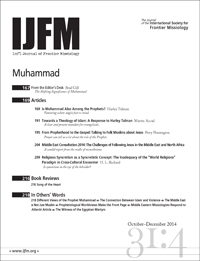
A Response to “Is Muhammad Also Among the Prophets?” by Talman (IJFM 2014)

IJFM<br />                          31_4I consider this a must read for those who are interested in an evangelical theology of Islam: Is Muhammad Also Among the Prophets? by Harley Talman. 

The article does an admirable job of nuancing the view of Mohammed between the (unfortunate) binary poles of 1. false prophet/evil leader and 2. final authoritative prophet of the One True God whose message supersedes and replaces all previous revelations. [In my experience, I have noted 8 ways that Mohammed has been called a prophet- see this post: Was Mohammed a prophet?]

Talman’s proposal is to allow for a positive prophetic role for Mohammed- claiming that Mohammed was “messenger” of God does not contradict biblical authority or our testimony of the Lordship of Christ. In acknowledging Mohammed as a prophet, Talman enlarges the role that general revelation plays for unbelievers and expands (reclaims?) the understanding of prophethood. Such a view of Mohammed, however, does not declare him to be as great as Moses; what it does is (according to Talman) enhance our potential for dialogue and evangelism among Muslims.

The article was very insightful and greatly enriches our understanding of “The Prophet” of Islam. Martin Accad discusses more the benefits of the article in his response. I’m not aiming for this to be only a critical post, but I don’t want to repeat what has already been said by Accad. In any case, here are some of my hesitations and questions:

1. Consistency in our Appraisals of the Emergence of Christianity and Islam

Like Talman and many others, I have serious doubts concerning the historicity of the traditional Islamic narratives of Mohammed.

Talman presents an image of Mohammed as a leader of an ecumenical movement (IMO with acute political aspirations) who sought to draw different religious sects together as “Believers” under the banner of the God of Abraham. It was Mohammed's followers who, generations later, drew a sharp, pejorative distinction between the new “Muslim” community of Islam and other religions as they began to venerate Mohammed and claim the previous Books were corrupted.

While I think this understanding of the emergence of Islam best matches the historical record, I am mindful of scholars who do the exact same thing with the emergence of Christianity. For instance see this quote from Talman (pg. 171):

Much of what is considered today as representing “orthodox” Islam likely represents an understanding that developed two or three centuries after Muhammad. The most widely accepted version of Muhammad, based upon Islamic tradition, is dubious.

Now, reread that quote and replace “Islam/Islamic” with “Christian” and “Muhammed” with “Jesus” … Sound familiar? The Jesus Seminar and Bart Ehrman come to mind. In light of this, I think our development of a theology of Islam needs to be robust in it’s critique of the primary sources. Would these same scholars of the emergence of Islam do the same thing with the same methods when applied to the early Jesus community? This is a foundational issue that needs a lot of work.

2. A Missiology of Mohammed and Mohammedolatry

Missiologically, I deeply appreciate what Talman is doing because it actually addresses Mohammed. Too much missiology tries to either ignore or demonize Mohammed; both are neither fair nor realistic. However, it strikes me as a tad ironic that the only way to allow for the “prophethood” of Mohammed is to deny the traditional Muslim understanding of said “prophethood.”

Practically speaking, in building friendships with Muslims, how easy would this conversation go? For so many who follow Mohammed, it is either all or nothing. While I think Talman’s theology could have warrant among some types of Muslims/MBBs, it is not a one-size-fits-all approach.

Instead of saying that Mohammed is in some way a prophet, wouldn’t it just be enough to agree that he was a skilled leader and wise politician who also happened to say some true and beautiful things? Do I have to go so far as to say he was a prophet in order to build relationships of trust and have meaningful dialogue? Perhaps this is true with some very traditional Muslims, but certainly not with all (in my experience).

Another issue to consider is the common practice of Mohammedolatry- where the Prophet is not only revered, but actually worshipped. I believe that there are indeed many Muslims who have formed idolatrous spiritual bonds by actually placing their ultimate faith allegiance in Mohammed’s intercession. In this same edition of IJFM, Pennington (From Prophethood to the Gospel: Talking to Folk Muslims about Jesus) touches on this issue: “the logic of salvation has everything to do with one’s relation to the Prophet Muhammad” (p. 198).

We need to take these spiritual realities seriously. The Bible deals with idolatry in various ways, but what are the consequences of Talman’s theology of prophethood with Muslims who are close to Mohammedolatry or the prophetological concept of salvation?

3. Prophethood as a Spiritual Gift for New Covenant, Regenerate Believers in the Lord Jesus Christ

While Talman starts from general revelation in this discussion (bottom-up?), I would like to start from the perspective of the New Covenant (top-down?).  This is how I think prophets in the kingdom of Jesus operate today, as I have said previously:

Some regenerate, new covenant believers are gifted by the Lord Jesus Christ as prophets (Eph. 4:11). In the New Testament, prophesy is a gift that some believers are given by the Lord Jesus for the edification of the church that will be effective until Christ returns (1 Cor. 12-14). Prophecy in this sense is not authoritative or equal to Scripture (Acts 21:4; 21:10-11; 1 Thess. 5:20-21; 1 Cor. 14:29).  “The essence of prophecy is to give a clear witness for Jesus” (Rev. 19:10 NLT).  In John’s thought, Jesus is the conquering, crucified lamb, King of kings, Lord of lords (Rev. 17:14), incarnate God-man in the flesh (John 1:1, 14) sent to save people from their sins (John 1:29), usher in the new rule of His kingdom (John 18:36; Rev. 1:6), and raise victoriously over death as the Messiah to commission His disciples to continue His mission of the forgiveness of sins (John 20) and the transformation of lives and communities.

Talman aptly demonstrates how other theologians have argued for a broader understanding of prophethood than I articulated above, so I tread very lightly here. Of course Mohammed operated in a kind of OT, pre-Pentecost type of a setting. But, as we all agree, Mohammed did not seek to advance the Kingdom of Jesus into the peoples of the Arabian Peninsula by making disciples who were zealous for the transformation of lives and communities!

Is it therefor appropriate to compare Mohammed with an OT prophet, even though he lived in the New Covenant “era”? Talman does explain the different types of prophets, but I wish there was a deeper treatment of the New Covenant as it relates to New Testament prophecy in Christ-exalting ministry. What we are left with instead is a kind of lowest common denominator type of reasoning where Mohammed plays a vague and shallow prophetic role.

By contrast, the deeper, Gospel-centered prophetic role of advancing the rule of King Jesus as savior of all peoples is obviously lacking in Mohammed’s career.  In my opinion, the Qur’anic Jesus, while wonderful and mysterious, is still irrelevant and anemic, all things considered. As as shrewd politician, was Mohammed simply trying to win over more Christians into his ecumenical political movement?

While it is definitely true that many Muslims are influenced to embrace biblical faith by the Qur’an, as Talman notes, it is not therefore corollary that MBBs continue to see it as a source of divine authority in their growth in Christ (more on this later). For many MBBs, the Qur’an points to the Bible. All truth is indeed God’s truth, but only the Bible (with the HS) has the power to transform. I’m sure Talman would agree. 

However, sometimes I feel this deeper aspect of New Covenant prophethood can easily become obscured in this complex discussion. But at least this is a discussion that avoids simplistic and binary solutions! Yet I am still nervous about extending the limits of general revelation and prophecy in the manner Talman does, because it seems to me then that practically anyone who says something nice about Jesus and the Bible can be considered a prophet.

So, was Mohammed a prophet? At the least, I think we can say there are other ways to view Mohammed other than as a false prophet- and that is the strength of this article. Despite my reservations, I commend Talman’s article to you as a fine piece of missiology, theology, and scholarship. As Martin Accad shows in his response to Talman, we are moving towards a more helpful evangelical theology of Islam, and that is reason to keep moving this conversation forward.

Thursday, February 12, 2015

American Protestant Pastors vs. Americans on “True Islam”

From Ed Stetzer, NEW RESEARCH: How Americans View Islam:

Forty-five percent of 1,000 senior Protestant pastors surveyed say the Islamic State, also known as ISIL or ISIS, "gives a true indication of what an Islamic society looks like." … The pastors had a much darker view of Islam than Americans at large. In contrast, in the second survey, 27% of Americans say the Islamic State reflects the true nature of Islamic society.

Why do Pastors have a much more negative view of “Islam” than typical Americans? I’ve got my theories, but I’d love to hear yours.

Tuesday, January 6, 2015

On Arguing About What “Real” Islam Is…

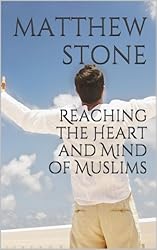
See this helpful little book: Reaching the Heart and Mind of Muslims by Matthew Stone. Some of the chapters are fun, and some are very basic. Here is a great quote about the point of debating the true nature of Islam (pg. 6-7):

Models are helpful, in the same way that habits are helpful. They both allow us to navigate through new and sometimes confusing situations without always starting at ground zero. Models are like maps where map are pictures, simplified pictures or representations of territory. They are condensed and accessed when we need them. However, maps are not territory. Some maps are good maps and help us steer through geography without too many problems. Some maps aren’t quite so good and end up having us go down paths with dead ends or venturing into dangerous territory. Models can be helpful, but they should never be confused with territory itself. Maps can never give one the feel of the land, its uniqueness, its smells, and its sounds. If we focus exclusively on the map and not the territory, we miss the richness of the land.

Models for reaching Muslims are also maps. They aren’t necessarily bad, but they are not a replacement for experiencing individual Muslims and the richness of their culture, groups, families, and individuality. Models of missions are helpful when viewed in a big brush stroke kind of way, but they are not helpful to the degree that they get in the way by having us focus too much on the model and too little on the uniqueness of the Muslim right in front of us. Too many Christians place their faith in the map and devote too much time arguing with other Christians about why their map is the best map.

This should encourage us to view “Islam” as simply being what people who profess it actually believe and do (Bates and Rassam 2001, 89). Biblically-based ministry in the Islamic world is not about engaging Islam per se, but rather about engaging Muslims. Romans 1:18ff does not refer to systems such as “Islam,” but to humankind. It is people who “suppress the truth by their wickedness” and thus need to be the focus of the gospel (Walls 1996, 66).

So whether or not the Islamic State, Saudi Sunnis, or Hezbollah represent “real” Islam is not a major concern for me. As ministers of the gospel, we start with people in the complexity of their contexts. It’s not our job to define Islam, but to present biblical faith. Yet the complexity of people in their contexts must be embraced without resorting to reductionistic oversimplifications which often lead to the type of decontextualized approaches to Muslim ministry that can be commonplace in evangelical missiology.

Tuesday, August 19, 2014

On the Nature of Christianity and Islam

Wilken, Robert L. 2009. "Christianity Face to Face with Islam." First Things:

“Christianity seems like a rain shower that soaks the earth and then moves on, whereas Islam appears more like a great lake that constantly overflows its banks to inundate new territory.”

Tuesday, January 8, 2013

Islam: Ready for Export

Why is Islam a global faith despite the untranslatability of its charter document and the Arabization that accompanies its diffusion? 

This answer sums it up pretty well:

This is the essential substance of Islam, perhaps as simple and easily marketable a religious package as has ever been prepared for export.  Lacking a formal church organization by means of which they could enforce orthodoxy, the learned doctors of Islam have of necessity a gradualist position: first the Confession, then the Pillars, later the piety, and after that the learning of the law.