Showing posts with label Discipleship. Show all posts

Sunday, November 8, 2015

Towards a Missiology of Disciple Making Movements

In very recent church history, church planting movements or disciple making movements (DMMs) have been observed in several different contexts which are characterized by rapid reproduction within a social network (usually in collectivist societies) of groups of seekers or new believers who study the Bible together and seek to obey its teachings.

In one sense, the DMM “strategy” is not actually a prescriptive methodology but a descriptive account of such movements. Yet books such as Contagious Disciple Making portray DMM as indeed a well-defined methodology. This is because the method of DMM has been reverse-engineered from the phenomenon itself

All new religious/social movements have a mechanism that drives their propagation into society, and DMMs are no exception. According to my friend Christopher Johnson, all DMMs have in common 1) a standard, transferrable liturgy for each meeting, 2) a specific set of easily reproducible Bible lessons, and 3) accountability for evangelism (others would also add extraordinary prayer to this as well). DMMs are not an organic or spontaneous movement of reproducing house churches (HT: NVH). They are a highly organized movement with a clear mechanism (DBS and immediate accountability) for multiplication and diffusion into a social network.

I would therefor argue that the DMM methodology is not biblical per se, but neither is it unbiblical. It is a synthesized strategy that explains why and how new Jesus movements are spreading today (especially in collective cultures). I don’t find examples of the DMM strategy in Scripture, and yet I don’t see anything in Scripture that would contradict the approach, generally speaking.

However, it does seems to me that the DMM strategy needs to be embraced fully- it is not something that one can choose certain elements from and discard others (like inductive Bible study).  Like a car engine, if one piece of the mechanism fails then the vehicle may break down.

Both those who are pro-DMM and those who are cautious of the approach would do well to recognize the nature of DMMs. If there is wisdom in the method then it deserves our serious attention! But at the same time, it doesn’t need to be presented as the biblical approach for engaging lostness.
Saturday, September 12, 2015

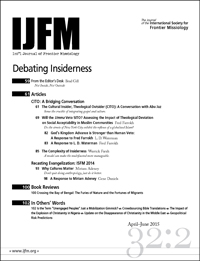
Introducing “The Complexity of Insiderness” (IJFM 2015)

IJFM<br />                          32_2An exciting new issue of IJFM was just released themed “Debating Insiderness” and with it the article “The Complexity of Insiderness.”

I want to point out a couple of features of the article:

  • It is a response to Farrokh and Abu Jazz’s articles in the issue (but also to missiology in general). Both have different understandings of the nature of insiderness. While I think Abu Jazz has a more sensible/realistic/healthy approach, both are still treating the issue in way that I feel is too basic. Thus, I’m advocating to at least recognize the complexity of insiderness. Yet it is actually more complex than I have described!
  • I also wrote the article as an introduction to the phenomenon of insiderness, so that someone with a basic understanding of the issues could quickly see what is happening in the world of mission today.
  • One could think of the model as an I-Scale (Insiderness) à la the C-Scale, but I would prefer that not be the case.
  • I also don’t intend for anyone to say, “This is as far as we contextualize…” and then to refer to one of the expressions listed in this model as a kind of limit, because that would be betray the idea I tried to explain in the conclusion: “Since every context is different, we cannot assess all insiders with broad strokes nor evaluate all insiderness with the same criteria. What we say in hermeneutics also applies in missiology: “context is king.”
  • I tried to be as descriptive and neutral as possible, and then to put the “meat” in the footnotes. I think there are some good ideas in the footnotes. But still, I have been too brief and much more can be said. I’m looking forward to your feedback.

Read the whole thing: The Complexity of Insiderness (2015 IJFM 32:2)

Wednesday, August 5, 2015

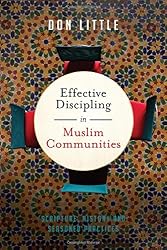
Effective Discipling in Muslim Communities, Don Little

From Amazon, Effective Discipling in Muslim Communities: Scripture, History and Seasoned Practices:

Muslims who come to Christ face momentous spiritual, psychological and social obstacles that drive many to abandon their faith. Often conversion and discipleship are framed by individualistic Western models that do not acknowledge the communal cultural forces that constrain and shape new believers. Effective discipleship requires a more relational, holistic process of Christian identity development and spiritual formation in community. In this comprehensive resource, missiologist Don Little engages the toughest theoretical and practical challenges involved in discipling believers from Muslim backgrounds. He draws on New Testament principles, historical practices and interviews with seasoned disciplers ministering in a dozen countries across the Muslim world. Addressed here are key challenges that believers from Muslim backgrounds face, from suffering and persecution to spiritual warfare and oppression. Also included are implications for the role of disciplers in church planting among Muslims.

In an email, author Don Little wrote:

As far as I am aware this is the first (and only) book on discipling believers from Muslim backgrounds (BMBs) that is more than simply one person sharing his or her experience.

Buy the book here. Kindle version to be released in a few weeks.

Monday, December 15, 2014

BMB Training Site

http://www.bmbtraining.org/:

Why have we created a website devoted to BMB discipleship?  It is because discipling BMBs is an urgent task.  We view discipleship as the task of helping believers grow in the likeness of Christ (Eph 4:15), maturing from new believers into active servants of God who can lead others (2 Tim 2:2).  We can see the urgency of the task from five different angles:

The Biblical Angle.  The biblical mandate is clear: make disciples of all nations (Matt 28:19-20).  If we merely make converts but then provide them with no means of discipleship, we do not obey Christ’s commission fully.

The Pastoral Angle.  New believers are like tender shoots that need care and watering in order for their roots to be anchored firmly in the ground.  This is the pastoral responsibility of mature believers who open their hearts and homes to BMBs.  Without this, disillusioned BMBs may turn away from the Christian community and even from the Christian faith.

The Sociological Angle. When Muslims turn to Christ, they experience a loss of social identity and often face difficult challenges in relating to their former Muslim communities.  Discipleship is the key process by which BMBs can learn how to live in their new Christ-centered identity and represent Christ to their former Muslim communities.

The Educational Angle.  Educational theory has demonstrated three areas in which people mature: the head (cognitive), the hands (behavioral), and the heart (affective).  We need to facilitate Christian growth in these three areas.  So, for example, a new believer should learn not only what Scripture teaches (head), but also put it into practice (hands) and come to love God more through the process (heart).

The Missiological Angle.  The future of missions among Muslim groups depends on the current generation of BMBs being trained in God’s word and sent out to train others.  If discipleship is ignored in one generation of BMBs, the next generation will lack a solid foundation for growth, an attractive Christ-like community and the motivation for spreading gospel witness to neighboring communities.

Discipling BMBs is an urgent task, and we hope this website will provide the tools for the task.

Wednesday, October 15, 2014

The Difference Between T4T and DMM

This is an informative 5 minute video from Roy Moran. (HT: Abdu Al-Musloob)

Saturday, August 9, 2014

“Discipleship” as Key Sound Bite for Communicating Biblical Mission

As someone who is involved in missions leadership, I understand the challenges facing evangelical sending agencies today in communicating vision, purpose, branding, and management. We all want to be unique, relevant, and Biblical.

I also understand that there are certain trends that rise and fall in the missions scene.  Church planting was all the rage a few years ago. And now it’s movements. Other trends include the rise of the term ‘transformation’ and the emphasis off the church and onto the kingdom.  This is related with holistic or integrated mission and on caring for the poor. Other long-lasting trends include the unreached or least-reached, and the use of metrics to evaluate our effectiveness. Of course every trend and emphasis has a way of highlighting only part of the nature of Biblical mission.

But is there a way for sending agencies to tie all of this together in a way that is not reductionistic?

Maybe. How about “discipleship?”

I’m interested all the talk these days on disciple-making movements. It might just be trend as well, but somehow I think that, as a necessary sound bite used in communication, it comes closer to recapturing the essence of what we’re doing across ALL contexts, more than church planting or integrated development or peace-making or proclamation or compassionate evangelism.

I want to commend Melanie McNeil’s Mission Paradigms: Is Discipleship Important? to you. It’s not an eloquent article (she’s a better writer than I am!), and I don’t agree with everything the says, but she makes a case of discipleship to be a key metaphor to reclaim Biblical mission in our world today (of course, discipleship has to be properly defined!).  From the conclusion:

We have explored the way the task of mission is described today by modern mission agencies, and I have argued that the reductionism of modern missions has resulted in a narrow definition of God’s commission. I have shown that the definitions of the task being used today fail to embrace the whole of God’s vision for the world he created. Whole life discipleship, the radical journey into relationship, and maturity of relationship with God is the core of God making his name known in the nations. God invites us to participate with His mission, and this will require a radical shift in the mission paradigms of today.

I have sought to demonstrate that such a shift opens up paths of radical transformation that impact both lives and communities, but it will come at a cost. The question is whether we in missions, and the Church, are prepared to count the cost and move into new things together with God, and with each other.

The review of methods and vision and mission statements here is not a judgment on any individual agency or strategy. It is a call for all of us who are disciples of Jesus Christ to embrace whole life discipleship and the radical rule of God in our lives and organisations.

Related Post: The Purpose (Vision) and Task (Mission) of Missions

Wednesday, May 1, 2013

“Narrative, Identity, and Discipleship” by Jens Barnett (2009)

Barnett, Jens. (2009), “Narrative, Identity and Discipleship”, in Musafir: A Bulletin of Intercultural Studies, 3:2, Dec 2009, pp3-5. DOWNLOAD

Narrative, Identity, and Discipleship is a brief article which examines our epistemological assumptions of discipleship among MBBs with special reference to socio-religious identity.

I appreciate Barnett’s willingness to grapple with the complexity of conversion and identity for MBBs while avoiding simplistic models and conclusions.

See also:

Saturday, March 9, 2013

How do you teach people to obey?

From Bill Mounce:

Jesus does not tell us to teach data; he commands us to teach people to obey what they are learning. How do you do that?

This is one of those questions that is more easily answered by saying what it is not.

  • Lecturing to a class does not make people obey.
  • Knowledge that doesn’t move to wisdom isn’t obedience.
  • The purity of academics, while essential to the process, is only half the process.

The only way I know to teach someone to obey is to do so in community, in relationship. Jesus preached to thousands but discipled 12, and it was those 12 who turned the world upside-down by fulfilling the Great Commission through the power and leading of the Spirit.

Monday, February 6, 2012

Miraculous Movements: How Hundreds of Thousands of Muslims Are Falling in Love with Jesus

51VP7SzLUHL__SS500_

You’ve probably heard of the CPM that has been happening among Muslims in East Africa by now.  Thankfully, they have put many of their stories and lessons learned in a book.  I just started reading an advance copy it looks really promising. You can pre-order on Amazon-> Miraculous Movements: How Hundreds of Thousands of Muslims Are Falling in Love with Jesus:

How do the people most resistant to the transformative power of the gospel come to be its most devoted followers? Miraculous Movement recounts an amazing change taking place within Muslim communities where the truth of Jesus Christ is turning around the lives of many thousands of Muslims from more than twenty people groups. Discover through the sometimes humorous, often sobering, but always enlightening and encouraging true stories how imams, sheikhs, and entire mosques are forsaking Islam and embracing Christ.

This close look at what the Lord is doing to spread the gospel highlights the key scriptural principles that help Christians reach out in love to share the gospel in their own community. The authors outline the principle of service to others that open doors of opportunity to the work of the gospel.

Author Jerry Trousdale works with CityTeam Ministries, an organization dedicated to helping disciples make disciples through CityTeam's own ministry and through training other ministries in more than thirty countries.

Features include:

  • Outlines important principles on how to share the gospel with non-Christians
  • Explains how ordinary people can lead neighbors to Christ in love and humility
  • Tells many exciting and encouraging stories of Muslims who have accepted Jesus
  • Describes CityTeam's unique program focused on God's work through disciple-making movements, a strategy that harnesses the power of disciples making disciples and churches planting churches

Endorsements:

With Miraculous Movements, Jerry Trousdale and his colleagues at CityTeam have made an invaluable contribution to the body of Christ!

-David Garrison, PhD Author: Church Planting Movements

As a church planter for the last 10 years, our family has made it our mission to go where no one else wants to go. This book, Miraculous Movements, very much aligns with this mission of getting to know the community around you and then sharing the teachings of Jesus rather than trying to go in and hope people come to a church or, in some cases, a home church, just because you set up shop. This book shows how to attract people to follow Christ, not try to convert them to simply know Christ. If you want to read stories that will change the way you think about church plants and churches built outside our Western models, this is the book for you. Whether you are a church leader or a person who is curious to see what God is up to in other parts of the world, you won’t be disappointed.

-Charles Hill, Church Planter, National Speaker

Thursday, October 13, 2011

New Apologetics Website for MBBs

www.unchangingword.com:

Evidence for God's Unchanging Word is a network of Jesus' followers from across South Asia. We are committed to promoting the seldom-heard evidence for the reliability of God's Word. We believe that God has spoken to mankind through his unchanging Written Word, and we promote the neglected Taurat, Zabur, and Injil. We believe that the Qur'an testifies clearly to the eternal validity of these Scriptures and to the unique role of Jesus as sinless "Messiah" or Savior and Living Word of God. It is through Jesus that we have experience forgiveness and reconciliation with God, and a new meaning and motivation for life.

We are committed to accurately following the Scriptures, not man's cultural traditions. Just as Jesus was wrongly opposed and condemned by Jewish religious authorities, so too Jesus' authentic followers throughout history are regularly condemned by both Muslim and Christian clerics alike, clerics who too often are more concerned with their narrow cultural traditions than with bold obedience to God's Word. Jesus didn't call himself Christian or Muslim, and his followers simply called themselves "the Way."

Monday, June 20, 2011

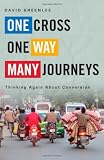
One Cross, One Way, Many Journeys, Greenlee

“How we conceive of conversion determines how we do evangelism.” –Richard Peace

This post is a summary of One Cross, One Way, Many Journeys: Thinking Again about Conversion by David Greenlee.  Greenlee did his PhD Dissertation in the 90s on conversion from Islam.  This concise book (152 pages) shares experiences of MBBs, but also includes examples from American, Asian, Latino, Hindu, Buddhist, Diaspora, and European contexts.

Below is a short summary of each chapter:

  1. Starting the Journey: People can “come to Christ” i.e. “get saved” i.e. … in an instant (Paul), or through a process (the Disciples).  Conversion includes cultural, social, spiritual, and political complexities involved in a person’s turning from sin towards God’s saving activity in Christ.  [I would add that conversion is different than regeneration. Regeneration is a work of the Holy Spirit, and conversion refers to man’s experience and interpretation of that act.]
  2. Inside Out or Heading Home?:  “Bounded set” Christianity understands that people must accept a list of new doctrines and usually also a foreign culture before they are considered “Christians.”  You’re either inside or you’re out.  But in “centered set” Christianity, what matters most is that people are pointed and moving towards the center, Jesus.  Bounded sets are very difficult for people on the “outside” because they are reluctant to jump inside- to become like one of “them.”  By contrast, centered sets illustrate that we’re really just trying to meet people where they are and get them to turn (and move) toward the center, Jesus.  “I am convinced that the key question is not how much we know but who we know.  What counts is not being inside certain boundaries of knowledge and behavior [which could actually give false assurance to “insiders”], but - by faith - being pointed to Christ” (11).  (Obviously also, it is better to be closer to Christ than further away.)
  3. Conversion at the Core: Beliefs are important, but you could have correct knowledge and still have repulsive feelings about Christ.  Or perhaps you could have the right beliefs and feel love for Jesus, but not actually have a commitment to him.  These are the the three levels that make up a worldview (from Hiebert); 1. Cognitive (beliefs, knowledge), 2. Affective (feelings, beauty), and 3. Evaluative (allegiance, commitment).  We need to foster three-dimensional conversion; transformation (the goal of conversion) only happens when all three levels are impacted.
  4. Groups, Families, and Anyone who Believes:  Conversion is an individual event, but can also happen simultaneously in groups.  “Church planting movements almost always spread through webs of family relationships” (47).  We need to foster conversion within and throughout social networks.  Most cultures are not as individualistic as the postmodern West.
  5. Congruence, Conversion, and Christian Witness:  The HUP (Homogeneous Unit Principle) famously coined by McGavran observes that people like to become Christians without crossing racial, linguistic, or class barriers.  The HUP claims that the call for ethnically heterogeneous churches actually inhibits the growth of the church and does not fully allow for fully indigenous expressions of faith.  Although it has some value as a sociological principle and a communications tool, the HUP has been widely criticized as a strategy and a method that falls short of the biblical practice and teaching of community.  “I suggest that… the Congruence of Cultural Values (CCV) principle gives a more adequate description of how God is at work than does the HUP” (55).  The CCV says that “people are more likely to come to faith when their own cultural values are significantly congruent with the cultural values of the witnessing Christian community and the means of communicating the gospel” (55).  You can foster similar cultural values without forcing ethnic homogeneity.
  6. Who’s to Judge? Looking in From the Outside:  Doctrine is vital to spiritual health and faithfulness, but “outsiders” should be very careful to judge (but we should discuss and engage them) “insider movements,” i.e. fellow believers who are trying to remain in (not extract from) their socio-religious context.  “Not all who are “in Christ” will express their faith in the same way that you or I do” (83).  As for contextualization, “I suggest, then, that Paul’s self-identification and intercultural practice as here briefly summarized point to what should be our emphasis and our limits: missionary outsiders who identify with the people we serve while maintaining a clear identity in the One we serve” (82).
  7. Worthy Witness: There is a clear difference between proselytism and evangelism.
  8. Fathoming the Unfathomable: Conversion is mysterious work of God and can never be fully understood.  But we can look at conversion through seven (dim) lenses to help us: psychology, behavior, sociology, culture, spiritual warfare, the human communicator, and God’s underlying role.  “None of these aspects gives us the full picture, but each emphasizes characteristics that get overlooked when we examine conversion for other perspectives alone… Properly understood and grounded in Scripture, these lenses… can help us gain new insights into how God is at work in conversion.  In turn, these insights can help us grow in faith and be more fruitful in ministry” (102-3).
  9. Conversion, Politics, Power, and Transformation: Conversion has undeniable political consequences (but we decry conversion for political reasons).  “If society perceives itself to be under threat, it is likely to resist a religion identified with the threatening society” (115).  But a new religion is likely to spread if it “offers a resource to leaders or to people as a whole in resisting threats to continued existence” (116, quoting Montgomery). [I would love to explore this further. Very interesting.]
  10. The Defeat of Darkness and Deception:  “Conversion is a spiritual battle that involves a change in allegiance that may include the breaking of overt demonic power in our lives” (136).  “We have a glorious eternal hope whether the battle is hidden or obvious, theological or physical, even in the face of overwhelming odds” (139).
  11. Becoming the People of God: We are not just converted to Christ, we are also converted to his body, the church.  “Becoming this God-praising people, not just saved souls in isolation, I believe is central to the goal of conversion and the purpose of God as we come to, and grow in, faith in Jesus Christ” (150).  [I would add à la Jonathan Dodson that we are also converted to mission.  See The Three Conversions.  This concept would have nicely rounded out the book.]

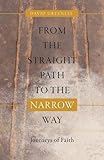
Greenlee has also edited From the Straight Path to the Narrow Way, which is a series of articles and studies that investigate the phenomenon of conversion of Muslims to Christ.

Monday, April 18, 2011

Vision for MBB Discipleship

Don Little says, “Part of the reason for our poor success in discipling BMBs [Believers from Muslim Backgrounds] has been that we have had an inadequate understanding of how discipleship works and what is the objective of discipleship. When our discipleship vision is weak then our practice will also be weak.

So, what is the vision for discipling MBBs?

From Little’s Effective Insider Discipling: Helping Arab World Believers From Muslim Backgrounds Persevere And Thrive In Community, pg. 227:

We endeavour to see believers from Muslim backgrounds (1) living in loving mutual submission within believing church groups that (2) experience together the transforming grace of God through the presence and power of the Holy Spirit. (3) They live their lives together in submission to the scriptures and in obedience to their Lord, (4) developing individual and corporate routines that fortify their faith (5) so that their worldviews are transformed in ways faithful to the reality of the great biblical story of creation, fall and redemption. (6) Further, they live out their faith in obedience to Christ in ways suitable to their culture and society. (7) Growing increasingly into Christ-like holiness together, (8) they compassionately serve and (9) reach out with the gospel to people in their families, social networks, communities and beyond, bringing Glory to God (10) as they grow and multiply.

Friday, April 15, 2011

Different Views Concerning Relationships and Money

Financial issues are the most difficult thing I have experienced in discipling MBBs.  I found the table below to be very helpful.  I wish I would have seen this a couple years ago.

From the new Perspectives edition (2009), page 483, by Joseph Cumming:

Muslim and Western views on money can be very different.  These observations apply not only in Muslim cultures, but in many places of the non-Western world.

Muslim

Westerner

All true friendships involve a financial element. The healthiest, happiest friendships are those where money does not change hands.
The way to refuse giving should not be by saying, “No.” The refusal must be indirect, so there is no embarrassment to the one asking. It is appropriate to be truthful and say, “No.”
Rules should be honored, but to show mercy is more important because of the high value of maintaining good relationships. Rules are rules. Period.
When you request and receive financial assistance or help with a job or strings pulled with government bureaucracy, this places certain obligations on you.  You must become a loyal supporter of your patron. A supporter only within ethical and moral boundaries.
If a needed person receives gifts for a particular need, and then an even more pressing need arises, then it is legitimate to use those gifts for a the more pressing need. This is morally wrong unless explicitly authorized by the donor.

From an article by Joseph Cumming of Yale University, inspired by David Maranz’s book African Friends and Money Matters.  Cumming has lived 15 years in a Muslim country.

Tuesday, April 12, 2011

The Dirty Little Secret of Missions

“The dirty little secret of missions is that we are sending missionaries all over the world who have not demonstrated the ability to make disciples who can make disciples.”

-Rick Wood, A Discipleship Revolution: The Key To Discipling All Peoples

Monday, March 7, 2011

A Revolution in Church Multiplication in East Africa

Here is an excerpt [for the excerpt click on the link] of a DMin dissertation called, A Revolution in Church Multiplication in East Africa.  The entire paper can be downloaded from that link as well.

Saturday, December 4, 2010

Seven Themes of Fruitfulness

Here is a short article that summarizes the key fruitful practices of kingdom workers who have planted at least one fellowship among Muslims.  From IJFM Summer 2009 Seven Themes of Fruitfulness by Eric Adams, Don Allen, and Bob Fish: 

These seven themes emerged in an inductive study of our data and our participants. We compared the technical statistics from our survey and key themes from the 115 interviews we conducted with fruitful workers (those who established at least one fellowship). We then highlighted those themes (such as orality and social networks) which are crucial for fostering movements, but are sometimes overlooked by western workers. Here, then, are these seven themes.
  1. Fluency - Effective workers are dedicated to be fluent in language and culture.
  2. Storying - Effective workers employ a strong use of storying throughout their ministry. In fact, storying is often tied with language.
  3. Reputation - Effective workers seek to maintain a valued reputation in the community.
  4. Social Networks - Effective workers maintain a focused involvement in existing social networks.
  5. Scripture Use - Effective workers seek to use the Scriptures in a variety of ways for the local context.
  6. Intentional Reproduction - Effective workers take what they learn and apply it to their life and to their community and pass it on to someone else.
  7. Prayer - Effective workers engage in regular disciplined prayer.

Read the whole thing (7 pages).

Sunday, November 14, 2010

What are the Indications that a Muslim Has Left the Kingdom of Darkness?

From the website of Greg Livingstone, under the Ministry Issues tab, What are the Indications that a Muslim Has Left the Kingdom of Darkness?:

What are the indications that a Muslim has left the Kingdom of Darkness and entered the Kingdom of God’s Beloved Son? I.e., ‘been born again’? Indwelt by the Spirit? Clearly become an obedient follower of Christ Jesus?

  1. S/he has come to understand the facts re: Who Christ Jesus is, and what He was accomplishing in His visit to the earth-the ONE sent from Allah to ransom him, bringing him acceptably to God.
  2. S/he has faced up to fact that he has been a rebel, demanding his own desires, and despite carrying the title, “muslim”, ignoring, not truly submitted to, Allah.
  3. Confessing his sin in heart felt repentance for his disobedience, then determining to look to Allah to change him
  4. Coming to understand that he must rely on the Sacrifice of Christ on the Cross as a subsitutionary atonement.
  5. S/he should memorize the titles attributed to Jesus in the N.T., i.e. “Lord of Glory”.
  6. Recognize that Christ is alive, having broken the power of death, and that he is returning to rule the world in peace, removing all suffering.
  7. He is determined to know what God wants through the Scriptures, and to obey, and practice everything Christ and His apostles taught. “God said it, I believe it, that settles it”.
  8. Daily asks what does God want…
  9. Called to new community UMMA, and is determined to live out the “one another” commands demonstrating the difference Christ living in him will make, as a witness.
  10. Desires to forgive those who offend him, and help believers who need reconciliation.
  11. To love his neighbour by seeking to bring them also into Christ’s Kingdom
  12. Understands it has been granted to him not only to believe, but also to suffer for His sake, therefore he will confess Christ as his Saviour and Master.
  13. He lives as a ‘good steward’…“seeking first the Kingdom of God”, i.e. to discover his gifts and role in establishing need-meeting house churches where Christ is not known.

Here is a nice video chronology of the Livingstone’s 50 year ministry.

Thursday, October 7, 2010

Effective Insider Discipling: Helping Arab World Believers From Muslim Backgrounds Persevere And Thrive In Community

Someone recently emailed me a DMin Thesis titled, “Effective Insider Discipling: Helping Arab World Believers From Muslim Backgrounds Persevere And Thrive In Community.”  I have found it to be intriguing, edifying, and highly relevant to the purpose of Circumpolar. 

It is a lengthy read (279 pages), but the conclusion is only about 20 pages and very helpful.  The paper gives a robust model of discipleship for MBBs and much practical advice concerning many of the thorny issues we face in our context.

If you would like a copy emailed to you, post a comment below with your email (you can delete it later).  I might ask you a couple questions before I actually email it to you.  The author (not me) does not want it posted on-line.

Here is the Abstract:

Around the world many Muslims are being introduced to Jesus Christ and choosing to follow him. Of the many challenges in this ministry to Muslims, one that is being increasingly seen as crucial, is the discipling of these men and women who are trying to live as disciples of Christ in their Muslim communities.

This research into the discipleship of Arab world believers from Muslim backgrounds (BMBs) is first placed in the missiological context of the ongoing debate on contextualization in ministry to Muslims. The author then provides exegetical and theological grounding for his research through an examination of discipleship in the New Testament, and missiological and methodological grounding through a review of the literature that addresses ministry in Muslim contexts.

Then, in the fourth chapter, the author analyzes the findings from seventy-five interviews that he conducted with disciplers ministering to BMBs in twelve countries. The analysis covers the nature and processes of discipling, the obstacles and challenges of the Arab world context, community and identity issues in discipleship, and ways of handling common discipleship challenges.

In the final chapter, the author draws his conclusions together into his Living Pyramid Model of Relational Communal Discipleship and highlights some of the great practical advice obtained for overcoming key discipling challenges. He then offers suggestions for further research and suggests some possible benefits from the study to those ministering to the Muslims of the Arab world and beyond.

Wednesday, August 18, 2010

Developing a Biblical Missiology Among Muslims

The blog Biblical Missiology posts a set of questions that the missions committee at Bethlehem Baptist Church (Piper’s Church) uses when considering supporting a missionary.  For the most part, answering these questions, plus maybe a few others, would amount to forming a Biblical missiology for working with Muslims:

    1. How will you help a new believer express his identity in Christ within his community?

    2. In your ministry context, what aspects of the local culture may be retained and which aspects must be rejected?

    3. As a minister of the Gospel, how will you communicate your identity in Christ to those among whom you seek to minister?

    4. How will you communicate the identity of Jesus in the language and culture of the context in which you minister?

    5. What will cross-bearing look like for new believers in your context? Are new believers truly ready to suffer for Christ? How will you prepare them?

    6. How will you present the gospel in such a way that Jesus is the stumbling block (not cultural practices, leadership style, dress, customs, habits)?

    7. How will you proclaim the gospel with gentleness, respect, and with all boldness in your host context (especially in highly restricted areas)?

    8. How will you demonstrate the supreme and exclusive authority of the Bible among peoples who revere other sacred texts as supreme authority?

    9. How will you instruct the new believer in Christ regarding his relationship to his community and mosque?

    10. How and when will you distinguish the intrinsic differences between God as he is revealed in the Bible and as he is written about in the Qur’an?

Some of these questions appear to assume that the foreign missionary should tell the MBB what to do.  E.g. #9 could have been worded better.  However, it is often unavoidable that we will be asked questions like this, and most of these questions hit at core issues we face everyday. 

What questions do you think need to be modified? Are there any other questions you think would be crucial or helpful for developing a biblical missiology among Muslims?

Tuesday, July 20, 2010

Transformation and Imagination

From Jon Hirst:

There is a lot of talk about transformation these days. It speaks to the yearning in believer around the world to go beyond head knowledge or behavioral adjustments to a deep and lasting change that allows us to be incarnational in our ministry to others.

But where does transformation begin? What launches transformation in our hearts? I was reading a post in the Lausanne Global Conversation from a friend of mine, Pauline Hoggarth, and she hit on this very question.

In her post about the ongoing Ephesians study that will be central to the Cape Town 2010 event, she said, “…metaphors function at the level of our imagination and it’s in our imagination that the process of transformation begins. Our imagination engages the cogs of our will to bring about transformed behaviour and attitudes.”

She was talking about the use of metaphors in Ephesians and the power they have to engage us and transform us. I had never thought of how our imagination is where the first stirrings of transformation are found but it rings very true.

Think about it . . . as you go about your Christian walk, there are moments when God stirs in you a new idea or understanding of Him and what obedience looks like. Your imagination propels you forward to consider the idea further and then to act on it.

But capturing the imagination is not something we often focus on in evangelism and discipleship is it? We have tended to focus on propositions and ideas or on emotions and fears. What would it look like if you strived to capture people’s imaginations in order to launch them into transformation?

Related Post: