Showing posts with label Anthropology. Show all posts

Tuesday, April 23, 2019

Is the concept of “worldview” still useful in missiology?

Conversion (coming to faith in Christ) as a “transformation of worldview” is practically canon in evangelical missiology, especially with the publication of Paul Hiebert’s Transforming Worldviews: An Anthropological Understanding of How People Change (Baker Academic 2008).

But does contemporary anthropology still use the concept of worldview today?

In his review of Kraft’s book, Worldview for Christian Witness (William Carey Library 2008), Wheaton professor of anthropology Brian Howell said:

Although the worldview concept has become mainstream in missiological circles, it is virtually defunct in use in contemporary anthropology. Kraft uses Michael Kearney’s 1984 book on worldview as the anthropological example; however, there is no anthropological reference more recent than that. Classic anthropology can still speak to us today, but there is a great deal more current theory that is helpful for understanding culture change.

So should we move on from the concept of worldview? Is it really defunct in anthropology? David Beine, in his short research article, The end of worldview in anthropology?, (SIL Electronic Working Papers 2010) concludes with this:

The worldview concept, although no longer in vogue in the dominant paradigm of American anthropology, has remained a fruitful construct of analysis over the past decade for several other valid anthropological paradigms. There seems to be agreement among those still using worldview effectively as an analytical framework, that cultures—if I can
still use that word—do have central ideas or themes that serve to organize a wide variety of things, from material culture to political behavior. And recognizing the limitations, worldview is still a valuable construct for studying and representing these ideas. In the end, I hope the rest of
us anthropologists will not throw the baby (worldview) out with the bathwater (valid concerns of about essentialism); I would rather that those most concerned just help us change the dirty diaper.

It seems to me that the worldview concept can still be employed, but it is wise to note, as Howell reminds us in his review, that “concepts of hybridity, global ethnoscapes, and practice theory-based approaches to agency yield more nuanced understandings of cultural change.”

And yet, despite the ways they are often used in missiology, worldviews and cultures do not have discrete boundaries in today’s globalizing world.

Wednesday, March 6, 2019

My Two Recent Articles in EMQ and IJFM

I currently have two articles out at the moment in EMQ and IJFM.

The first is with EMQ and if you are a member of Missio Nexus (most North American agencies are with Missio Nexus, and if your org is a member then you are too), then you have access. If not, I’ll make it available in April. It is called Outlining a Biblical Theology of Islam: Practical Implications for Disciple Makers and Church Planting and is something I wrote as a kind of promo piece for the annual Middle East Consultation in Beirut, Lebanon (I’ll be giving two keynotes this year). Here are the topics I have paired together in the EMQ article:

  • Religion and Kingdom Sociology
  • Biblical Anthropology and Idolatry
  • Prophecy and Muhammad
  • Revelation and the Qur’an
  • Christocentric Doxology and Allah

It is obviously a lot to discuss in just over 3,000 words (EMQ’s limit), but these are the major themes that need consideration in our theology of Islam.

The second article is Adaptive Missiological Engagement with Islamic Contexts at IJFM. This is also Chapter 17 in our book Margins of Islam: Ministry in Diverse Muslim Contexts. Here is my outline for the article:

Changing Understandings of Muslim Contexts

  • Postcolonial Studies: “The Muslim World” vs. “The West”
  • Cultural Anthropology: Modern Essentialism and Postmodern Relativism
  • Religious Studies and the Fog of “Religions”

A Call for Adaptive Missiology

  • Towards a Missiology of Islam(s)
  • Idolatry and Mission
  • Transforming Relationships

This is a longer article that deals with epistemology and issues which inevitably color our approaches to reaching Muslims.

Let me know what you think in the comments below.


Monday, October 8, 2018

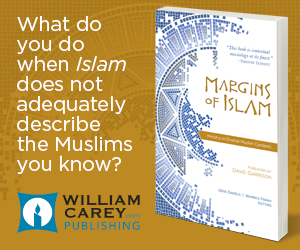
Introducing our New Book | Margins of Islam: Ministry in Diverse Muslim Contexts

On behalf of Gene Daniels, I’m excited to introduce our new book Margins of Islam: Ministry in Diverse Muslim Contexts. Here is the book description:

What do you do when “Islam” does not adequately describe the Muslims you know? Margins of Islam brings together a stellar collection of experienced missionary scholar-practitioners who explain their own approaches to a diversity of Muslims across the world. Each chapter grapples with a context that is significantly different from the way Islam is traditionally presented in mission texts. These crucial differences may be theological, socio-political, ethnic, or a specific variation of Islam in a context—but they all shape the way we do mission. This book will help you discover Islam as a lived experience in various settings and equip you to engage Muslims in any context, including your own.

One of the most succinct and descriptive endorsements comes from Timothy Tennent, President of Asbury Theological Seminary:

In a marvelous tour de force, Margins of Islam exposes the widely held, but false assumption that the house of Islam is a monolithic religious entity which either resists or responds to missiological strategies. Collectively, these authors offer up case studies and rich and textured “on the field” experience which reflects the true variegated diversity of Islam. This book is contextual missiology at its finest.

The project was the brainchild of Gene Daniels. I vividly remember sitting next to him on a bus discussing it with him on our way to a conference center from a hotel a couple years ago. His big idea was to gather missionary scholar-practitioners serving in various Muslim settings to explain how they take context seriously and how they deal with the phenomenon that we call “Islam.” I was genuinely surprised and honored when he asked me to be his coeditor!

We immediately started networking and looking for contributors. Gene already had several people in mind. My job was to help edit each chapter and then to produce a concluding chapter that explained the themes of the book. It was a rich learning experience. As I researched for the book, I found myself often disagreeing and pushing back on evangelical treatments of Islam.

My criticism began to take shape and eventually became an introductory chapter—most evangelical missiological treatments of Islam are reductionistic with what I call a “top-down” approach, meaning that Islam (and subsequently, Muslims) can be adequately understood by addressing the Qur’an, hadith, and history of Islam. From this textual understanding, it is assumed that Muslims believe what Islam teaches, and thus there is a “Muslim worldview” and strategies on how to engage it. In this framework, Muslims are often simplified as cultural and spiritual clones of one another.

Many workers have read books based on this top-down approach, but when they begin to engage Muslims in their context, they quickly discover that the Muslims they are working with believe very different things from what “Islam” teaches. While the top-down approach is incredibly valuable, it can also distort our understanding of Muslims if it is our only lens. We also need a “bottom-up” approach that explains the historical evolution of the Islamic phenomenon and the sociological perspectives that accounts for the diversity of Islam today. Ergo my chapter two: How Muslims Shape and Use Islam: Towards a Missiological Understanding.

As I was editing the chapters (which do a wonderful job of combining the top-down and bottom-up perspectives) and after I wrote the introductory chapter, I started to reflect on how recent developments in postcolonial theory, anthropology, and religious studies have influenced mission to Muslims. Gene and I later decided that I would write a theory piece again for a concluding chapter which I titled Adaptive Missiological Engagement in Islamic Contexts. Gene then did a masterful job tying the themes of the book together in the final chapter, “Conclusion: Learning from the Margins.”

Here are the contents of the book:

Foreword, David Garrison

Introduction, Gene Daniels

PART 1: CONCEPTUALIZING ISLAM

1 Who Represents Islam?, Evelyne A. Reisacher

2 How Muslims Shape and Use Islam: Towards a Missiological Understanding, Warrick Farah

PART 2: ENGAGING MUSLIMS

3 The Donkey and the Straw: Reaching South Asian Sufis with the Gospel, Kevin Higgins

4 Secular Muslims in Bosnia and Herzegovina, Ted Esler

5 Egalité, Fraternité, and Cous-cous: Ministry to Muslims in the Context of a Resurgent Islam and French Laïcité, Rick Kronk

6 Biblical Approaches to the Nurcu Gülen Movement in Turkey, Yakup Korkmaz

7 Magical Mystical Muslims: Sufi-oriented Islam and African Traditional Religion, Robin Dale Hadaway

8 Ordinary Muslims in Pakistan and the Gospel, Warren Larson

9 Ministry to Hui Muslims in China: An Approach to Dual-layered Cultural Settings, Enoch Jinsik Kim

10 Context as Flypaper: The Island of Java in Indonesia, Michael A. Kilgore

11 Liberating Liminality: Mission in the North African Berber Context, Patrick Brittenden

12 Russified Muslims of the Former Soviet Union, Gene Daniels

13 The Queen’s Muslims? Muslim Identities in the UK, Phil Rawlings

14 In the Shadow of a Buddhist Temple: Muslims in Thailand, Alan Johnson

15 Uyghurs of the Tarim Basin: Muslims in Northwestern China, CG Gordon

16 Muslim Youth in a Glocal World, Arthur Brown

PART 3: REFRAMING MISSIOLOGY

17 Adaptive Missiological Engagement with Islamic Contexts, Warrick Farah

18 Conclusion: Learning from the Margins, Gene Daniels

As our endorsements were rolling in, one from JD Payne stood out in particular that helped us identity the biggest potential takeaway from this book:

Margins of Islam takes readers on a global journey revealing the multiple expressions of the Islamic faith… We no longer have any excuse to train others to reach all Muslims in the same way.

I want to thank Gene for this incredible opportunity, and also for our excellent group of contributors who have taught me so much about the variety of Muslims and the varieties of biblical mission in the world today. Go ahead and buy the book on Amazon, and please help us spread the word—you can easily share this from the button on the bottom of the post on the blog. Thank you for considering! We feel this volume represents a significant encouragement for the mission of the church.

SM Post 1

Friday, May 18, 2018

What is sharia law?

From The Sociology of Islam: Knowledge, Power and Civility (p. 79-80):

Based on a Qur’anic keyword meaning the “straight path,” the sharia was first elaborated by Muslim scholars as a philosophical and theological rather than a strictly legal concept (W.C. Smith 1962).

Yet over time and by virtue of the force represented by the rising importance of Sufism as a discipline stressing the inner truth, the sharia, as much as it was seen as the manifestation of divine Will (shar`), also came to represent the outer dimensions of the ethico-religious code of Islam. The sharia happened to be identified with the more systematic dimension of the Islamic normativity, the one that could be formulated in terms of legal norms which, in turn, would be liable – to a not yet exclusive extent – to be enforced. Apart from this technically legal dimension, the sharia covered a comprehensive concept of norm, which included ritual and dietary rules, as well as rules about family, commerce, and social relations more in general. However, this normative idiom, reflecting basic values of humanity, justice, and equality, never became a code in the sense of a closed (and univocally ‘searchable’) text. It rather preserved an inherent, inner pluralism and contestability in the form of a cumulative tradition articulated in translocal schools and local, contextualized sets of practices variably drawing from most pre-Islamic customs.

This is why the understandings of sharia and related practices have been historically dependent on the types of knowledge and the varieties of culture prevalent on a local scale, as well as on the degree of social contention and reconstruction that they authorized. The convergence between concretely practiced Islamic jurisprudence and the idea of sharia was therefore a diversified, gradual, and (at least till the colonial era) never fully accomplished process… Modern attempts to systematize and implement sharia, whether associated with ‘liberal’ and ‘reformist’ or with ‘fundamentalist’ and ‘puritan’ interpretations (all labels that, originating in Western history, should be taken with a grain of salt), have been hardly able to extinguish its historic dynamism. Yet they certainly contributed to obfuscate the consciousness of this dynamism among a mass public, which in the colonial and postcolonial eras has been more prone to appreciate its new rigidified contours.

It is a myth to assume that sharia is a universal, coherent legal code that is ready to be applied. Any missiological approach to Muslims that claims sharia is some sort of spiritual force that means the same thing to all Muslims everywhere has not done enough contextual analysis.

Wednesday, February 7, 2018

Jesus Christ as the Patron for Muslims | 5 Min Video

Here is an excellent video from Richard Yacoub that explains the implications of patronage for ministry with Syrian refugees. Applications extend to many other contexts as well.

In an earlier article, I said this about the Patron-Client Gospel for Muslim conversions:

Hanaan grew up very disillusioned with the hypocritical lifestyles of some fundamentalist Muslims she knew. One night a man in a brilliant white robe holding a staff appeared in her dream and told her that she was correct to doubt Islam. The next morning she described this event to her loving and devout Muslim father, who told her the person from her dream was Isa al Masih. Eagerly she went to the Qur’an and read everything she could about Jesus, who continued to show up in dreams for many years at key moments in her life.

According to her testimony, Hanaan joined herself to Jesus long before she met another Christ follower who studied the Bible with her for the first time. Like Hanaan, MBBs appear to bond themselves to Christ in a patron-client relationship as they initially begin to understand His lordship and even the atonement.

A biblical, missiological view of conversion must take into account the social context of the first century Mediterranean world (Asia and Africa are much closer to this worldview today than is the West). Relationships were conceptualized around the concept of “patronage,” where “they saw their gods as patrons and benefactors and their own conduct as clients” (Crook 2004, 254). “In this hierarchical society, where the status of the person you follow and to whom you give allegiance is very important, the position of Isa becomes the focus of reconsideration” (Edwards 2013, 84). MBBs relate to Christ in ways that are difficult for Westerners to understand, but make sense in their worldview. Yet this understanding of salvation is commonly found in the writings of the Apostle Paul. Christ is our ultimate Patron (the Divine Lord), we must be found “in him” and part of the new people of God.

See also http://honorshame.com/patronage.

Monday, June 12, 2017

Challenging the Concept of “The Muslim World”

Contrary to widespread assumption, the term “Muslim world” does not derive from ummah, a concept as old as Islam, which refers to the Muslim religious community. Instead the idea of the Muslim world began to develop in the nineteenth century and achieved full flower in the 1870s. Also mistaken is the belief that Muslims were united until nationalist ideology and European colonialism tore them apart. This is precisely backward; in fact, Muslims did not imagine belonging to a global political unity until the peak of European hegemony in the late nineteenth century, when poor colonial conditions, European discourses of Muslim racial inferiority, and Muslims’ theories of their own apparent decline nurtured the first arguments for pan-Islamic solidarity. In other words, the Muslim world arrived with imperial globalization and its concomitant ordering of humanity by race. The racialization of Islam was bound up with its transformation into a universal and uniform religious tradition, a force in international politics, and a distinct object in a discourse of civilizations. Political strategy and intellectual labor made this new reality, and both Muslims and European Christians took part.

Aydin, Cemil (2017). The Idea of the Muslim World: A Global Intellectual History (Kindle Locations 91-99). Harvard University Press.

See also: How the Muslim World Was Invented

Saturday, December 14, 2013

Theology, Gospel Missions, and Insider Movements, by Nabeel Jabbour

[UPDATE: Jabbour is not the only writer of the document. See Joel’s comment below.]

Here is a resource that is worth perusing for a while (HT: MH).  230 pages long.

A CALL TO FAITHFUL WITNESS
-PART TWO –
THEOLOGY, GOSPEL MISSIONS, AND INSIDER MOVEMENTS

A PARTIAL REPORT (PART TWO OF TWO PARTS)
OF THE AD INTERIM STUDY COMMITTEE ON INSIDER MOVEMENTS
TO THE FORTY-FIRST GENERAL ASSEMBLY OF THE
PRESBYTERIAN CHURCH IN AMERICA
MARCH 20, 2013

By Nabeel Jabbour (See also www.nabeeljabbour.com)

Nabeel JabbourAmong his other works are The Crescent Through the Eyes of the Cross: Insights from an Arab Christian and The Rumbling Volcano: Islamic Fundamentalism in Egypt.

Sunday, March 24, 2013

Exegeting Culture with Lingenfelter

For those who want to be be able to exegete their context and the cultures they live in, including their own, I recommend Transforming Culture: A Challenge for Christian Mission (1998) and Agents of Transformation: A Guide for Effective Cross-Cultural Ministry (1996).  Transforming Culture lays out the blueprint of culture and the roots of cultural bias, and Agents of Transformation goes deeper and provides tools for analysis.

According to Sherwood Lingenfelter, there are five “social games” people play based on their culture and personal bias (1998). This theory is based on the “grid-group” classification of cultures proposed by Mary Douglas. The classifications run along a continuum and the two axes are plotted against each other to form four dimensions. The “grid” dimension describes the place and role of individuals, and the “group” dimension describes the degree of social solidity. In weak grid cultures, people can interchange roles easily and are more homogenous in their place in society. In strong grid cultures, people are distinguished and classified according to roles, and there is a sense of entitlement. In weak group cultures, people are more isolated from each other, whereas in strong group cultures there exists a strong sense of unity and people are bonded together.

The first culture, Authoritarian (the Social Game) and Bureaucratic (the Environment), is a defined by weak group, strong grid. Here there are great differences between people, but they do not feel close together. The second culture, Hierarchist and Corporate, is defined by strong group, strong grid. This is the collectivist culture that feels a strong solidarity with one another, and each person has a defined place in society. The third culture, Collective and Egalitarian, is defined by strong group, weak grid. Here there is less difference between people, and they all share a common identity. The fourth culture, Individual and Individualist, is weak group, weak grid. In this culture, individuals are less controlled by a central authority, and each person is free to create her own identity. The fifth culture is known as Hermit or Autonomy and this person lives in isolation as a social dropout. Important to note is that all cultures play multiple games depending on the context, and each cultural above should be viewed as a “prototype” because in reality there are endless variants. “Each of these five social games is potentially present in every sociopolitical context, often in variant cultural forms… The individualist and hierarchist games are typically the central and dominant paradigms, while authoritarian and egalitarian games constitute border or peripheral options” (Lingenfelter 1996, Kindle Location 295 - 316).

According to Lingenfelter, a Christ follower is a pilgrim in the sense that she can serve the gospel while participating in any of the four social games above. “Once you have an understanding of your social values and the social games that you prefer, you will be able to identify the social roots of situations of conflict and tension and apply Scripture in an appropriate way to help you and others live transformed lives” (1998, 38). The Christian pilgrim’s goals transcend each culture because they oriented towards the Cross and serving others.

Lingenfelter’s main thesis…

“…is that Christian cross-cultural workers will desire to be agents of biblical transformation, rather than agents of sociocultural change. An agent of sociocultural change brings new economic, social, and cultural interests and facilitates the change process so that members of a local community adopt ways of education, economy, and lifestyle common to the industrialized nations of the world. While change agents may have a positive effect in the development of communities in the two-thirds world, and some Christian workers may legitimately serve in this role, the primary objective of much Christian cross-cultural ministry is to help people come to know Christ, and thereby to become his disciples” (Agents of Transformation: Kindle Locations 16-20).

These two books though are about more than just context analysis; they are actually a cross-cultural hermeneutic to understand Scripture.  Lingenfelter uses many Biblical case studies as examples and has challenged my thinking on many key issues of theology.  His writing style is dry, and the material is complicated, but Lingenfelter helps us include a much needed (albeit small) slice of anthropological theory in our missiology.

Thursday, November 8, 2012

One of my fears…

I have no shame in sharing that I’m a wannabe missiologist.  I suspect most readers of this blog are too, and we even have some official missiologists who subscribe to Circumpolar (Missiology is a dynamic academic discipline which examines the theories and practices of Christian mission as it relates to Biblical theology, history, and the behavioral and social sciences.). 

In any case, one of my fears is that my missiology will reflect the following (pg. 175) criticism of it, which is unfortunately descriptive of most evangelical missiology today:

[Missiology is] the marriage of mediocre anthropology and shallow theology.

No Lord, may it never be!

Wednesday, October 17, 2012

The Anthropology of Islam

From the introduction of The Anthropology of Islam, by Gabriele Marranci:

STUDENT: What is Islam?

ANTHROPOLOGIST: Lots of things, of course.

STU: Yeah, but I mean, is Islam its holy books or what Muslims do?

ANT: Neither, I suppose.

STU: Well, it should be one or the other for sure!

ANT: Why should it be so?

STU: I think that the Qur’an and Hadiths, and the other texts, tell Muslims how to be Muslims and this guides their actions.

ANT: OK, we can try an experiment. Get that copy of the Qur’an on my desk. So, tell me what this is.

STU: A book; a holy book, at least for Muslims.

ANT: What makes it holy?

STU: The fact that Muslims consider it so.

ANT: OK, but if you were a Muslim why would you have insisted that this particular book is the holiest?

STU: That’s simple Doc! Because, I would believe the book to be God’s words.

ANT: You see, Islam is not just what is written in its books.

STU: Why not? I don’t follow you.

ANT: Well, it’s very simple. You just said that this book, the Qur’an, is holy because at least one Muslim believes that God revealed it. Now you can agree with me that Muslims, each of them, have to perform cognitive operations to form a cognitive map of what for them is Islam. There is no Islam without mind.

STU: Certainly, you need Muslims to have Islam. Yet I still think that what is written in the sources of Islam shapes how Muslims are. Though there are some cultural differences, I am not sure about your point. I think that something called Islam actually exists.

ANT: OK, we will proceed point by point. Not only do we have different cultures among Muslims but also different interpretations. Which is the most basic element that you need to form interpretations?

STU: First, you need to know at least the language in which the text has been transmitted or trust a translation; but there are also other elements, like personal views and social conditions that surely influence one’s interpretation.

ANT: You are discussing a second order of elements. I asked about the basic element without which we cannot have interpretations, or any other mental process, since interpretations are complex mental processes.

STU: Well . . . the most basic is that you should be able to think. To have mental processes, like thoughts, we need a mind.

ANT: Yes, because for the ‘thing’ we call Islam to exist, we need a mind that can conceive of it, making it part of a mental process.

STU: Why refer to Islam as ‘the thing’ now?

ANT: You have just agreed that Islam exists because of the mental processes allowing some people to make sense of certain texts and practices. Are mental processes ‘real’ things?

STU: Well, I would say that they are exactly that, processes. We make sense of what is around us through mental processes.

ANT: Exactly, we, as human beings, through mental processes form what we can call maps.

STU: I can see that. So you are saying that Islam is just a map.

ANT: Well, more than one, for sure. It’s like one of those maps formed by many other different small maps, which, when put together, represent a vast territory.

STU: And, as you have reminded us many times, the map is not the territory.

ANT: But in this case, we can only know the map, since the territory consists of an endless ensemble of mental processes.

STU: At this point, I do not see the difference between a Muslim and non-Muslim forming mental processes about Islam. What makes them different?

ANT: Nothing, indeed, if we speak of the cognitive processes involved. You know, I have the impression that the most important thing that has been forgotten while studying Muslims is the otherwise obvious fact that they are human beings like me and you.

STU: But, I mean, doesn’t the fact that they believe in Islam make their mind different? Sometimes, in some articles, I come across the expression ‘Muslim mind’.

ANT: Some scholars, and unfortunately some anthropologists among them, have even suggested that a Muslim mind can exist. But how can a mind, which means cognitive processes allowed through neurological activities, be Muslim? Think if we extend this reasoning to other adjectives: Christian minds, Conservative minds, Jewish minds, Scientology minds, Jedi minds and Flying Spaghetti Monster minds.

STU: So, what makes a person a Muslim? I thought that the fact that a person believes in the Qur’an and the sunna and in the shahda, the profession of faith, makes a person a Muslim.

ANT: You are suggesting that it is the person’s act of believing that makes him a Muslim. Let me see . . . do you believe that Juan Carlos I is the king of Spain?

STU: Yes, Doc.

ANT: Are you Spanish?

STU: Of course not. You know I’m Scottish!

ANT: Why are you Scottish and not Spanish, though you believe that Juan Carlos I is the king of Spain?

STU: First, I was not born in Spain, I do not have Spanish parents and, by the way, I do not feel Spanish at all. I am not emotionally attached to the idea of being Spanish. Like during the World Cup, if Scotland is not playing, I can support another team, but when Scotland is playing, I am excited and feel something . . . a particular attachment that tells me that I’m Scottish.

ANT: Indeed, what matters here is that you feel to be Scottish.

STU: Are you suggesting that Muslims are Muslims because they consider themselves Muslim?

ANT: Does it sound so strange?

STU: Well, if you are right it means that the most important aspect is neither what the Islamic texts read, nor what Muslims believe, nor how they act, but rather whether or not they believe themselves to be Muslims, and here emotions play a very important role, as in my case of feeling to be Scottish.

ANT: Yes, this is correct. We need to restart our research, as anthropologists, from that ‘feeling to be’, in this case, Muslim.

I’m not sure every anthropologist would agree with this.  The point is, Islam is diverse and regionally based.  As Christians, we should be more interested in engaging Muslims than we should in engaging ‘Islam.’

Here are a couple more resources I’m reading right now, and I’ll let you know what I think about them:

Anjum, Ovamir. 2007. "Islam as a Discursive Tradition: Talal Asad and His Interlocutors." Comparative Studies of South Asia, Africa and the Middle East no. 656-672 (3).

Asad, Talal. 1986. The Idea of an Anthropology of Islam. Center for Contemporary Arab Studies Occasional Papers Series.

Related: