Showing posts with label Church. Show all posts

Friday, December 17, 2021

Good Ecclesiology Continues Jesus’ Life and Teachings: A Response to ‘The Potential Dark Side of Movements’ | Guest Post by David Garrison

Last week I posted The Potential Dark Side of Movements: Lessons from the Rise and Fall of Mars Hill which was my reflection on American Evangelicalism and movements.

David Garrison, executive director of Global Gates and author of Church Planting Movements and A Wind in the House of Islam, responds with an ecclesiological comparison between Mars Hill and Church Planting Movements (CPM).


Let me toss my two cents into this conversation. Every CPM is different with varying strengths and weaknesses. If, and I doubt it is so, the Mars Hill model is a CPM at all, it would fit on the extreme end of the spectrum as a sort of frankensteinian American mega-church planting movement. In so many ways, it fails to meet any of the descriptive elements found in the CPM phenomena that we’ve been describing around the world for the past 25 years.

In South Asia, as we sought to sharpen our CPM ecclesiology, we looked at the variety of movements around the world and adopted an eclectic approach to incorporating the best elements of ecclesiology that we were seeing. We sought to strike a balance between reproducibility and integrity to the ideal of continuing to reproduce all that Jesus taught and did in his life on earth.

The resulting ecclesiology, we called “A Handy Guide to Healthy Church,” so named because we used the “hand” as a mnemonic devise for teaching and reproducing key elements of the ecclesiology. Essential to this ecclesiology were what we called “antibodies” that fought off the twin maladies of immorality and heresy. The antibodies were woven into the structure of the ecclesiology and included:

  1. Small size of meeting groups that prevented the sort of megalomania that afflicted Driscoll and threatens so many mega-churches today.
  2. Intimate meetings in homes that ensure that discipleship exposes and penetrates every aspect of family life.
  3. Participative Bible study built on 2 Tim. 3:16-17, asking one another the Pauline questions: 1) what is God teaching, 2) what is God rebuking, 3) what is God correcting in my life, and 4) what will I apply to my life this week? This is radically different from the “knower/teacher to passive recipient” model abused by Driscoll.
  4. Shared leadership responsibilities with male and female deacons stewarding the five purposes of: 1) worship, 2) fellowship, 3) ministry, 4) discipleship, 5) evangelism/missions.
  5. Dedicating all tithes and offerings exclusively to one of these five purposes, with none available for salaries, buildings, or property.

These internal checks and balances within our house church network (that produced 106 churches in two years), served as antibodies within the body of Christ to fight off the sort of immorality and heresy that infected Brother Driscoll’s network.

Good ecclesiology that is both faithful to the Christ ideal and nimble enough to keep up with rapidly multiplying new conversions/disciples is a moving target. Our challenge must always be to measure our churches and ourselves by the ideal of: “Is this continuing what Jesus began?” Aiming for anything less, whether it is rapid or slow, Reformed or Charismatic, is missing the mark of fidelity to the One who claimed the Church as His Body.

David Garrison | Executive Director, Global Gates

Friday, April 16, 2021

Movemental Ecclesiology: Recalibrating Church for the Next Frontier

https://abtslebanon.org/2021/04/15/movemental-ecclesiology-recalibrating-church-for-the-next-frontier

Alan Hirsch and I wrote a short blog post that contrasts a "typical ecclesiology" with a "movemental ecclesiology" in order to propose a way of imagining Church as a living, distributed, incarnational, network — the very essence and mark of all world-changing, transformative movements.

Tuesday, July 8, 2014

The Significance of the Naja Case Study

IJFM recently released Sixteen Features of Belief and Practice in Two Movements among Muslims in Eastern Africa: What Does the Data Say? by Ben Naja.  I think the publication of the empirical study is highly significant. 

Obviously, just because something is happening doesn’t automatically mean God is blessing it. However, this Naja case study shows, regardless of our positions or opinions, that the Holy Spirit (apart from a postmodern expatriate missionary!) is birthing emerging expressions of “church” in frontier settings where MBBs retain, to some degree or another, a “Muslim” identity.  (Whether or not they will always have a “Muslim” identity is another issue.)

Followers of Jesus in these movements:

  1. trust in Jesus alone for salvation, forgiveness, blessing and protection
  2. believe that Jesus is the Son of God who died on the cross for
    their sins
  3. have been baptized
  4. pursue a dual identity (social and cultural insider, spiritual outsider)
  5. do not acknowledge Muhammad as a true prophet nor trust in his power to intercede
  6. no longer consider the Qur’an as their sole and highest authority
  7. pursue diverse practices with regard to mosque attendance
  8. feel that they are a part of the worldwide family of God
  9. attend ekklesia meetings at least once a week
  10. read or listen to the Bible frequently
  11. share their faith
  12. have family members who also follow Jesus
  13. have been persecuted
  14. experience the supernatural power of God
  15. are frequently from a Sufi or other non-Wahabi background
  16. grow into more biblical expressions of faith and practice over time.

Here is an extended quote from the article:

My research provides empirical evidence that Jesus movements are a God-given way in which many Muslims are coming to saving faith in Christ. In addition, two features of these movements—pursuit of a dual identity and regular ekklesia gatherings within the Muslim community— are not simply theoretical possibilities, but actual reality.

In the literature on insider movements, supporters and opponents are divided as to whether such movements are a modern theoretical construct concocted by Western missiologists or whether they are actually happening as a God-given phenomenon in the Muslim world today. My research on these two Jesus movements in Eastern Africa seems to suggest the latter. These movements appear to have been divinely initiated and are not the result of a new strategy developed by a few mission strategists from the West. In fact, no Western gospel worker even knew about them at first. Only at a later stage, as more things were happening, were these movements brought to the attention of field practitioners. These practitioners then sought to find biblical guidelines and answers to the missiological questions these believers were asking.

Whatever their origin, the data make it clear that Jesus movements among Muslim communities are happening; they are an undeniable reality today.

My findings show that many followers of Jesus in these two movements pursue a dual identity. Culturally and socially, these believers are Muslim, while spiritually they are disciples of Jesus. They are still part of the wider Muslim community, even though their thinking diverges theologically and spiritually from that of mainstream orthodox Muslims. Their Muslim communities do not seem to mind that much what these disciples actually believe and practice, as long as they do not bring shame or offense to the community.

Within the wider umbrella of at least some expressions of Islam, there seems to be room for many deviant views, practices, and opinions. This is true not only for members of Jesus movements, but also for the very numerous members of Sufi orders or other Muslim sects.

The findings presented here show discreet gatherings of disciples of Jesus within a wider Muslim community to be a reality (and one that can now be carefully documented). The existence of “visible/invisible” informal groups of disciples (ekklesia) who regularly gather in the midst of Muslim communities might be one of the most important findings of my research.

These informal ekklesia are “invisible,” in that they do not actively seek public recognition by displaying Christian symbols or engaging in practices generally connected with Christianity (such as large buildings, loud music, or full-time clergy). But they are nonetheless very real or “visible” fellowships because actual people are meeting at actual times in actual places on a regular, at least weekly, basis.

Structurally, these ekklesias usually follow the lines of natural family and other pre-existing social networks. Rather than extracting members from their networks into an aggregate church, the kingdom of God and its values are implanted into them.

Given the rather authoritarian character of Islam, open or normal ekklesia gatherings do not seem to be an option. Nevertheless, my research shows that—however unlikely on a theoretical level—a new redemptive community within the old is an actual reality.

Tuesday, November 20, 2012

Wolfgang Simson’s 15 Theses (in English and Arabic)

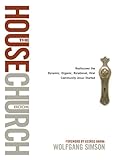
Wolfgang Simson is known for being a pioneer of the house church movement. His “The House Church Book” is a brief summary of his philosophy.  I mostly agree with him, but because I believe in the principle of the irreducible ecclesiological minimum, I think the Bible prefers some flexibility in the form of the church according to the context (though I think the NT is quite clear on the leadership structure).  Simson argues that the church must be formed around the oikos.  In any case, I think his proposal is correct for pioneer settings, and especially helpful for new MBBs who, for some reason or another, think they need to do church the way CBBs do church.

To that end, here are Simson’s Fifteen Theses towards a Re-Incarnation of Church (read the whole thing, below are just the main points):

  1. Church is a Way of Life, not a series of religious meetings
  2. Time to change the system
  3. The Third Reformation
  4. From Church-Houses to house-churches
  5. The church has to become small in order to grow big
  6. No church is led by a Pastor alone
  7. The right pieces – fitted together in the wrong way
  8. God does not leave the Church in the hands of bureaucratic clergy
  9. Return from organized to organic forms of Christianity
  10. From worshipping our worship to worshipping God
  11. Stop bringing people to church, and start bringing the church to the people
  12. Rediscovering the “Lord's Supper” to be a real supper with real food
  13. From Denominations to city-wide celebrations
  14. Developing a persecution-proof spirit
  15. The Church comes home

And here is a pdf of the 15 Theses in Arabic. (HT: Jens Barnett)

Monday, August 22, 2011

"Kingdom" and "Church" in Frontier Mission

This ISFM conference in September looks really interesting:

"The terms ‘Kingdom’ and ‘Church’ are contested in mission today, but they are catalyzing exceptional ministries across religious and cultural frontiers. The prism of contemporary Kingdom interpretation includes the transformation of societies, bringing justice to the nations, and the eradication of evil. A younger generation in mission marches to this Kingdom cadence, opting for new models of community, deeper devotion, and more holistic service. How does this rising Kingdom commitment intersect with the emerging church movements we see and expect to see on the frontiers? At ISFM 2011 a range of international speakers will explore the interface of Kingdom, Church and Mission in frontier settings across the globe, setting a framework for interaction among participants. Students and younger adults are especially welcome."