Showing posts with label Honor Shame. Show all posts

Tuesday, October 27, 2020

Misreading Scripture with Individualist Eyes | Richards and James

Richard James is an associate editor for our upcoming Motus Dei volume and will be contributing a chapter tentatively titled, Hearing the Story of “People of Peace” in Luke-Acts.

Together with E Randolph Richards, he has coauthored a new book for InterVarsity titled Misreading Scripture with Individualist Eyes: Patronage, Honor, and Shame in the Biblical World.

From the back cover:

The Bible was written within collectivist cultures. When Westerners, immersed in individualism, read the Bible, it's easy to misinterpret important elements―or miss them altogether. In any culture, the most important things usually go without being said. So to read Scripture well we benefit when we uncover the unspoken social structures and values of its world. We need to recalibrate our vision. Combining the expertise of a biblical scholar and a missionary practitioner, Misreading Scripture with Individualist Eyes is an essential guidebook to the cultural background of the Bible and how it should inform our reading. E. Randolph Richards and Richard James explore deep social structures of the ancient Mediterranean―kinship, patronage, and brokerage―along with their key social tools―honor, shame, and boundaries―that the biblical authors lived in and lie below the surface of each text. From Abraham, Sarah, and Hagar to Peter's instructions to elders, the authors strip away individualist assumptions and bring the world of the biblical writers to life. Expanding on the popular Misreading Scripture with Western Eyes, this book makes clear how understanding collectivism will help us better understand the Bible, which in turn will help us live more faithfully in an increasingly globalized world.

Nijay Gupta, professor of New Testament at Northern Seminary, has a good review of the book at Christianity Today. Here are some highlights from his review:

Richards is a well-respected biblical scholar, bringing reliable insight and interpretation to the study of individual texts. And James (“Richard James” is a pseudonym) has been involved in church-planting ministry in the Middle East. As a team, they deftly weave in modern cross-cultural stories to demonstrate worldview factors and social values of collectivist people. And they cycle back and forth between stories and passages from the Old and New Testaments…

I wish I had been given a handbook like this 15 years ago when I was first learning how to read the Bible well…

A central assumption of this book is the idea that we all read Scripture through our own cultural lenses or “eyes.” That is not necessarily bad. We have two eyes but only one perspective. Many modern Western readers of the Bible see the world differently than the biblical writers and the many characters in our Holy Book. I am thankful that Richards and James wrote this crash course in collectivism versus individualism to help us avoid many faux pas and pitfalls.

Read the whole review. Buy the book.

Wednesday, February 7, 2018

Jesus Christ as the Patron for Muslims | 5 Min Video

Here is an excellent video from Richard Yacoub that explains the implications of patronage for ministry with Syrian refugees. Applications extend to many other contexts as well.

In an earlier article, I said this about the Patron-Client Gospel for Muslim conversions:

Hanaan grew up very disillusioned with the hypocritical lifestyles of some fundamentalist Muslims she knew. One night a man in a brilliant white robe holding a staff appeared in her dream and told her that she was correct to doubt Islam. The next morning she described this event to her loving and devout Muslim father, who told her the person from her dream was Isa al Masih. Eagerly she went to the Qur’an and read everything she could about Jesus, who continued to show up in dreams for many years at key moments in her life.

According to her testimony, Hanaan joined herself to Jesus long before she met another Christ follower who studied the Bible with her for the first time. Like Hanaan, MBBs appear to bond themselves to Christ in a patron-client relationship as they initially begin to understand His lordship and even the atonement.

A biblical, missiological view of conversion must take into account the social context of the first century Mediterranean world (Asia and Africa are much closer to this worldview today than is the West). Relationships were conceptualized around the concept of “patronage,” where “they saw their gods as patrons and benefactors and their own conduct as clients” (Crook 2004, 254). “In this hierarchical society, where the status of the person you follow and to whom you give allegiance is very important, the position of Isa becomes the focus of reconsideration” (Edwards 2013, 84). MBBs relate to Christ in ways that are difficult for Westerners to understand, but make sense in their worldview. Yet this understanding of salvation is commonly found in the writings of the Apostle Paul. Christ is our ultimate Patron (the Divine Lord), we must be found “in him” and part of the new people of God.

See also http://honorshame.com/patronage.

Saturday, October 1, 2016

Ministering in Honor-Shame Cultures (IVP Academic Georges and Baker 2016)

Ministering in Honor-Shame Cultures releases today.

From Amazon:

Many a Westerner has had a cross-cultural experience of honor and shame. First there are those stuttering moments in the new social landscape. Then after missed cues and social bruises comes the revelation that this culture―indeed much of the world―runs on an honor-shame operating system. When Western individualism and its introspective conscience fails to engage cultural gears, how can we shift and navigate this alternate code? And might we even learn to see and speak the gospel differently if we did? In Ministering in Honor-Shame Cultures Jayson Georges and Mark Baker help us decode the cultural script of honor and shame. What's more, they assist us in reading the Bible anew through the lens of honor and shame, often with startling turns. And they offer thoughtful and practical guidance in ministry within honor-shame contexts. Apt stories, illuminating insights and ministry-tested wisdom complete this well-rounded guide to Christian ministry in honor-shame cultures.

Chapter 7 on “Relationships” can be downloaded here. Also make sure to see http://honorshame.com/book/ (Also a very helpful blog.)

Authors

Jayson Georges (MDiv, Talbot) lived in Central Asia for nine years doing church planting and micro-enterprise development. He is the author of The 3D Gospel and blogs at HonorShame.com. He serves with an evangelical organization, developing tools and training for Christians working in honor-shame contexts. More here.

Mark D. Baker
(PhD, Duke University) is professor of mission and theology at Fresno Pacific Biblical Seminary in Fresno, California. He served as a missionary in Honduras for ten years and has written a number of books in English and Spanish. More at www.ProfMarkBaker.com

Endorsements

Georges and Baker have taken the seeds of previous work on honor and shame in the environment of the biblical world and in modern cultures and cultivated them into fruitful insights and guidance in the areas of theology, cross-cultural engagement and, especially, missions.

~David A. deSilva, distinguished professor, Ashland Theological Seminary

Every message bearer working in non-Western cultures needs to read and apply the insights and principles of this book if they are to avoid the typical cultural blunders too often committed by too many. Within are crucial insights for effective cross-cultural ministry.

~Marvin J. Newell, senior VP, Missio Nexus

Building responsibly on biblical and anthropological foundations for understanding honor and shame cultures, the authors offer practical reflections on how to engage honor-shame societies in the work of intercultural mission.

~Edward Smither, dean, Columbia International University

The text is full of examples that help the reader understand how differently honor-shame codes play out in the understanding of salvation and discipleship. … Sherwood and I strongly recommend this book.

~Judith Lingenfelter, professor emerita, Biola University

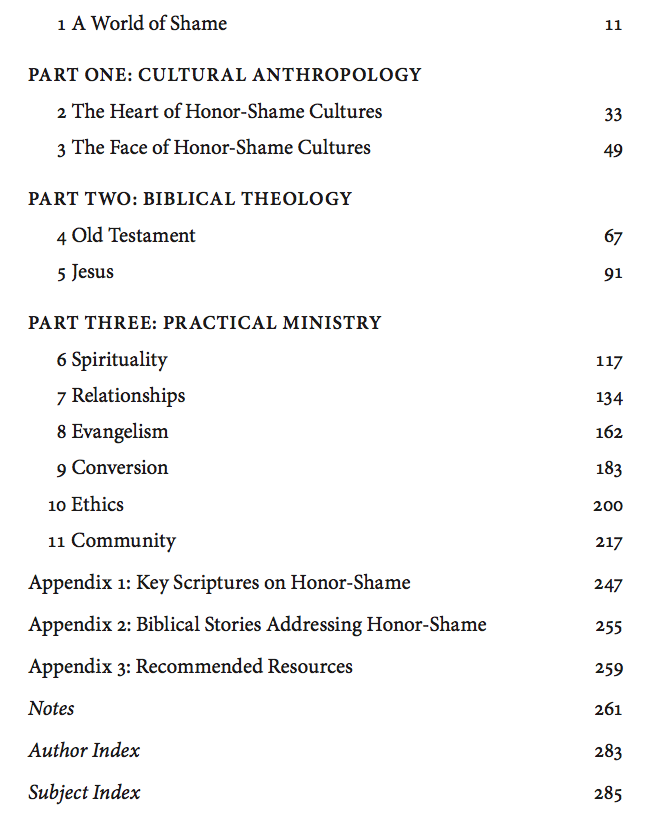
Contents

Contents for Honor-Shame book

Tuesday, November 24, 2015

Deepening Our Understanding of Honor/Shame


Because we Evangelicals are so stepped in a guilt/innocence paradigm it is hard for many to accept addressing honor/shame as an authentic part of the gospel.  It is not difficult for us to see honor/shame as an important cultural framework, but if that is all it is, then we view it as supplementary to the gospel rather than a fundamental part of redemption. 

This is unfortunately where much of the literature on honor/shame leave the reader. I’m sure this is not intentional, nevertheless, the honor/shame paradigm often comes across as a descriptor of culture rather than an intrinsic part of the gospel. 

This is where Roland Muller’s book “The Messenger, the Message & the Community” stands out. The book’s first edition came out almost 10 years ago (2006), which was before honor/shame became a major missiological topic, therefore I fear many people have missed this important volume. Although there is much to like in Muller’s work, in particular I was fascinated by the strong, coherent argument he makes that shame is a fundamental part of sin, therefore the restoration of honor is an essential part of of in Christ.
 
It seems to me the core of our Evangelical misunderstanding about honor/shame is that we think of guilt as man’s objective state before God, but shame as only a subjective feeling before  man. So I found it particularly helpful that Muller grounds his argument in the garden of Eden:

“… unfortunately many Christians and some Christian theology stop at guilt, or rather, get so wrapped up with ‘guilt-based theology’ that they fail to notice the other results of sin… When Adam and Eve realized they had sinned, they immediately hid themselves (v. 8).  Adam and Eve were ashamed. Shame had come upon Adam and Eve, but their shame was not for them alone. Shame, like guilt, passed upon all of mankind from that point on. As a result, man is not only guilty from this point on, but man is also in a position of shame before God” (pp 141-142).

Since what happened in the garden forms a backdrop to the narrative of sin that is almost universally accepted, grounding shame there establishes it alongside guilt as a fundamental part of sin’s impact on the human race. Just like guilt, shame haunted man even when he stood before an audience of One, thus it is an objective part of his standing before God.

For this reason and others, Muller’s book is must reading for those trying to fully integrate the honor/shame paradigm into their missiology.