Showing posts with label Spirituality. Show all posts

Thursday, July 2, 2020

Online Missiological Training: Post-Pandemic Insights and Applications

Based on "Neurobiological Data on What Online Education Could Be Doing to Our Spirituality and Our Brains: Some Augustinian/ Niebuhrian Reflections" (Ellingsten 2019) and "Makeshifting the Learning Management System: Strategies and Tactics in the Digital Classroom" (Smith 2019)  Articles Available Here

* The nature of the online world fundamentally changes the way our brains work. While accessing vast amounts of information is enhanced, "heavier online use is making us more shallow, more caught up in the present moment and its patterns, less transcendent in our thinking and behaviors" (Ellingsten 2019, 10). In short, we are less intelligent, more reactionary, and more spiritually shallow.

* Cross-cultural ministry is always more difficult, both cognitively and emotionally. Over-exposure to the internet and poor approaches to online education can have drastic effects on the missionary who will be less intellectually prepared for complex issues and impaired from the ability to love deeply.

* Increase in social media usage seems to be evidenced by those who are more depressed. Because the internet makes us less empathetic, could this be contributing to the increase in irrational online outrage/anger, the spread of conspiracy theories, and to anti-science rhetoric?

* Whether we like it or not, online training is here to stay. Things are not going back to the way they were before the pandemic.

* Learning facilitators who are more creative and involved in the online LMS (Learning Management System) tend to have higher levels of job satisfaction and also students who tend to have more transformative learning experiences (Smith 2019). Personal touches such as short videos and audio are helpful, as well as face-to-face synchronous meetings when possible.

* Online learning needs to intentionally contain elements that are offline. This includes longer stretches of reading and reflective writing while not connected to the internet. Videos and podcasts are proliferating but immersive reading needs to be maintained. Additionally, intentional offline time for the spiritual disciplines of meditation, prayer, and solitude is now MORE important in an online environment than in traditional formats.

* Online course design also needs to include the context of the learner. Learners are always in a "classroom." Especially for the missionary, the classroom is the ministry setting. Reading and writing needs to be integrated with the complicated classroom of real life. This has advantages to artificial (traditional) classrooms, but it requires more creative design from learning facilitators.

Wednesday, April 23, 2014

Count for Zero – The Issachar Initiative

http://issacharinitiative.org

A 6 week small group resource that will Count for Zero:

ZERO languages without the Scriptures

ZERO people groups without Disciple Makers

ZERO oral learners without an oral Bible

ZERO villages or neighborhoods without a church

ZERO people who have not heard the Gospel


The Issachar Initiative from The Issachar Initiative on Vimeo.

Thursday, December 19, 2013

“Not Doing God a Favor”

Before departing for the ends of the earth, you should settle in your mind and heart that you are not doing God a favor by going to reach the unreached; rather, He is doing you a favor by leading you away from your comfort zone and causing you to be more dependent upon Him.

-Patrick Lai, Tentmaking: The Life and Work of Business as Missions, pg. 139

Saturday, October 12, 2013

The Silent Witness of Love and Integrity (Part 3 in the “How are Muslims coming to Christ?” Series)

Previous posts in this series: How are Muslims coming to Christ? Introduction, Part 1: Conversion is a Contextual Process, and Part 2: The Prominence of the Affective Dimension.

Now we look at a missiological theme closely related to the affective dimension of worldview (from this article):

3. The Silent Witness of Love and Integrity

imageAlthough this is clearly related to the affective dimension theme, I believe the compassion and love from Kingdom workers to Muslims is significant enough to warrant inclusion. The godly lifestyle of Christians and the experience of genuine love significantly and positively change Muslims’ attitudes towards Christ and Biblical faith. This is perhaps true in every context, but even more so for Muslims. The lingering effects of the Crusades coupled with the war on terror create the lasting impression that “Christians” are imperialists who wish to destroy Muslims. Kingdom workers simply living lives of integrity and compassion among Muslims have done much to dispel this harmful misconception.

In Dudley Woodberry’s massive global survey of MBB conversions, the lifestyle of Christians was the most important factor facilitating conversion (Woodberry 2006). Like the stories of Qaasid and Yehia, I have not personally found a MBB who did not have a positive interaction with “Christianity” and Christian believers somewhere in the past.

Implications?

Live and love like Jesus. Enough said.

Next: Part 4, A Patron – Client View of the Gospel.

Sunday, May 19, 2013

Mission History and Humility

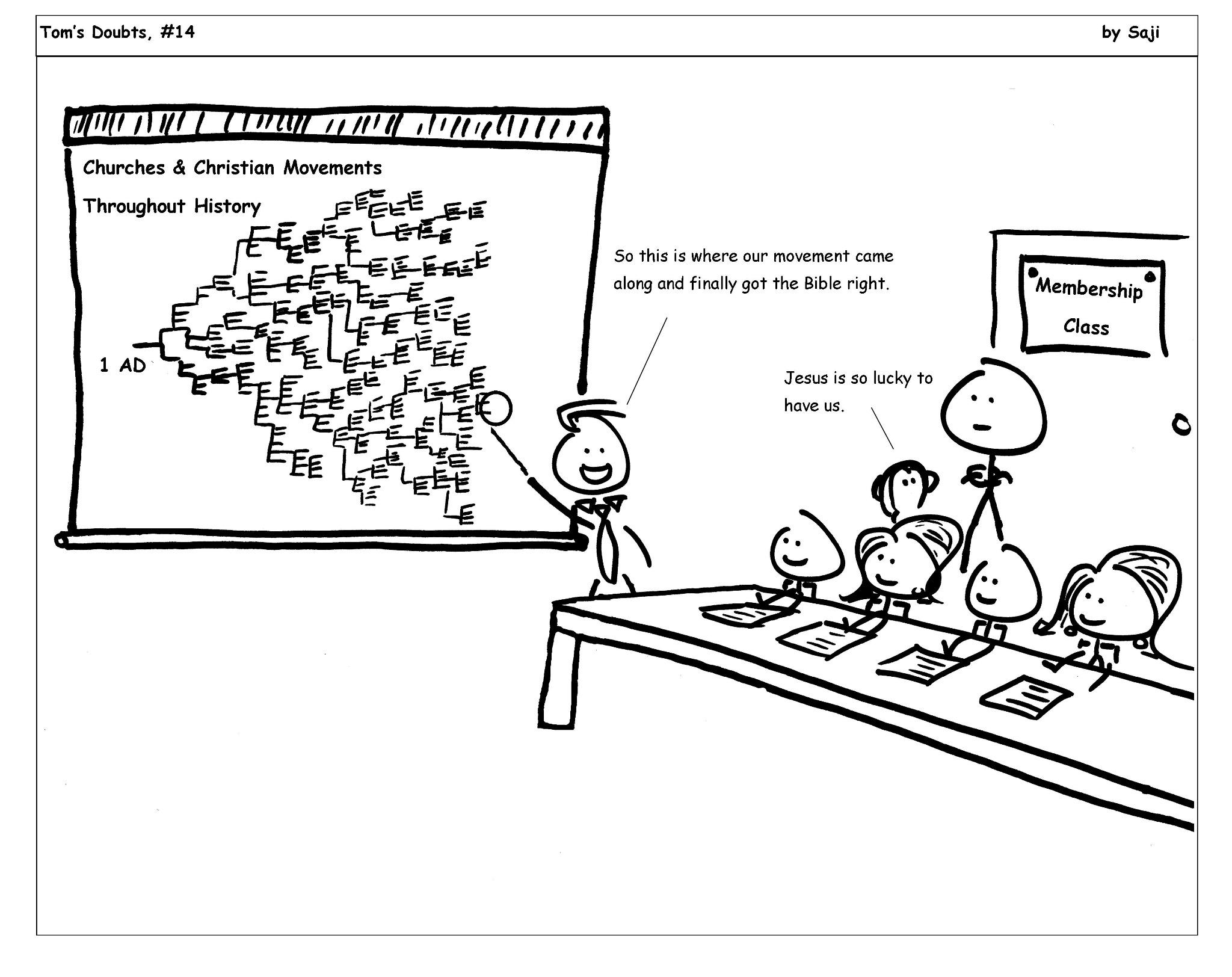
I’ll be attending the Bridging the Divide conference next month (I’m sure I’ll post what I can on that later).  In order to prepare for the dialogue I’ve been thinking a lot about humility.  I think this cartoon (you’ve probably seen this before) puts a lot in perspective rather quickly. (Click on the picture if you can’t read the text.)

Related: Quarrelling and Blog Arguing

Monday, April 1, 2013

Holy Restlessness

From Witvliet, John. 2007. "Afterword: Inculturation, Worship, and Dispositions for Ministry." In Christian Worship Worldwide: Expanding Horizons, Deepening Practices, edited by Charles E. Farhadian. Grand Rapids: Eerdmans:

Missional Christianity lives in a constant, question-asking, liminal, restless state - a kind of holy restlessness that comes from loving people and loving the gospel at the same time. Restlessness about culture is a sign of health this side of the coming kingdom. For now, it is the way things are supposed to be. Whenever this restlessness fades, whenever the question-asking stops, whenever practices are perpetuated just because "we've always done it that way" on the one hand or just because "it's on the cutting edge of ministry" on the other - then it is time to worry…

Ultimately, the topic of culture and contextualized ministry leads not to despair, but to hope. It leads us to consider things far greater than we would ever imagine on our own. And it reminds us that the source of our confidence in ministry does not rely on any culture-bound form, but rather on the sturdy fact that the church belongs to Jesus Christ our Lord.

Tuesday, March 5, 2013

Problem-Solving, Opinionated Americans

From Leadership Journal, The African Planter: Nairobi Chapel pastor on mission trips, and working well across cultures. An interview with Oscar Muriu (quoted in Leading Across Cultures: Effective Ministry and Mission in the Global Church pgs 110-111):

Americans have two great things going for them culturally. One is that Americans are problem-solvers. Every time I come to the U.S., I like to spend a couple hours in a Wal-Mart. I find solutions to problems that I never thought of!

The rest of the world, even Europe, isn't so intent on solving inconveniences. We tend to live with our problems… Americans don't easily live with a problem—they want to solve the problem and move on…

The second great thing for Americans is that your educational system teaches people to think and to express themselves. So a child who talks and asserts himself in conversation is actually awarded higher marks than the one who sits quietly.

Those two things that are such great gifts in the home context become a curse when you go into missions. Americans come to Africa, and they want to solve Africa. But you can't solve Africa. It's much too complex for that. And that really frustrates Americans.

And the assertiveness you are taught in school becomes a curse on the field. I often say to American missionaries, "When the American speaks, the conversation is over."  The American is usually the most powerful voice at the table. And when the most powerful voice gives its opinion, the conversation is over.

I tell Americans: "We're going into this meeting. Don't say anything! Sit there and hold your tongue." When you sit around a table, the people speaking always glance at the person they believe is the most powerful figure at the table. They will do that with you when you're the only American. And at some point, they will ask you: "What do you think?"

Don't say anything. If you say anything, reflect back with something like "I have heard such wisdom at this table. I am very impressed." And leave it at that. Affirm them for the contribution they have made. Don't give your own opinion.

Americans find that almost impossible. They do not know how to hold their tongue. They sit there squirming, because they're conditioned to express their opinions. It's a strength at home, but it becomes a curse on the field.

In a sense western missions has been marked by that. But isn't it strange that Jesus not only entered society incarnate at the weakest point, as a defenseless child who needed the care of his host community, but he also told his disciples: "Do not go with money; do not go with a second pair of shoes; go in a stance of vulnerability; be dependent on the communities you visit"? Isn't it interesting that for 30 years he doesn't speak out; doesn't reveal himself; he remains quiet, and only after 30 years of listening and learning the culture does he begin to speak…

Monday, September 17, 2012

“It’s time for Islamophobic evangelicals to choose”

This is worth reposting in full.  Somebody has to say it!  From Brian McLaren on CNN:

I was raised as an evangelical Christian in America, and any discussion of Christian-Jewish-Muslim relations around the world must include the phenomenon of American Islamophobia, for which large sectors of evangelical Christianity in America serve as a greenhouse.

At a time when U.S. embassies are being attacked and when people are getting killed over an offensive, adolescent and puerile film targeting Islam - beyond pathetic in its tawdriness – we must begin to own up to the reality of evangelical Islamaphobia.

Many of my own relatives receive and forward pious-sounding and alarm-bell-ringing e-mails that trumpet (IN LOTS OF CAPITAL LETTERS WITH EXCLAMATION POINTS!) the evils of Islam, that call their fellow evangelicals and charismatics to prayer and “spiritual warfare” against those alleged evils, and that often - truth be told - contain lots of downright lies.

For example, one recent e-mail claimed “Egyptian Christians in Grave Danger as Muslim Brotherhood Crucifies Opponents." Of course, that claim has been thoroughly debunked, but the sender’s website still (as of Friday) claims that the Muslim Brotherhood has “crucified those opposing" Egyptian President Mohamed Morsy "naked on trees in front of the presidential palace while abusing others.”

Many sincere and good-hearted evangelicals have never yet had a real Muslim friend, and now they probably never will because their minds have been so prejudiced by Islamophobic broadcasts on so-called Christian television and radio.

Janet Parshall, for example, a popular talk show host on the Moody Radio Network, frequently hosts Walid Shoebat, a Muslim-evangelical convert whose anti-Muslim claims, along with claims about his own biography, are frequently questioned. John Hagee, a popular televangelist, also hosts Shoebat as an expert on Islam, as does the 700 Club.

Many Christian bookstores that (used to) sell my books, still sell books such as Paul Sperry’s "Infiltration: How Muslim Spies and Subversives Have Penetrated Washington" (Thomas Nelson, 2008). In so doing, they fuel conspiracy theories such as the ones U.S. Rep. Michele Bachmann, R-Minnesota, promoted earlier this year.

In recent days, we’ve seen how irresponsible Muslim media outlets used the tawdry 13-minute video created by a tiny handful of fringe Christian extremists to create a disgusting caricature of all Christians - and all Americans - in Muslim minds. But too few Americans realize how frequently American Christian media personalities in the U.S. similarly prejudice their hearers’ minds with mirror-image stereotypes of Muslims.

Meanwhile, many who are pastors and leaders in evangelicalism hide their heads in the current issue of Christianity Today or World Magazine, acting as if the kinds of people who host Islamophobic sentiments swim in a tiny sidestream, not in the mainstream, of our common heritage. I wish that were true.

The events of this past week, if we let them, could mark a turning point - a hitting bottom, if you will - in the complicity of evangelicalism in Islamophobia. If enough evangelicals watch or try to watch the film trailer that has sparked such outrage in the Middle East, they may move beyond the tipping point.

I tried to watch it, but I couldn’t make it halfway to the 13-minute mark. Everything about it was tawdry, pathetic, even pornographic. All but the most fundamentalist believers from my evangelical Christian tribe who watch that video will be appalled and ashamed to be associated with it.

It is hate speech. It is no different from the anti-Semitic garbage that has been all too common in Western Christian history. It is sub-Christian - beneath the dignity of anyone with a functioning moral compass.

Islamophobic evangelical Christians - and the neo-conservative Catholics and even some Jewish folks who are their unlikely political bedfellows of late - must choose.

Will they press on in their current path, letting Islamophobia spread even further amongst them? Or will they stop, rethink and seek to a more charitable approach to our Muslim neighbors? Will they realize that evangelical religious identity is under assault, not by Shariah law, not by the liberal media, not by secular humanism from the outside, but by forces within the evangelical community that infect that religious identity with hostility?

If I could get one message through to my evangelical friends, it would be this: The greatest threat to evangelicalism is evangelicals who tolerate hate and who promote hate camouflaged as piety.

No one can serve two masters. You can’t serve God and greed, nor can you serve God and fear, nor God and hate.

The broad highway of us-them thinking and the offense-outrage-revenge reaction cycle leads to self-destruction. There is a better way, the way of Christ who, when reviled, did not revile in return, who when insulted, did not insult in return, and who taught his followers to love even those who define themselves as enemies.

Yes, “they” – the tiny minority of Muslims who turn piety into violence – have big problems of their own. But the way of Christ requires all who claim to be Christians to examine our own eyes for planks before trying to perform first aid on the eyes of others. We must admit that we have our own tiny minority whose message and methods we have not firmly, unitedly and publicly repudiated and rejected.

To choose the way of Christ is not appeasement. It is not being a “sympathizer.”

The way of Christ is a gentle strength that transcends the vicious cycles of offense-outrage-revenge.

Sunday, July 29, 2012

Summary and Outline of Invitation to World Missions: A Trinitarian Missiology for the Twenty-first Century (Tennent 2010)

If missiology is a puzzle, then Invitation to World Missions by Tim Tennent has helped me put more pieces in place than any other book.  Perhaps this is due to the fact that I’ve read several books on missiology and things are beginning to come into focus for me.  But Tennent’s missiology not only provides the corner pieces and the edges, it also fits several seemingly odd pieces that didn’t look compatible before (Tennent is an evangelical who loves to learn from other Christian traditions: the three most quoted missiologists in his book are Walls, Newbigin, and Sanneh).  Before reading this book I felt like I was trying to put together the puzzle without referencing the picture on the box, but now I have a clearer view of the puzzle’s shape and image.

The four major features of Tennent’s missiology (provided in the conclusion of the book) are as follows. 1. The Missio Dei.  Mission is primarily God’s, not ours.  Mission is “God's redemptive, historical initiative on behalf of His creation.”  Missiology must be articulated from a theological and theocentric framework.  Social science and business-world insights are helpful, but the Bible still rules the day.  2. The Triune God.  “The Father is the Sender, the "Lord of the harvest"; the incarnate Son is the model embodiment of mission in the world; and the Holy Spirit is the divine, empowering presence for all of mission” (Kindle Locations 722-723).  3. The New Creation.  Missions is about the in-breaking of the future reign of King Jesus into the present.  We minister in the “already but not yet” of the kingdom.  4. The Global Church.  Most missiologies have been written from a mono-cultural perspective where the West has assumed to be the major player.  But the rise of the majority-world church has changed the game and there is much to be learned.

If you want to develop your missiology and learn more about missional theology from a trusted guide, then Invitation to World Missions is a book that deserves careful study.  Readers of Circumpolar will find his discussions on Islam and the “insider movement” helpful and interesting.

Below is the outline of the book along with brief chapter summaries.

PART ONE: INTRODUCTION

Section A: Megatrends That Are Shaping Twenty-first Century Missions

1. From Moratorium and Malaise to Selah and Rebirth

Seven megatrends that are shaping missions today: 1. The Collapse of Christendom.  2. The Rise of Postmodernism: Theological, Cultural, and Ecclesiastical Crisis. “The Western church has responded in very different ways to the collapse of Christendom and the emergence of postmodernity, but none has managed the transition without experiencing some form of crisis.” (176-178).  3. The Collapse of the "West-Reaches-the-Rest" Paradigm. “Western Christians have been slow to grasp the full missiological implications of the simultaneous emergence of a post-Christian West and a post-Western Christianity” (247-248).  4. The Changing Face of Global Christianity.  Six sending and receiving continents!  5. The Emergence of a Fourth Branch of Christianity: “Independent” “Pentecostals”.  6. Globalization: Immigration, Urbanization, and New Technologies.  7.  A Deeper Ecumenism. “The simultaneous emergence of postdenominational identity among many, as well as the emergence of thousands of new denominations, requires the forging of new kinds of unity that transcend traditional denominational and confessional identities” (426-427).

Section B: The Triune God and the Missio Dei

2. A Trinitarian, Missional Theology

We must maintain a difference between mission and missions.  Mission belongs to God, missions is the church joining in God’s mission.  “Maintaining the distinction between mission and missions enables the church to be both God-centered and church-focused” (606-607).  “The only way to maintain the link between God's mission and missions in the church is to immerse the entire training in a thoroughly Trinitarian and ecclesial framework, so that everything is ultimately related to God (missio dei) and His church (missio ecclesiae)” (619-620).  LESSLIE NEWBIGIN and KWAME BEDIAKO have been key thinkers to try to advance this in the past and their contributions are summarized. 

3. A Trinitarian Framework for Missions

This chapter fleshes out what Tennent means by a Trinitarian missiology.  Missions must be talked about in the context of the Missio Dei, where each person of the trinity has a distinctive role to play.  God the Father is the source, initiator, and sender. God’s mission began with Abram in Genesis 12.  Missions is the expression of God’s relational and holy love, and the trinity is the seminal relationship that lies behind all human relationships.  God the Son is the embodiment of the Missio Dei.  God the Holy Spirit is the empowerment of the Missio Dei.    

PART Two: GOD THE FATHER: THE PROVIDENTIAL SOURCE AND GOAL OF THE MISSIO DEI

Section A: A Missional Perspective on the Bible

4. The God of Mission Reveals His Plan

The Abrahamic covenant reveals that God is the source and initiator of mission, that Yahweh is a sending God, and reveals God’s heart for all nations.  The missio Dei focuses on communities and nations- it doesn’t stop with individuals.  Tennent primarily looks at God’s blessing of the nations in the OT, and Wright is oft quoted.  “There is, therefore, a grand narrative of mission unfolding in the Bible that will ultimately follow the broad contours of creation –> covenant –> Incarnation –> Cross –> Resurrection –> Pentecost –> return of Christ –> eschaton/New Creation. Missions must be understood as the driving purpose for this grand narrative, not as some optional auxiliary of it. In other words, the missio dei is the central message of the Bible. The Bible, like the missio dei, is the story of God's redemptive, historical initiative on behalf of His creation. Missions ultimately must derive its life from that source” (1289-1293). 

5. The Sending Father and the Sent Church

This chapter reviews the “Great Commission” passages of each gospel writer.  We must listen to all in context and together in order to understand the missio Dei.  “Matthew emphasizes the role of discipleship and planting the church across ethnic and cultural boundaries among every people group in the world. Although we do not have the original words of Mark's commission, the received version is consistent with Mark's emphasis on perseverance in persecution and the central role of proclamation. Luke's commission emphasizes the importance of Spirit-empowered, holistic missions as we bear witness to the ongoing, mighty deeds of God. John's commission emphasizes the sending role of the church. Taken collectively, the commissions demonstrate the Father's initiative in missions. The Father imparts all authority to Jesus in Matthew's gospel. In Luke, the church fulfills only what the Father has promised. In John, the Father sends the Son, who, in turn, sends the church. Thus, all of the commissions are set within the larger context of the missio dei and God's original promise to Abraham that He would bless "all nations on earth" (Gen. 22:18) (1701-1706).

Section B: Creation, Revelation, and the Human Response to God's Rule

6. A Trinitarian, "New Creation" Theology of Culture

This chapter attempts to define a theology of culture.  Richard Niebuhr’s famous Christ and Culture (Christ against Culture, Christ of Culture, Christ above Culture, Christ in Paradox with Culture, Christ the Transformer of Culture) was flawed in several ways: First, Niebuhr's understanding of culture was constructed on the foundation of secular anthropology… To create a barrier between Christ and culture is to relegate God to the supracultural category, which maybe acceptable to some Islamic theologians but can scarcely be accepted as a thoroughly Christian view” (1757-1765). Second, Niebuhr's entire perspective on culture assumes a Christendom framework.  Third, the cogency of Niebuhr's argument requires a monocultural perspective and, therefore, is increasingly unpersuasive within the context of twenty-first-century multiculturalism.  Fourth, “Niebuhr's conception of culture is not set within an eschatological framework that sees the future as already breaking in to the present order… his secularized view of culture, which puts God in a supracultural category, robs his entire project of the eschatological perspective that is so central to all Christian thinking” (1795-1800).  Revelation is better described as transcultural, not supracultural.  

There are four ways Christians differ from secular anthropology in regards to culture.  First, Christians affirm that God is the source and sustainer of both physical and social culture.  Second, Christians affirm the objective reality of sin, rooted in the doctrine of the Fall, which has both personal and collective implications for human society.  “Human cultures, therefore, are simultaneously a sign of God's creative design as well as a manifestation of human sin, which stands in opposition to God's rule” (1865-1866).  Third, Christians affirm that God has revealed Himself within the context of human culture. God's revelation does not occur in a cultural vacuum apart from the particularities of culture. And fourth, Christians affirm that a future, eschatological culture, known as the New Creation, already has broken into the present.  “By relating the entire cultural process to the inbreaking of the New Creation, we are able to provide a vantage point from which to prophetically critique and enthusiastically celebrate as the gospel is embodied afresh in a potentially infinite number of new global contexts” (2094-2095).

7. An Evangelical Theology of Religions

(This identical chapter appeared in Encountering Theology of Mission.)  Tennent renames the classic paradigms of exclusivism, inclusivism, pluralism, in addition to the postmodern acceptance model.  He likes the hospitality of the pluralists, the inclusivist insistence that the missio Dei transcends the church, and the narrative emphasis of the postmoderns which reminds us that the gospel is primarily story and not simply doctrine.  He renames exclusivism to “revelatory particularism.”  Revelatory particularism should be articulated within a Trinitarian context.  The Father is the source of all revelation.  The Holy Spirit is the agent of the New Creation, and salvation is not simply justification but includes becoming a part of the New Creation.  And the Son is the “apex of God's revelation and the ultimate standard by which all is judged. Rather than comparing and contrasting Christianity with other religions, we measure all religions, including Christianity, against the revelation of Jesus Christ” (2479-2480).  Revelatory particularism embraces a canonical principle that asserts that the Bible is central to our understanding of God's self-disclosure, and positions an evangelical theology of religions within the context of the missio Dei where God desires to bless all nations.

PART THREE: GOD THE SON: THE REDEMPTIVE EMBODIMENT OF THE MISSIO DEI

Section A: Missions History as a Reflection of the Incarnation

8. Turning Points in the History of Missions before 1792

Seven snapshots of mission: 1. UNNAMED DISCIPLES FROM CYPRUS AND CYRENE in Acts 11:20.  The first instance of cross-cultural evangelism that led to the Jerusalem Council in Acts 15. 2. ST. THOMAS PREACHES THE GOSPEL IN INDIA.  Church history taught in the West misses the multidirectional spread of Christianity. 3.  THE TALE OF TWO MONKS, ALOPEN AND AUGUSTINE.  Two groups of monks in different parts of the world.  Early examples of contextualization and missional ingenuity.  4. RAYMOND LULL AND THE CHALLENGE OF ISLAM. Lull understood the long-term ill effects of the Crusades before any other.  He was also an effective apologist and mobilizer.  5.  FROM PADROADO (1493) TO PROPAGANDA FIDE (1622).  The difference between "missions as translation" and "missions as cultural diffusion" (Sanneh).  6. COUNT NICOLAS VON ZINZENDORF AND THE MORAVIAN MISSION.  The Pietist missionary movement that occurred prior to William Carrey.  7.  THE ODD ORIGINS OF KOREAN CHRISTIANITY.  The church was born outside of Korea among prisoners in Japan, and the message was first heard from Chinese, not from western missionaries.

9. The "Great Century" of Missions, 1792-1910

Five defining themes that give shape and force to the “Great Century.”  1. HOLY "SUBVERSION": THE BIRTH OF THE PROTESTANT MISSIONARY SOCIETY.  Protestants didn’t have a strucure for sending missionaries for a couple hundred years because they didn’t see the para-church structure in the Bible.  2. THE WORD MADE TEXT: VERNACULAR BIBLE TRANSLATIONS.  “Christianity is the only world religion whose primary source documents are in a language other than the language of the founder of the religion.”  Translation of the Bible was key.  3.  PERPETUATING PERPETUA: THE LEGACY OF WOMEN MISSIONARIES.  Women were mobilizers, professionals, pioneers.  4.  INDIGENOUS INGENUITY: CHURCH PLANTING IN THE "GREAT CENTURY".  Rufus Anderson and Henry Venn propose the three selfs: governing, supporting, and extending.  5.  GLOBAL COLLABORATION: THE BIRTH OF "WORLD CHRISTIANITY".  The famous Edinburgh World Missionary Conference in 1910.

10. The Flowering of World Christianity, 1910-Present

Seven portraits of twenty-first-century world Christianity. 1. PENTECOSTALISM IN LATIN AMERICA.  2. THE AFRICAN INDEPENDENT CHURCHES IN SUB-SAHARAN AFRICA.  3. MUSLIMS WHO ARE FOLLOWING CHRIST IN THE MOSQUE.  “I see C-5 as a temporary, transitional bridge over which some Muslims will be able to cross into more explicit Christian identity” (Kindle Location 3407).  4.  SOUTH INDIAN MISSIONARIES TO NORTH INDIA.  5. THE NON-REGISTERED HOUSE-CHURCH MOVEMENT IN CHINA.  6.  THE KOREAN MISSIONARY MOVEMENT.  7.  POST-CHRISTENDOM VIBRANCY IN EUROPEAN CHRISTIANITY.

Section B: Cross-Cultural Communication as a Reflection of the Incarnation

11. The Incarnation and the Translatability of the Gospel

Cross-cultural communication and contextualization.  “This chapter has demonstrated that the Incarnation provides the theological foundation for effective missionary communication. It serves as the model for all the ways that we seek to contextualize or translate the universal gospel message into a potentially infinite number of particular settings. There is indeed much to be gained from insights from anthropology, ethnography, and communication theory. However, if the whole of the missionary enterprise is to be properly rooted in the missio dei, it is essential that the foundation arise out of the missional and incarnational heart of the triune God” (Kindle Locations 3969-3972).

12. Access and Reproducibility in Missions Strategy

Mobilization for church planting among the unreached.  “The Incarnation makes the good news of God's redemptive love accessible. God, in Christ, relocates into our frame of reference and makes the inbreaking of God's rule intelligible in culturally understandable ways, summoning all cultures to the new realities of the kingdom of God. The themes of this chapter have been raised in order to help the church to better reflect the Incarnation as we seek to make the gospel accessible to every people group and as we nurture viable, reproducing churches in every people group in the world” (Kindle Locations 4358-4361).

13. Reflecting the Incarnation in Holistic Missions

The evangelism vs social action debate.  Tennent’s position is that the incarnation teaches the fundamental unity of word and deed.  “The emergence of a post-Western Christianity has finally liberated Christianity from what Kwame Bediako calls the "western possessiveness of it." The result is that a paradigm of evangelism that is focused on "saving souls" while closing our eyes and ears to human need is no longer tenable. For centuries most of the church has looked upon a world of need from the upper-side perspective of privilege and power. Today, most of the church reads the Bible from the "lower-side" perspective of poverty and powerlessness. In this respect, we may finally have come full circle to a global situation that is far closer to the vibrancy and holistic perspective of the first-century Christians” (Kindle Locations 4613-4617).

PART FOUR: GOD THE HOLY SPIRIT: THE EMPOWERING PRESENCE OF THE MISSIO DEI

Section A: Empowering the Church to Embody the Presence of the Future

14.  The Holy Spirit, the Book of Acts, and the Missio Dei

“During the twentieth century, the Pentecostal movement served to reawaken the church to the normative aspect of the Holy Spirit's activity in the church and in our witness in the world. Ultimately the Spirit is the central agent in the ongoing unfolding of the missio dei, enabling the church to experience the realities of the New Creation in the present. Of course, there have been glaring inconsistencies and theological problems within Pentecostalism, as with any Christian movement. If, in this chapter, I have neglected the "mote" in the Pentecostal eye, it is only because I am so painfully aware of the "beam" in my own eye. In other words, I maintain that despite its problems, Pentecostalism remains an important corrective to the blind spots in the pneumatology and practice that have dominated the West for centuries. As Samuel Escobar has wisely stated, evangelical Protestantism emphasized the "continuity in truth by the Word," whereas Pentecostalism has emphasized the "continuity in life by the Spirit!'" To be faithful to Christ in the twenty-first century, the church desperately needs the dynamic union of both” (Kindle Locations 4880-4886).

15. The Church as the Embodiment of the New Creation

Highlights the importance of the church AND the mission agency.  “This chapter has sought to examine the relationship between biblical ecclesiology and the emergence of various voluntary associations, parachurch ministries, and mission organizations that serve the church. Only the modality of the church infused with the Holy Spirit can embody the full realities of the New Creation in the present age. Sodalities exist only to further this goal. It has been argued that sodality structures are biblical and have historically served and assisted in the effective mobilization of the church in a wide variety of ways. However, it is essential that these organizations be held accountable to godly Christian leadership and that the individual members of the various societies be sent out from, and be held accountable to, a local church” (Kindle Locations 5196-5200).

Section B: Missionaries as Agents of Suffering and Heralds of the New Creation

16. The Suffering, Advancing Church

Chapter covers 5 perspectives on persecution.  “Now that we stand at the end of the long legacy of Christendom, it is vital that Western Christians be given a more robust theological and missiological framework to help us understand persecution better” (Kindle Locations 5242-5243).  “This chapter has provided a theological framework that places persecution and suffering within the larger context of the missio dei. Within this context, it is clear that persecution should not be viewed as an unfortunate bane in the life of the church or something that is experienced only by certain groups of Christians in history or only in a few parts of the world” (Kindle Locations 5501-5503). Persecution serves the church in various ways.

Conclusion: The Church as the Reflection of the Trinity in the World

Tennent concludes by using the “Insider Movement” as a case study to show his three step process for engaging new missiological questions.  Interesting stuff.  Read it for yourself.

Wednesday, April 25, 2012

Divine Sovereignty: The Fuel of Death-Defying Missions

David_PlattHere is a recent sermon from David Platt, author of the popular book Radical: Taking Back Your Faith from the American Dream, when speaking at a recent T4G event.  So many people have recommended this to me I just had to pass it on.  Watch the video, listen to the audio, or read the transcript.  Here is a line that stood out to me:

Brothers and sisters, if there are 6,000 people groups that have still not been reached with the gospel of Christ, then we have missed the point of the atonement.

Saturday, February 11, 2012

Quarrelling and Blog Arguing

I have been following some blogs lately that attempt to “expose” unbiblical models of ministry.  The idea in itself can be commendable.  God is truth and we should love the truth.

The irony is that heresy hunters almost always become unbiblical themselves, both in their manner of arguing (judging fellow believers i.e. Rom. 14) and the peripheral issues they choose to attack.  Especially to Christian fundamentalists, a heretic is anyone who does things different than you- every issue becomes essential.

I say all this because I myself am tempted to quarrel with fellow believers in the blogosphere over unprofitable issues!

Here are some verses I was meditating on this morning:

Romans 14:1:  As for the one who is weak in faith, welcome him, but not to quarrel over opinions.

2 Corinthians 12:20: For I fear that perhaps when I come I may find you not as I wish, and that you may find me not as you wish—that perhaps there may be quarreling, jealousy, anger, hostility, slander, gossip, conceit, and disorder.

1 Timothy 2:8: I desire then that in every place the men should pray, lifting holy hands without anger or quarreling;

1 Timothy 6:4: he is puffed up with conceit and understands nothing. He has an unhealthy craving for controversy and for quarrels about words, which produce envy, dissension, slander, evil suspicions,

2 Timothy 2:14: Remind them of these things, and charge them before God not to quarrel about words, which does no good, but only ruins the hearers.

2 Timothy 2:23: Have nothing to do with foolish, ignorant controversies; you know that they breed quarrels.

Titus 3:2: to speak evil of no one, to avoid quarreling, to be gentle, and to show perfect courtesy toward all people.

Titus 3:9: But avoid foolish controversies, genealogies, dissensions, and quarrels about the law, for they are unprofitable and worthless.

James 4:1: What causes quarrels and what causes fights among you? Is it not this, that your passions are at war within you?

Thursday, January 19, 2012

Prayer: the Work of Missions

From the famous sermon by John Piper in 1988, Prayer: the Work of Missions:

Not only has God made the accomplishment of his global purposes of salvation hang on the preaching of the Word; he has also made the success of the preaching of the Word hang on prayer. God's goal to be glorified in a world full of white-hot worshippers from every people and tongue and tribe and nation will not succeed without the powerful proclamation of the gospel by people like you and me. And that gospel will not be proclaimed in power to all the nations without the persevering, earnest, global, faith-filled prayers of God's people. This is the awesome place of prayer in the purposes of God for the world. They won't happen without prayer.

Listen to the whole thing.

Thursday, December 22, 2011

Guest Post: Living with the Wise, Ant Greenham

From Ant Greenham, Assistant Professor of Missions and Islamic Studies at SEBTS, and author of Muslim Conversions to Christ: An Investigation of Palestinian Converts Living in the Holy Land.  See also his research published as an article in St. Francis here: Key factors why Palestinian Muslims became Christians.

-----

My friend Tony Maalouf [author of Arabs in the Shadow of Israel: The Unfolding of God's Prophetic Plan for Ishmael's Line] argues persuasively that the magi, or wise men, who visited Jesus in Bethlehem, were Arabs. They came from the east (i.e. from present-day Jordan, or thereabouts), not from the north, like Babylonians, Persians and Greeks, who imposed centuries of hegemony over God’s people as they waited for their Messiah.

Whether they were Arab or not, the magi were quite likely influenced by Babylonian wisdom, as their name suggests. But they definitely had the wisdom to discern that a particular star, whatever it was astronomically, signified an extraordinary birth. In fact, the infant they went to see was not only King of the Jews, but one worthy of worship (Matt 2:2). How did they know this? While not excluding the supernatural, I would like to suggest they read and believed that portion of the Jewish Scriptures written in Aramaic, almost certainly a language they read with ease. The portion concerned is Daniel 2:4–7:28.

clip_image002Reading just this Scripture, they could conclude two things: From the time of Nebuchadnezzar’s Babylonian Empire, there would be four kingdoms, the last superseded by an everlasting kingdom, set up by God himself (Dan 2:44). The Babylonians, Persians and Greeks had come and gone. They were now in the era of the fourth kingdom, Rome. So it would stand to reason to look for a sign (such as an unusual star) which signified God was about to fulfill his promise. Second, God’s promise was centered in one like a Son of Man, who would be given eternal dominion, and enjoy the adulation of all peoples, nations and languages (Dan 7:13–14). So what else could they do, but respond to the star by going to Jerusalem and inquiring after one who was both human king and divine Lord?

Herod, that impetuous Roman ally, would try to negate God’s kingdom by slaughtering the infants of Bethlehem (Matt 2:16). But God’s word is true, and Jesus was spared to live a perfect life, die on the cross for our sins, rise from the dead, and return one day in glory. The magi, it seems, had the wisdom to understand this. Once they reached their goal in Bethlehem, they worshiped the child Jesus (but not his mother, or Joseph), and presented him with gifts of gold (for a king), frankincense (for a priestly mediator), and myrrh (to foreshadow his death, Matt 2:11).

This advent I am living among a delightful group of Arab believers in Jordan. They certainly have the wisdom to place the Jesus born in Bethlehem, who came to save us from our sins, at the center of attention. As we move into Christmas, it is my prayer that everyone reading this would do so too.

Ant Greenham, December 2011

Thursday, November 3, 2011

A Form of Slavery to Books

I confess to my shame that I feel somewhat guilty for NOT reading all the books and articles and blogs I can on Muslim Ministry.  Can you relate?  Here is book I probably won’t read but I thought the interview was helpful: Lit!: A Christian Guide to Reading Books.

From an interview the author gave on his book:

So many Christians treat books [and articles, blogs, etc.] as taskmasters. Most Christians have a stack of unfinished books in their house, maybe on a desk or a bookshelf. Those unfinished books are often a source of low-grade guilt. We’ve been conditioned to think that if we buy a book, we must read it from cover to cover. That’s not true, and I’m trying to loosen Christians from this misunderstanding of what is really a subtle form of slavery to books.

Apart from Scripture, all other books are optional reading. In fact, all other books are tools for us to use in our lives as we see fit. We use books when we need them. This means that we can read books cover to cover if we wish. Or we can read one chapter, or one page. It’s our call. By writing in a book, I claim the book as a tool. I own it; it belongs to me; it was purchased to serve me, and its value to me as a tool far exceeds its resale value. This does not give me license to ignore the truth God teaches me in my reading, but it does liberate me to see books as gifts from God, not as taskmasters. And that’s a very important stage of development for Christian readers.

Of course, I mark all sorts of things in my books, but fundamentally it is a claim of ownership, a claim that reminds me that my books are my tools and that I am not enslaved to them.

Tuesday, August 30, 2011

Spiritual Survival Handbook for Cross-Cultural Workers

The Spiritual Survival Handbook for Cross-Cultural Workers is not a great book, but it is filled with important concepts and is short (112 pages).  The intended audience is for those involved in team-based pioneer church planting.

Friday, August 26, 2011

All of Life is Repentance

Repentance is an important idea in Islam.  But it is a “religious” repentance that Muslims practice.  Here are some concepts from Tim Keller that might prove useful to bridge to the gospel with Muslims: All of Life is Repentance.

Saturday, August 13, 2011

GLS Session 7B: Patrick Lencioni “Getting Naked: The Importance of Vulnerability in Service”

patrick_lencioniGlobal Leadership Summit Session 7B: Patrick Lencioni

Author of the famous Five Dysfunctions of a Team.  Pat is an ENFP, and he is very funny.

One of the ways we manifest humility is by being vulnerable.  There are massive potential rewards for vulnerability, but it’s not guaranteed and you could loose a lot.  It involves suffering and pain sometimes.  But we are called to be humble and vulnerable by Jesus.  What are the three fears that keep us from being vulnerable?

1. Fear of Being Rejected.  Fear of losing the business.  We have to exercise our willingness to be rejected- that is how we are going to draw people to us.  We have to enter the danger.  Jesus was rejected, it is really possible that it will happen to us as well.  We need to be hungry to hear the kind truth, and to tell the kind truth.

2. Fear of Being Embarrassed.  We have to do things that embarrass us.  We need to ask dumb questions and be prepared to look stupid.  We have to celebrate our mistakes. 

3. Fear of Being Inferior.  We are afraid of putting ourselves in a lower position.  We have to do the dirty work.  Show people that you are willing to do what you’re asking them to do.  We need to be really interested in others.  Make everything about others and not about yourself.  It’s not about looking good.

[There was a lot of good overlap between this session and the previous one.]

GLS Session 7a: John Dickson “Humilitas”

john_dicksonGlobal Leadership Summit Session 7a: John Dickson

Dickson is the of the book Humilitas: A Lost Key to Life, Love, and Leadership.

Humility is not humiliation, it is not low self esterme.  It is the noble choice to forgo your statues and use your influence for the good of others, not yourself.  To withhold power for the good of others.  Humility makes the great greater.  [It doesn’t make you great?]

1. Humility is common sense.  None of us is an expert at everything.  Expertise in one area counts for very little in another.  A true expert should know this better than anyone.  “Competency extrapolation” is when you think that just because you can be an expert in one area will mean that you be competent in another area.

2. Humility is beautiful.  We are more attracted to the great who are humble, rather than to the great who want everyone to know it.  Humility has not always been been beautiful.  In Ancient Greece, love of honor was prized.  People used to seek honor.  Historically speaking, a humility revolution took place in the middle of the first century.  It started with the crucifixion of Jesus. Phil 2:3-8.  Our culture has been massively influenced by the cross of Christ.  Greatness and humility are one because of Jesus.

3. Humility is generative.  It generates new knowledge and abilities.  A proud person will go away from a conference taking very little with him, while the humble person will take away more.  The Scientific Revolution is because of humility, you must test and expose your science to critical examination.  Humility is the place of flourishing.  Humility is the fast-track to improvement.

4. Humility is persuasive.  Aristotle “On Rhetoric” 1.2.4: “Character is the controlling factor of persuasion.”  People are interested in you when you are interested in them.  We are biased towards people who are humble.  The most persuasive person is the person who has your best in mind.

5. Humility is inspiring.  You can only empower someone if you want them to succeed.  When leaders are aloof, we admire them, but we don’t want to be like them.  When great leaders are humble, they want to spend time with us, we want to be just like them.  Four tools of leadership, ability authority, character, persuasion.  But the most inspiring leaders don’t have structural authority.  You don’t need the keys to the kingdom to impact the kingdom.

Humility is not just another leadership technique.  It is a reflection of reality.  The cruciform life is a life in touch with reality.

Tuesday, August 9, 2011

“Incarnational” Mission?

Some people I really respect, such as Andreas Köstenberger, argue that the term “incarnational” as used to describe our mode or model of ministry is unhelpful and misleading, because it makes Jesus’ specific mission of atonement for sin less unique and trivializes the actual incarnation event.  But I think the term is great.  As Alan Hirsch says, “The implications of the incarnation for mission are massive.

Ed Stetzer has a great series arguing that the term “incarnational ministry” is not only biblically justifiable, but necessary and incredibly helpful.  You can read it here: Why We Should Use the Phrase "Incarnational Mission" (Part 1 of 3), Part 2, and Part 3.

See also the Infinite Translatability of the Christian Faith.

Tuesday, July 19, 2011

The Spirit of Christ is the Spirit of Missions

"The spirit of Christ is the spirit of missions. The nearer we get to Him, the more intensely missionary we become.”

-Henry Martyn

Martyn was educated at Oxford, and he was deeply affected by the commitment of William Carey and the devotion of David Brainerd. He fell in love with his cousin’s sister in law, but he considered marriage an earthly joy that would distract him from missions. When he arrived in India in 1806, Carey recognized his brilliance, and encouraged him in translation work. In the next four years he was able to translate the New Testament into Urdu, Persian, and Arabic. Martyn died at the age of 31, having only one convert, and before seeing his translations make it to print. “He was one of the first Protestant workers to direct his energies almost entirely towards Muslims.[1]


[1] Survey of Islam. Survey of Islam, Institute for the Study of Islam and Christianity. On the CDROM “The World of Islam: Resources for Understanding.” Global Mapping International: 2000.