Showing posts with label Movements. Show all posts

Tuesday, December 23, 2025

Inside Church Planting Movements (Garrison 2025)

I was happy to endorse David Garrison’s most recent book, Inside Church Planting Movements: What 25 Years of Assessments Reveal. Here is what I said:

Only David Garrison could distill thousands of pages of reports into a compelling story! From the pioneer who launched it all in the 1990s, this book brings you up to date on the exciting world of movements that are making disciples of Jesus among all nations. Inside Church Planting Movements is the data-rich resource we’ve been waiting for.

Here is the book description:

Are Church Planting Movements Real? Are they fabrications? How can we know?

David Garrison (PhD, University of Chicago) set out to answer these questions by analyzing twenty-five years of onsite assessments of Church Planting Movements conducted by the Global Research Department of the Southern Baptist International Mission Board.

This book pulls back the curtain on in-depth evaluations of twenty-eight reported movements from Asia, Africa, Europe, and the Americas. The findings are surprising. Discover what is really happening in reported movements across Cuba, India, East Asia, Africa, and the Muslim world.

Garrison was granted unprecedented access to previously unpublished onsite surveys of movements that claimed hundreds of thousands of new Christians and churches among the world's least-reached peoples. For the first time, this book opens the International Mission Board's archives, offering a behind-the-scenes look into the findings of one of the world's largest missionary organizations. What do hundreds of interviews, random samplings, and firsthand accounts reveal about one of the most significant issues in modern missions?

Inside Church Planting Movements offers new insights into this long-debated subject and is essential reading for any Christian wanting to understand what is actually happening in the remotest corners of the world. It is the most extensive analysis of Church Planting Movements ever produced and promises to be an invaluable resource for students and practitioners of contemporary Christian missions.

Buy on Amazon.

Friday, October 31, 2025

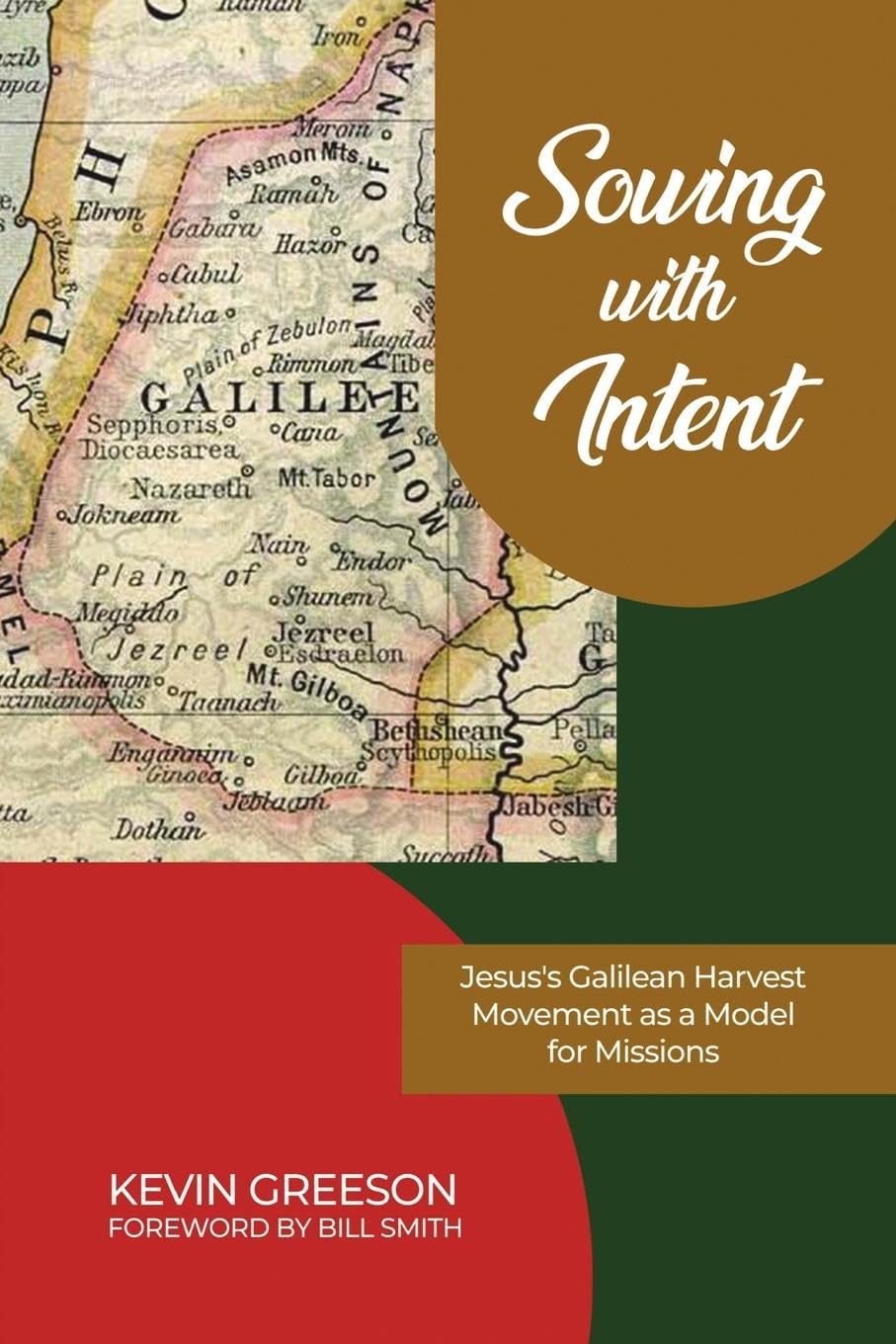
Sowing with Intent: Jesus’ Galilean Harvest Movement as a Model for Missions

I commend to you this book by Kevin Greeson, Sowing with Intent: Jesus’ Galilean Harvest Movement as a Model for Missions. The description:

Sowing with Intent offers a fresh look at Jesus's Parable of the Sower by demonstrating that the parable (a) stands above other parables, (b) represents Jesus's own approach to field ministry, (c) implicitly invites all obedient disciples to adopt Jesus's ministry approach, and (d) guides disciples to discover catalysts who ignite harvest movements.

Jesus's original intent for telling the Parable of the Sower was likely lost in the second century and remained lost until the end of the nineteenth century when scholars declared the original meaning can be known today. Using hermeneutical principles, Sowing with Intent attempts to provide churches and missionaries with Jesus's original intent for telling the Parable of the Sower and how to apply it in today's context.

Endorsement by David Garrison:

In Kevin Greeson’s masterful Sowing with Intent, the author takes us on his
personal journey to understand the missional strategy of Jesus. Greeson's book achieves a fusion of ideas between two worlds, the academic and the missionary practitioner world. Anyone intent on fulfilling the Great Commission through Jesus's own Great Plan must read this book!

Buy the book on Amazon or the eBook from Dorrance.

Saturday, May 10, 2025

A Bigger Table, Not a Smaller Net: Contemporary Missiology vs Movements Missiology

Through the years I have known and conversed with many well-known mission scholars who focus on social justice and political theology. I share their passion for exposing oppression, especially when sleazy politicians manipulate Christian supporters. We need to unmask the “powers” at work in the Church!

Where we part ways is how quickly some of them write off a movement of ordinary people who simply open a Bible in their own language, invite neighbors to study, and watch new house churches emerge in the process.

Look at how Jesus starts in Mark. After announcing the arrival of the gospel of the Kingdom, he walks up to fishermen and says, “Follow me, and I will make you fishers of people” (Mk 1:17). That’s it. A little later Jesus sends the Twelve out two by two, long before they fully understand what they are doing, and tells them to rely on God for the basics (Mk 6:7-13). By Mark 9 and 10 they are still tripping up over his true Messianic identity, yet Jesus never stops the movement. If Christ trusted new, immature disciples to learn and grow as they went, why do contemporary critics imply that new believers demonstrate racial reconciliation and economic justice before sharing the good news?

The irony hits even harder when you consider the cost these new believers already pay, especially in Muslim contexts. Some are functionally illiterate. Many live under suspicious neighbors or hostile authorities. A few have been beaten or killed for nothing more than saying, “I follow Jesus, and I want to read God’s Word with my family.” Declaring their theology “too thin” behind the safety of a Christian institution is, at best, tone-deaf.

Cross-cultural witness is not colonial by default. In many regions today, semi-trained missionaries are themselves from the Majority World, crossing borders that other Majority World mission scholars barely notice. Criticizing them because their approach feels “simplistic” risks another sort of colonialism - the kind that polices missiology from afar and never takes the same risks on the ground.

Do these young movements need to grow into a deep concern for justice, reconciliation, and public theology? Absolutely. That growth comes after birth, not before. It is unrealistic to expect a young church planting movement to show the theological depth and social engagement of one that has matured and institutionalized over decades.

We do not need to shrink the disciple-making net. We need to widen the table so that justice advocates, missiologists, movement catalysts, theologians, and brand-new disciples of Jesus in least-reached peoples all find space to contribute. Each group exposes a blind spot the others cannot see. When a scholar unmasks oppressive systems, vulnerable churches benefit. When relatively young believers share Christ across a language barrier in a nearby town (e.g. Acts 11:20), scholars gain a living case study for fresh insights into mission.

So to my political theology friends: keep naming the powers, but do not dismiss ordinary believers who risk everything for a faith in Jesus they are still learning to articulate. And to those catalyzing movements in new places: keep crossing cultures with bold humility, but keep listening to prophetic voices that remind us the Kingdom is for the whole person and the whole community.

The motus Dei is a large enough puzzle for us all. Let us stop measuring whose piece matters more and start fitting our pieces together.

Tuesday, January 28, 2025

Living Fire: Advancing God’s Kingdom in Challenging Places (Aychi B.R. with Dave Coles, 2025)

Another important book on movements has released: Living Fire: Advancing God’s Kingdom in Challenging Places, by Aychi B.R. with Dave Coles. Without mentioning it, many of the stories and examples in the book occur in Muslim contexts.

I was honored to offer an endorsement:

Living Fire is a powerful testament of the movement of God to disciple the least-reached. With practical insights and compelling stories, Aychi provides a narrative roadmap for igniting and sustaining Disciple Making Movements in challenging contexts. Honest about the hardships and full of hope, this book will inspire and equip anyone passionate about multiplying disciples and seeing God’s kingdom advance. A must-read for movement practitioners.

Buy on Amazon.

Monday, January 27, 2025

Overcoming Self Focus, by Dave Coles

In September 2024, Lausanne Global Analysis published David Williams’ article, Disciple-Making Movements: Applying a Faithful Balance. While it highlighted several concerns about maintaining theological integrity, parts of the critique seemed misplaced regarding the multiplicative and contextual nature of DMMs.

Last week, Dave Coles offered a thoughtful counterpoint in his response, Reimagining Missions: Overcoming Self Focus, published by the WEA Mission Commission. Coles encourages us to move beyond a monocultural evaluation, reminding us of the Holy Spirit’s work in places where traditional models have often struggled. Coles’ response contributes to our ongoing discussion about how best to participate in and understand movements today.

Saturday, January 4, 2025

Movements for Realists: An Extended Missiological Review of “Religion for Realists” (Perry 2024)

It is increasingly common for me to slowly study a book with which I don’t agree and that has glaring limitations, yet is still incredibly profitable and stimulating. Religion for Realists: Why We All Need the Scientific Study of Religion is one such book. Author Samuel Perry is a professor of Sociology (PhD, Chicago) who also has a ThM from Dallas Theological Seminary where he graduated summa cum laude in 2008. Perry has published some important works and is currently the number 1 ranked sociologist in the world by ScholarGPS. For those interested in podcasts, Perry recently discussed Religion for Realists on Dangerous Dogma, focusing on the implications of his work for the rise of authoritarian populism.

Perry believes that we need the evidence-based, empirical study of religion (i.e. “realism”) rather than our idealistic notions of it. Particularly, his subject matter is what he calls “Anglo-Protestant Christianity” in America: “The philosophical “idealism” that grounds much of the dominant Anglo-Protestant tradition has been relentlessly assaulted by evidence” (77). Perry gathers an impressive array of empirical studies, mainly in North American and Europe, to make his case. As such, the book is intended for an American audience, and primarily directed towards those in academia who tend to diminish the powerful sociopolitical role religion plays in the United States.

The focus of the book is also its limitation–at least, for global missiological purposes. Most of the research cited is on WEIRD populations and lacks an intercultural lens. Another limitation is the quantitative, macro-sociological emphasis. I read the book with my personal research in mind: church multiplication movements which tend to happen in the Majority World among deviant population samples (MBBs & HBBs). Sociological research in that setting is rare indeed, and hence the need for Motus Dei.

With those two limitations in mind, Religion for Realists is however a stimulating work current on sociological methods, and the bibliography is a gold mine of relevant resources in the sociology of religion. In my opinion, academic “religious studies” is basically missiology without mission. For committed Christians versed in the Bible who tend to think theologically, it is not difficult to make the missiological connections.

What is the main argument of Religion for Realists? From the Introduction:

This book is a short argument about how the scientific study of religion should transform our dominant understandings of religion in the West, some reasons why it has failed to do so, and what must be adjusted in the future to change that.

I have no intention of empirically debunking Protestantism or religion generally. I am, in fact, a lifelong Protestant, in a family of Protestants, with a Protestant seminary education. Yet dominant Anglo-Protestant assumptions about what motivates human beings (faith), what directs the futures of religious communities and broader societies (ideas or doctrines, often found in sacred texts), and the emphasis they place on individual agency are largely wrong. Not biblically or morally wrong. I won’t speak to either of those issues. But they are empirically wrong. Instead, I'll argue the scientific study of religion helps us understand that:

  1. humans are in greater part driven by the more fundamentally cognitive "deep culture" of social norms, identities, and loyalties;
  2. societies are transformed less by moral ideas or doctrines than by discernible transitions in human populations, and
  3. our agency, to an extent we may resent recognizing, is powerfully shaped by social structure–the layers of laws, policies, formal roles, material resources, and institutions in which we live our lives. (4)

Religion for Realists insightfully tackles this “ambient folk theology” of Evangelicalism (xiv). In other words, the popular theology/missiology many Evangelicals are immersed in teaches that faith (beliefs), doctrines (ideas), and obedience (individual actions) are the primary elements of Christianity. Sound familiar?

Instead, Perry maintains that when you really want to understand religion (and mission), then faith, doctrines, and obedience all come downstream from social identity, population dynamics, and social structure. This sociological perspective adds interesting nuance to our missiological inquiry and should help us see our own ideologies, providing a “realist” perspective. Table 1.1 (pg. 10) outlines this argument:

Primary Operant in Religion According to Anglo-Protestant Tradition vs Reality

DomainAnglo-Protestant TraditionReality
Cognitive Force Beliefs (Faith) Social Identity and Norms
Growth Factor Ideas (Doctrines) Population Dynamics
Change Agent Individuals (Obedience) Social Structure

Chapter 1 provides an overview, while chapters 2-4 describe each of these points in detail:

  1. We Were All Wrong: Anglo-Protestant Misconceptions
  2. Belongers before Believers: Group Identity and Norms
  3. Evangelism the Old-Fashioned Way: Population Dynamics
  4. Come Over Here and Make Me: The Power of Structure

Chapters 2-4 contain the heart of the book, and with a little nuance, are vital for missiological inquiry, including the study of CMMs (church multiplication movements) which will be my primary conversation partner in this review. (Chapters 5-6 speak to the importance of the study of religion in the secular academy and are not as relevant to our purposes here.)

Belongers before Believers: Group Identity and Norms (Cognitive Force)

In Chapter 2 of Religion for Realists, Perry argues that religion is primarily about group identity and social norms. Theology serves as a flexible tool to reinforce group cohesion, functioning more as a marker of belonging than as a transformative belief system. This might sound backwards, but think about it: depending on your own theological tribe, your position on the complementarianism vs egalitarianism issue (or charismatic gifts, ecclesiology, eschatology, etc.) is the defining feature of your faithfulness to Jesus!

Theology often operates as “sacralized groupness,” driven by relational impulses and social concerns rather than, primarily, doctrinal beliefs. Shared stories, symbols, and rituals bind communities together, while theological beliefs simply help narrate these bonds. Humans are “belongers before believers,” with group identity shaping religious behavior and biblical interpretation.

Ultimately, religion works through group status concerns, biases, and norms. Its fundamentally social nature prioritizes maintaining community over theological consistency or individual transformation. In fact, groups often switch their theologies when it suits the preferences of the group.

So let’s think through this missiologically. Movements avoid extracting individuals from their contexts and instead rely on social embeddedness (e.g. The Homophilous Unit Paradox: Church Planting Movements Within and Beyond the Oikos). Transformation often occurs collectively rather than solely through isolated individual decisions. In CMMs, as individuals within a social group begin to follow Christ, their shared norms and communal identity adapt, creating a ripple effect that leads others in the group to embrace faith.

This process does not negate personal conversion but recognizes that transformation is deeply embedded in the social context where beliefs and behaviors are shaped. This should challenge missiological frameworks that center theology as static and primary. It should also challenge Western individualistic approaches to mission.

Let’s also consider the sociological primacy of social identity and norms from the perspective of DBS (Discovery Bible Study). Perry references one very interesting study, How the Bible Works: An Anthropological Study of Evangelical Biblicism (Malley 2004):

What people are doing in group Bible studies has little to do with inductive education. People aren’t asking “How can I build my theology from the ground up based on what I see here in the text?” Instead it turns out to be more a collective exercise in connecting what they’re reading in the text with what their group has already decided the Bible teaches on that topic. [Malley] calls this “establishing congruence.” Our social group gives us an interpretive tradition such as “The Bible teaches traditional gender roles” or “The Bible teaches racial segregation” or “The Bible teaches that slavery is evil,” and we work to establish congruence between our group's traditional interpretation and the actual text. (53)

[Again, this study was on a WEIRD population. What about with non-Christian background, semi-literate oral preference learners who have never done an inductive group study of the Bible before?]

This is not to say that the Bible is not “living and active” with the utility to change people. Group identity and norms are powerful mechanisms for change, aligning with how DBS fosters transformation through shared engagement with Scripture. By immersing groups in the Word of God, DBS leverages the communal nature of belief formation, allowing the Spirit to work within relational networks to bring both individual and collective transformation.

The success of church multiplication movements depends on their ability to navigate and address deeply rooted social realities, rather than simply preaching rigid theological abstractions. As was said previously in Chapter 1 of Motus Dei (15-16), people will accept or reject a new religion based on whether they see it as strengthening or weakening a valued part of their social identity.

Evangelism the Old-Fashioned Way: Population Dynamics (Growth Factor)

In Chapter 3, Perry argues that religious transformation is primarily driven by population dynamics, not only superior ideas or doctrines. “Bodies precede ideas,” (70) with religious growth and decline resembling ecological systems rather than religious debates or marketplace competitions. Religious success depends on producing more members with durable social identities and norms.

Historically, religious groups have grown through high fertility rates and cohesive subcultures, especially in conservative, pro-natalist communities. As societies modernize, pluralism and secular civic options increase, leading to disaffiliation and the normalization of secularization. I found this quote fascinating:

Political scientists Pippa Norris and Ronald Inglehart show that as economic development increases around the world, citizens increase in their “existential security,” meaning they don’t live in constant fear of famine, disease, war, or political corruption. And when existential security increases, populations simultaneously experience lower birth rates, rising individual-choice norms, and lower levels of religiosity. (83)

But seculars have fewer babies, right? Yes. Then why is secularism increasing in the West? Because population dynamics are about more than just fertility and immigration. In the West, there are now enough religiously unaffiliated persons in the population to where secularity is an increasingly live option “that people rarely switch back from once they embrace” (87).

In thinking through where there are church multiplication movements today, my hunch is that nearly every place that is seeing a movement is also experiencing population growth, including overall Christian growth. In the US, Ryan Burge has documented that growing churches are also much more likely to be in counties with positive population growth. This adds an important caveat for those seeking to explain the rise of CPMs globally. Where Christianity (of various kinds) is declining, you are also less likely to have CPMs. The reverse is also true.

Understanding movements requires a focus on population trends and their interplay with societal changes. And of course, this is not to deny that God is the author of authentic Jesus movements.

Come Over Here and Make Me: The Power of Structure (Change Agent)

In Chapter 4, Perry argues that religious life is fundamentally shaped by social structures—the rules and resources that organize, constrain, and reproduce societal behaviors and arrangements. Western societies often overlook this, focusing instead on individual belief and conversion. Modernity has created structural alternatives to religion, such as existential security, urbanization, and state welfare programs, which reduce both the need for and trust in religion. These structural shifts are typically irreversible except under authoritarian regimes.

Religious groups privileged by the state often decline in participation and piety, while religious minorities tend to grow. This dynamic reveals that state involvement in religion frequently fosters negative associations, further accelerating secularization. In authoritarian contexts, religion may grow, but this growth is often tied to nationalist fervor rather than genuine religiosity. Modern structural arrangements fundamentally alter how religion functions in society, prioritizing identity over practice and weakening traditional religious participation.

Concerning persecution, there is little evidence that state repression directly catalyzes Church growth. Justin Long is quoted here:

Missiologist Justin Long cross-referenced international data from Pew Research Center on government and social persecution in particular nations with Operation World's numbers on annual growth of Christian populations in those nations and the combination yielded no discernable pattern. (111) [See Sorry, Tertullian at CT]

Social structures, more than personal beliefs or evangelistic strategies, determine the trajectory of religiosity within modern societies. This reinforces the need for missiological strategies that account for structural realities rather than solely focusing on individual conversions. “We are bodies, then belongers, then believers” (99).

The insights in this chapter refer to the challenges of movements in both urban and secular contexts, covered also in Chapter 1 of Motus Dei (12-13). To address this, CMMs involve fostering smaller, tightly knit communities with strong relational bonds that resist the isolating effects of modern urban environments.

Additionally, the growth of minority religions in contexts where they lack state privilege highlights the importance of resilience and adaptability. CMMs can thrive by embracing grassroots, decentralized models without crippling institutional dependency.

So, Were Jesus and Paul Sociological Realists?

I would like to wrap up this lengthy book summary and review by offering a brief reflection. To do so, a thought experiment might help. What would Jesus or Paul say about Religion for Realists? Three ideas come to mind.

1. Jesus’ teachings in Matthew 5-7 align closely with Perry’s insights, emphasizing identity and norms over doctrinal precision. Rather than telling the crowd what to believe, Jesus focuses on who they are to become (identity as salt and light) and how they are to live (norms like loving enemies and practicing justice). Paul, similarly, often addresses churches as communities defined by shared behaviors and relational unity rather than solely on abstract theological arguments. Both suggest that the early Jesus movement thrived when they prioritized forming durable social identities and shared practices, resonating with Perry’s argument that belonging and embodied norms are central to religious transformation.

2. Jesus’ statements in Matthew 10:5-7 and 15:23-24, where He emphasizes being sent “only to the house of Israel,” reflect an initial focus on a specific social and cultural identity. Similarly, Paul in Romans 15:8–9 highlights Jesus’ mission to Israel as a means to fulfill God’s promises, paving the way for the inclusion of Gentiles into the New Covenant people of Jesus. These passages might align with Perry’s insights on the power of social structures and group identity in religious movements. Jesus and Paul recognize the importance of working within existing social frameworks (Israel’s identity and norms) before expanding outward. This possibly illustrates that sustainable CMMs grow by embedding within a community’s structures and promoting an adaptive, movemental ecclesiology for broader inclusion.

3. Let me close with this: if you thought that either myself or Perry have lost our theological minds, then this last reflection is especially for you. Perry’s claim that the scientific study of religion reveals the “game plan” of authoritarian, ethno-nationalist politicians raises a critical tension for biblical missiology.

“My goal in writing this book is not to give authoritarian ethnonationalists on the far-right something like a game plan. Rather I believe the scientific study of religion reveals their game plan… Academics like me–those who deal professionally in the discovery and dissemination of facts–have something of a missional obligation to inform the world.” (122-23)

So what are we to make of this? Is Perry’s “realist” religion for our edification, or for our admonition? I think both.

In the New Testament, terms like stoicheia and exousiai are used to describe structures and principles and powers that exert influence over humanity, often opposing God’s purposes. The norms and structures that Perry mentions can be for good or evil, either outer manifestations or inner spiritual realities. Biblically, Paul warns against being taken captive by “the elemental principles of the world” (stoicheia) in Colossians 2:8, highlighting the potential of these forces to lead believers away from Christ.

So while sociological studies provide valuable insights into how social structures and norms influence religious behavior, they also expose systems that may perpetuate oppression or divert communities from biblical truths. Jesus and Paul were acutely aware of these dynamics, often challenging prevailing social and religious structures that contradicted God's kingdom values. For example, Jesus’ Sermon on the Mount (Matthew 5-7) redefines righteousness beyond Israel’s norms, and Paul confronts the “powers” (exousiai) that hinder the gospel’s advance (Eph. 6:12).

This tension underscores the necessity for missiological strategies to prioritize biblical norms and discernment. While empirical studies reveal the realities of human social behavior, they should not dictate our mission or ethics. Instead, believers are called to critically engage with these insights, recognizing the influence of stoicheia and exousiai. In doing so, we can navigate the complexities of societal structures without compromising faithfulness to Jesus.

So, even though Jesus and Paul were obviously not sociologists, their teachings exhibit a profound understanding of both social dynamics and spiritual forces. The missiological task of integrating sociological insights into a biblical framework requires careful discernment to ensure that the Church remains aligned with the motus Dei, resisting the subtle influences of worldly powers that seek to undermine mission.

Friday, November 15, 2024

The Contextual Dynamics of Trump’s MAGA Movement

This is a movement like nobody's ever seen before and, frankly, this was, I believe, the greatest political movement of all time.

President Elect Donald Trump, November 6, 2024

Donald Trump is a movement catalyst, and he knows it. In fact, the MAGA phenomenon offers valuable insights into the contextual nature of movements.

All movements, whether they are religious, social, political, etc., share common characteristics and require certain preconditions. But in explaining a specific movement, the starting point of the narrative is important. There is a reason why the MAGA movement would not have been possible in 1980s America but appealed to many in the 2010s. Let me explain.

Historically, religion played a central role in creating a sense of belonging for Americans. By becoming an active member of an organized group, most likely a church, people learned how to relate to others and become citizens in the process. Imperfectly, attendance in these groups built social capital and contributed towards a sense of cohesion in society.

Because trust between peoples was relatively high, democracy could work reasonably well. Nearly every American President has identified as Christian, with the vast majority specifying their denomination. In “Christian” America, faith was idealized as “love God and love your neighbor,” at least in the public sphere. Character and humility were important and valued for most Americans.

But that was then. MAGA is now. What changed?

The “Great Recession” of 2007-2009 and the related sub-prime mortgage rate scandal created significant societal distrust in America’s governing institutions, especially among the working class. It was an entirely avoidable problem precipitated by corporate greed and poor governmental oversight. The rich were getting richer, but the working class had more reasons to resent being ruled by so-called “elites.” This resentment has continued to fester.

By 2012, social media became ubiquitous. Intended to monetize clicks and likes, the algorithms actually manipulated our sociology which led to the increase in misinformation/disinformation and conspiracy theories. As we are all too aware, social media has normalized vulgarity, slander, and collective bullying. Not to mention, also an epidemic of mental illness.

In truth, a decline in civic engagement has been decreasing since the 1950s: social media simply accelerated it.

Foundational to this decrease in community participation, the Church in America lost 40 million members in the last 25 years, and those claiming no religious affiliation have increased from 14% of US adults in 2000 to 28% in 2024. “Nones” are now the largest religious cohort in the U.S.

These shifts have ushered us into an era referred to as “post-Christian America.” Today, a sense of belonging is felt, not through religious affiliation, but through expressing personal identity. One needs to discover who they truly are in their authentic self, and then communicate that via social media or other similar means. As societal trust once provided by religious affiliation declined and face-to-face interactions diminished, polarization, distrust, and resentment inevitably grew.

With this context in mind, we can now examine the specific dynamics of Trump’s MAGA movement. In her book, The Origins of Totalitarianism (1951) (HT: Berkowitz) political philosopher Hannah Arendt described three key mechanics of authoritarian movements (which she distinguished from totalitarianism):

  1. Hatred of the State. This highlights the paradoxical nature of authoritarian movements: there can be no movement without animosity towards the current incarnation of the State. Foster discontent in order to control.
  2. A Mood of Disruption. Authoritarians are not interested in policy (it’s too complex to motivate the working class) but in what Arendt calls the “mood” of the movement. By tapping into this collective emotional atmosphere, authoritarians use a rhetoric of disruption, resentment, and a desire for unity against perceived threats.
  3. A Group to Blame. Authoritarian movements often consolidate power by identifying a scapegoat—a group to blame for societal problems—which helps unify supporters through a shared adversary. They create propaganda to spread this narrative, manipulating information to reinforce the perceived threat and justify actions against the targeted group.

With a good grasp on how religion works in politics, Trump’s 2015 prepower alignment with evangelical leaders emphasized carefully selected “Christian values,” tapping into collective identity and emotions to reinforce loyalty among the “nones” and the nominally Christian working class. The economic hardship following the Great Recession fueled resentment, which Trump capitalized on through his repeated promises to “drain the swamp.”

By framing scapegoats as threats to religious and national values (“they’re eating the pets”), he uses propaganda to create a common enemy (“enemies from within”), uniting his base through shared fears and advancing an authoritarian movement centered on his celebrity status (“I alone can fix it”).

Similar to other successful movements, MAGA operates like an open social network. Importantly, anyone can opt in, as long as they bend the knee to Trump, even if they were once against him. The fall and rise of Marco Rubio within the Trump orbit is evidence, as is V.P. Elect J.D. Vance, who previously referred to Trump as “America’s Hitler.”

Without popular resentment of the ruling “elites,” normalized social vulgarity, and Christian faith on the decline, the MAGA phenomenon would not have the social space necessary to develop into a movement. Trump is an iconic President for a post-Christian America in our post-truth world. He is also the undisputed GOAT of reality/news TV, which has been MAGA’s limitless resource for mass mobilization.

***

Exit polls and election analysis reveal two consistent issues explaining Trump’s landslide victory: inflation and immigration. American voters decided that Trump’s impeachments, indictments, and his antics did not matter as much as their personal bank accounts. To a degree, I can relate.

Yet this election is not unique. Every incumbent governing party facing election in a developed country this year lost the vote, which is the first time this has ever happened. This is mainly due to the effects of global inflation (not solely in America), which were as much as Trump’s fault as Biden’s, and also beyond both of their control. Trump however did a masterful job of placing the blame entirely at the feet of the Biden/Harris administration.

Republicans often spoke this year of a mythical migrant crime wave. Trump was able to successfully perpetuate the zero-sum-thinking myth that more immigrants are bad for a country of immigrants. Ironically, the U.S. has a strong economy but actually needs more immigration for our economy to stay that way.

And thus, MAGA’s 2024 election dominance has been called a “triumph of misinformation.” This is not to say that Democrats are simply losers in the battle for reality. They have their own disfunctions and their own policies to blame. For instance, Trump was also able to leverage working class dismay of the progressive Left’s LGBTQ+ ideologies. And then there is Biden’s arrogance in deciding that he was indispensable to the Democratic party after signaling that he was going to be a one-term, transitional president… We could go on about Democrats, but this article is about the MAGA movement.

***

Yet more irony – MAGA Republicans are celebrating and Democrats are catastrophizing for the same reason: propaganda. As an authoritarian, Trump expertly plays the game of perception and illusion. And as a showman, he peddles both impossible promises and contrived fears.

Yet Trump has no ideological anchor. We might be grateful that he cares most about his own fame and not a specific ideology. Since the MAGA movement is likely to continue to be loyal to Trump himself, he will be unable to “make America great again” but also unable to take us down into some ideological abyss. Trump is no fascist and no totalitarian. While authoritarian regimes seek to consolidate political power and suppress opposition, totalitarian regimes aim to dominate every aspect of life. This is not something Trump is seeking, nor would it be possible in a “don’t tread on me” individualistic society like the U.S.

Trump’s reelection is not the end of democracy in America. Remember, he was deeply unpopular after his first term. The sky is not falling. Has the MAGA movement peaked? Probably, but it will likely hang around for a while too. Everyone just needs to stop freaking out.

But more to my point, as followers of Christ, we reject the politicization of our faith on both sides of the ideological aisle, and we care about all nations, not simply whatever country we find our temporary citizenship. In Jesus and the Powers: Christian Political Witness in an Age of Totalitarian Terror and Dysfunctional Democracies, N.T. Wright and Michael Bird bring us back to first principles:

The gospel calls us to believe in Jesus Christ, to belong to the Church and to build for the kingdom. If we perform that role properly, we will walk in the way of the cross, and build – right under Caesar’s nose! – things that challenge the edifices of totalitarian regimes, that show forth the beauty of God’s new creation, that demonstrate that there is a different way to be human, liberated from the lusts of pleasure and power, attaining a genuine human life by conforming to the image of the Son of God. (pg. 99)

***

Around 4/5 American Evangelicals who voted cast their ballots for Trump. In my view, it is perfectly acceptable to vote Republican or Democrat. Because I am not a fan of either, I can understand why someone is more disillusioned with the Democratic Party than the Republican.

What I personally find most troubling is, specifically, unfettered support for a man with Trump’s pernicious behavior. This cult-like loyalty to Trump is a crisis of discipleship in the Church, but also a crisis of citizenship in America (HT: Jethani).

Finally, not to sound triumphalistic or dismissive, but the greatest movement of all time is not MAGA (sorry, Mr. President), but the Church participating in the motus Dei. Lessons gleaned from reflecting on the MAGA movement are not for our edification, but for our admonition.

Wednesday, July 24, 2024

CPMs Within and Beyond the Oikos

The latest issue of IJFM is out, titled Homogeneity and Hybridity: Does McGavran’s Homogeneous Unit Principle fit the Realities of a Multiethnic World?

Yep, the debate surrounding the infamous HUP remains as lively as ever.

I contributed an article using the phenomenology of CPMs as a conversation partner. Historically, there have been some passionate one-sided takes on the HUP, but I believe every article in this issue of IJFM offers much needed nuance. 

Here is my contribution: The Homophilous Unit Paradox: Church Planting Movements Within and Beyond the Oikos. Pardon the quirky title—it seemed like a good idea at the time! From the intro:

At a fundamental level, the discipline of frontier missiology is based on “crossing difference:” dissimilarities between peoples are significant enough to require an intentional apostolic effort to engage such peoples. By contrast, much of contemporary missiology is based on “uniting difference:” distinctions between peoples are harmful to the unity of Church and a pastoral response requires the ministry of reconciliation. In this regard, Donald McGavran’s infamous Homogeneous Unit Principle (HUP) serves as an inflection point between frontier missiology and contemporary missiology. The apparent contradiction lies between an apostolic function and a pastoral function, both of which are needed, but at different times and in different ways. Phenomenologically, church planting movements (CPMs) highlight this tension. In this lecture, after presenting three short case studies introducing CPM’s intersection with the HUP, I’ll share what I’ve discovered specifically as it relates to the nature of church multiplication within networked oikos churches. Along the way, I’ll make two proposals: 1) that “homophilous” is a more appropriate term than “homogeneous,” and 2) the HUP is better understood as a “paradox” and not a “principle.”

So what is my proposal? The Homophilous Unit Paradox…

…guards against cultural paternalism to promote polyphonic worship from all ethne and yet can also endorse racism and segregation if left unchallenged.

Read the whole thing. Feedback welcomed.

Friday, May 24, 2024

From Missio Dei to Motus Dei: The Recovery of Movement

We tend by a secret law of the soul to move toward our mental image of God. This is true not only of the individual Christian, but of the company of Christians that composes the Church. Always the most revealing thing about the Church is her idea of God.

-A.W. Tozer

I usually feel okay about my appearance when I look in the mirror. But when someone shares a photo of me from a different angle, I realize, “I am clearly an overweight, middle-aged man who needs hair implants.” A slight shift in viewpoint changes a lot. Sometimes painfully so.

Similarly, common ideas we believe to be “okay” can seem very different when we shift our perspective. And some theological concepts become stale over time. Might we be facing that issue now when talking about “mission”?

Keep reading…

Wednesday, May 8, 2024

Cabbages in the Desert

New book alert: Cabbages in the Desert: How God Transformed a Devout Muslim and Catalyzed Disciple Making Movements among Unreached Peoples by Aila Tasse with Dave Coles:

Are Disciple Making Movements really happening among Muslims? If so, how are they happening? And what do those movements look like? You’ll find answers to these questions and many more in Cabbages in the Desert, where a zealous Muslim teenager meets a kind Christian teacher. Radically transformed then banished from home, Aila receives a vision of unreached peoples coming to Christ. After successfully planting many churches, he hears a challenge to explore a more fruitful approach: Disciple Making Movements. Find out how and why these movements, with many generations of disciples, are spreading in over a dozen countries in East, Horn, and Southern Africa, in a variety of social and religious contexts. Discover the vital role of indigenous leaders, and how movements can take root and grow, even among nomadic peoples and oral learners.

Cabbages in the Desert provides inspiration and insight about the dynamics of Disciple Making Movements. It also goes beyond that, encouraging practical application for all who want to see the Lord do similar work in their life and context. The same God who does amazing things in East, Horn, and Southern Africa, also desires to work in and through you!

I was happy to endorse the book. Here is what I said:

Dr. Aila Tasse, an African follower of Christ from a Muslim background, has witnessed significant success in his decades of ministry. Yet only after undergoing a transformative paradigm shift did he discover a path to even greater fruitfulness among least-reached peoples—an uncommon vision symbolized by "cabbages in the desert." Through compelling stories, Aila and his colleagues urge us to recalibrate mission back to the matchless standards for sprouting disciple-making movements: Jesus Christ and the Bible.

Get it on both paperback and Kindle.

Friday, September 8, 2023

The Blockchain Institution as a Metaphor for Movemental Ecclesiology

Previously we looked at the splintering end of “institutional” Evangelicalism and proposed that microchurch movements could be an avenue for refounding (à la Hirsch) the Church on the person of Jesus in its original movemental form which was a decentralized, multiplying community of disciples who existed within and beyond the gathered expression.

There is a lot of talk about the decline of “institutions” these days and the need for counter institutions. I don’t agree with everything here, but Aaron Renn has an interesting article on how a counter mainstream DNA is needed to renew institutions but without a “negative identity” (you are what you are against) that simply adopts the same institutional forces that led to decline in the first place.

Herein, the blockchain metaphor has some value. In other words, if prevailing model ecclesiology is like centralized banking, then movemental-microchurch ecclesiology is like blockchain currency.

Metaphors function on the level of hermeneutics. When we read “in the church at Antioch…” (Acts 13:1), Christendom ecclesiology (centralized “bank” metaphor) is often imported, eisegetically, into the text. Instead, the blockchain institution more closely resembles the nature of the Church in the NT context. The Bible serves as our source in demonstrating movement principles, but sometimes we need to first unlearn concepts/traditions in order to properly exegete the text, and metaphors can help.

In the context of movemental ecclesiology, where the emphasis is on decentralized and grassroots expressions of biblical faith and community, a blockchain institution could be compared to a network of interconnected microchurches. Here's how this metaphor might help us reimagine the nature of the Church (with the help of ChatGPT):

  1. Decentralization: Just as a blockchain is decentralized with no single central authority, a movemental ecclesiology encourages the decentralization of the Church. Instead of a hierarchical church structure, there are numerous microchurches with unique expressions.
  2. Nodes as Microchurches: In the blockchain, nodes are individual computers that participate in maintaining the ledger. In this metaphor, each microchurch could be seen as a node in the network. Each microchurch operates independently but is connected to the broader movement through shared principles, beliefs, and values.
  3. Transactions as Spiritual Connections: In the blockchain, transactions represent the transfer of value between participants. In the context of the Church, these "transactions" could be symbolic of the spiritual connections, relationships, and interactions that occur within and between house churches. These interactions may include sharing of resources, support, and collaboration on various aspects of faith and community life.
  4. Consensus as Shared Vision: Just as blockchains use consensus mechanisms to agree on the state of the ledger, microchurches within a movemental ecclesiology may use consensus-building processes to align around a shared vision or set of principles. This type of distributed leadership helps maintain the cohesion of the movement despite its decentralized nature.
  5. Immutable Faith and Values: Similar to how data on a blockchain is immutable, the orthodox beliefs of the Church remain unchanged and consistent across the system. These principles serve as the foundation upon which each microchurch builds its unique contextual expression of faith.
  6. Transparency and Accountability: Blockchains are known for their transparency, and in the metaphor, this could represent the transparency and accountability that microchurches have with one another and with their members. Open communication and shared values ensure that each microchurch remains aligned with the broader movement's goals.

The blockchain metaphor in this context highlights the decentralized, interconnected, and transparent nature of microchurches within a movemental ecclesiology. Each microchurch operates independently yet contributes to the strength and resilience of the motus Dei, much like nodes in a blockchain network maintain the integrity of the ledger.

This metaphor solves some of the problems inherent in institutional ecclesiology by decentralizing authority, promoting transparency, and enabling adaptability. In this network of interconnected microchurches, power is diffused, relationships are fostered, and the movement remains resilient, effectively addressing issues related to hierarchy, bureaucracy, and rigidity often associated with traditional institutional structures.

Tuesday, July 25, 2023

Six Journal Reviews of Motus Dei

Below is a compilation of all the “official” reviews of Motus Dei: The Movement of God to Disciple the Nations that I have come across to date. If you know of others, please let me know. I’m anticipating a negative review at some point ;-), but for now, we are grateful for how positively our communal effort has been received in diverse circles.

Please continue to share the book with your colleagues and consider leaving a review or a rating of Motus Dei on Amazon. (Remember, the digital version can be purchased here.)

Additionally, Ephesiology Master Classes has an online, affordable, and accredited MA in a Missiology of Movements. This includes a course called Foundations for a Missiology of Movements (can be taken as a stand-alone course as well) which uses Motus Dei as a core text along with a 15-minute video presentation of each chapter in the book – this really is a great resource. (There is a DMin and a PhD in movements as well!)

Here are some snippets of the reviews:

Jeyaraj, Dasan. 2022. “Book Review of Motus Dei.” Global Missiology 19 (4). http://ojs.globalmissiology.org/index.php/english/article/view/2697:

Motus Dei: The Movement of God to Disciple the Nations is a great read. I find this book extremely useful both for my teaching and missional practices. It is an instructive tool for anyone interested in knowing the way God works, and it is a great tool and resource for churches, foundations, and missiologists who want to know about “Motus Dei.”

Kelley, Karry. 2023. “What Factors Contribute to DMMs? Review of Motus Dei.” Evangelical Missions Quarterly 59 (2). https://missionexus.org/what-factors-contribute-to-dmms/:

Motus Dei (movement of God in Latin) is a useful introduction to church planting movements (CPMs) and disciple-making movements (DMMs). Editor Warrick Farah and the other missiologists who contributed chapters aim to answer the question “What factors are contributing to the increase of discipleship movements in the world today?” (xv). The book explains the theological and theoretical underpinnings of CPMs, then goes on to describe their practical outworking. There also are abundant examples and recommended applications.

Miller, Dave. 2023. “Motus Dei (Book Review).” Seedbed 34 (1). https://www.seedbedjournal.com/book-reviews/motus-dei:

We are confronted with the reality of gospel movements happening around the world today. As missiologists, theologians, and practitioners study the Scriptures to learn the message, model, and character of gospel movements, Motus Dei: The Movement of God to Disciple the Nations is a tremendous resource. It curates and distills years of practitioner wisdom passed down for generations. It outlines exciting insights into how God is transforming people from every, tribe, tongue and nation in miraculous ways through movements. Thank you to the contributors for sparking more conversation about the movement of God to disciple the nations.

Morton, Chris. 2022. “Book Review: Motus Dei: The Movement of God to Disciple the Nations.” Transformation 39 (3): 216–17. https://doi.org/10.1177/02653788221112747:

Reading Motus Dei feels like going on a year-long course in DMM missiology, and thus makes it ideal for the academic setting. But for mission agencies/leaders who are seeking to keep in step with the Spirit, it will provide a challenge and a guide to seeing DMMs in the context in which they operate. A well-rounded missiology of DMMs was needed, and Motus Dei has provided it in rich detail.

Seckler, Thomas W. 2022. “Review of Motus Dei.” Themelios 47 (2). https://www.thegospelcoalition.org/themelios/review/motus-dei-the-movement-of-god-to-disciple-the-nations/:

Although Motus Dei has weaknesses, it accomplishes its purpose of providing diverse research to further the global conversation on Christian movements. As such, Motus Dei is beneficial for those currently involved in movements as well as those desiring to understand more.

Campbell, David. 2022. “Book Review: Motus Dei.” Great Commission Research Journal 14 (2): 165–69. https://place.asburyseminary.edu/gcrj/vol14/iss2/16/:

Motus Dei is a remarkable achievement as a resource and scholarly work both in its breadth and depth for cutting-edge missiological research.

Congratulations and thank you to the 30 different contributors of Motus Dei for your excellent research and missiology. I am grateful to God to learn so much from you.

Saturday, February 25, 2023

How God is Moving in Movements | Curtis Sergeant

Motus Dei was recently added as a partner in the Global Alliance for Church Multiplication (a network you should know about!): https://gacx.io/members/motusdei

GACX has a lot of great resources, including an insightful evaluation of the movements discourse by Curtis Sergeant, “How God is Moving in Movements.” From the video description:

During the 2022 GACX Forum, movement catalyst and mobilizer Curtis Sergeant shares some of the global trends he is seeing in disciple-making and church-planting movements around the world. He begins by looking at some of the quantitative data about global population and church growth, then moves into some qualitative observations about what movement practitioners are doing well -- and where we still need to grow.

Watch the 38 min video here: https://gacx.io/videos/how-god-is-moving-in-movements

Thursday, July 28, 2022

Responding to Popular Critiques of Movements

Earlier this year, No Shortcut to Success: A Manifesto for Modern Missions (9Marks, Matt Rhodes) was published. The book aims to promote missionary professionalism by critiquing what is likened to “shortcuts” and “miracle cures for covid” among Western missionaries. Notably, CPM/DMM “movements methodologies” are the author’s primary concern and what he views as deeply problematic. No Shortcut is highly reviewed on Amazon, although you can also note a few critical reviews as well.

In April, Global Missiology published two contrasting reviews of No Shortcut, one positive by Jackson Wu and another critical review by Dave Coles. Subsequently, the editor Nelson Jennings asked myself and No Shortcut’s author Matt Rhodes to write articles in dialogue with one another about improving today’s missiological discourse on movements. I was pleased that Pam Arlund graciously agreed to coauthor the article with me as I respect her wisdom and experience in these matters.

This process of writing in dialogue took several months and is covered nicely in the editorial written by Nelson: “Missiological Iron Sharpening.” Matt Rhodes’ article, which is a response to Dave Coles’ critical review and to Motus Dei, is here: Advancing Conversations about Proclamational and Movements Methodologies. The abstract:

Movements methodologies have spread throughout much of today’s missions world. The prevalence of these methods necessitates conversation about their validity. This article provides constructive critique of movements methodologies, addresses responses to previous critique, and suggests paths for conversation going forward.

In dialogue with Matt, Pam and myself wrote a response to No Shortcut and attempted to “zoom out” and respond to popular critiques of movements: Discussing and Catalyzing Movements: An Invitation to Research, Sacrifice, and Commitment. The abstract:

As a global discussion and a significantly large phenomenon in the world today, church planting movements (CPM) or disciple making movements (DMM) have attracted much attention and enthusiasm in the missions community. They are widely accepted, and many different agencies have adopted movemental approaches to ministry in the past two decades. However, there is also a minority view of detractors who disagree with the voluminous case studies and published literature on movements. This article responds to some of those critics—represented here by the recently published No Shortcut to Success—by engaging that book’s important critiques but also what this article’s authors believe to be misinformation and ambiguous logic inherent in the book’s arguments. The authors hope that this approach will foster a helpful, constructive, and ongoing dialogue on movements missiology for the missions community.

I encourage you to read the reviews by Wu and Coles before reading the two articles, assuming you have read No Shortcut already. I want to thank everyone in the Motus Dei Network who reviewed earlier drafts of our article and also Pam, Nelson, and Matt for their friendship and cooperation throughout this process.

Saturday, July 9, 2022

The Genesis and Evolution of Church Planting Movements Missiology

I have recently written a contemporary history of the CPM/DMM phenomenon: The Genesis and Evolution of Church-Planting Movements Missiology. Originally, the article was 8,500 words but I had to trim it down to 5,000 words for publication. I will include more details at a later time but what you can read right now is a concise explanation of how CPM/DMM – a specific type of missiological movement in history – originated and continues to develop.

Here is the abstract:

While the dramatic growth of church-planting movements (CPMs) in non-Christian contexts around the world provides ample opportunity to explain their emergence and significance, a missiology of these movements is struggling to keep pace. This article argues that CPM is a unique feature in the field of mission studies that emerged in the later 20th century. Although it shares some of the same characteristics as the early Church Growth Movement discourse, CPMs today are a specific type of movement occurring mostly in least-reached Muslim and Hindu contexts. CPM missiology contains a number of features and unknowns which demonstrate that the discourse is both evolving and invaluable for how the global church understands mission.

Here is the outline:

  • Introduction
  • Missiological Antecedents of CPM
  • IMB’s Cooperative Services International as the Innovation of CPM
  • David Garrison’s Research and the Formalizing of CPM
  • Flexible and Diverse CPM Strategies
  • The Challenge of Defining CPM in a “Community of Practice”
  • Missiological Discourses Parallel to CPM
  • Conclusion

You can read it here: The Genesis and Evolution of Church-Planting Movements Missiology

Citation:

Farah, Warrick. 2022. “The Genesis and Evolution of Church Planting Movements Missiology.” Missiology: An International Review, Online First: 1–13. (DOI)

Feedback welcome.

Wednesday, April 27, 2022

A Movemental Turn in Missions: Thoughts on New Eras and New Wineskins

See the latest post at the ABTS blog: A Movemental Turn in Missions: Thoughts on New Eras and New Wineskins.

We are in a new era of missions and we cannot expect to deal with 21st century complexities using 19th century exemplars. The four most prominent shifts in this new era include:

  1. From Western to Indigenous
  2. From Linear Management to Holistic Complexity
  3. From Pastor-Centric Leadership to Mutual Polycentric Leadership
  4. From Institutions to Movements

Read the whole thing.

Friday, December 17, 2021

Good Ecclesiology Continues Jesus’ Life and Teachings: A Response to ‘The Potential Dark Side of Movements’ | Guest Post by David Garrison

Last week I posted The Potential Dark Side of Movements: Lessons from the Rise and Fall of Mars Hill which was my reflection on American Evangelicalism and movements.

David Garrison, executive director of Global Gates and author of Church Planting Movements and A Wind in the House of Islam, responds with an ecclesiological comparison between Mars Hill and Church Planting Movements (CPM).


Let me toss my two cents into this conversation. Every CPM is different with varying strengths and weaknesses. If, and I doubt it is so, the Mars Hill model is a CPM at all, it would fit on the extreme end of the spectrum as a sort of frankensteinian American mega-church planting movement. In so many ways, it fails to meet any of the descriptive elements found in the CPM phenomena that we’ve been describing around the world for the past 25 years.

In South Asia, as we sought to sharpen our CPM ecclesiology, we looked at the variety of movements around the world and adopted an eclectic approach to incorporating the best elements of ecclesiology that we were seeing. We sought to strike a balance between reproducibility and integrity to the ideal of continuing to reproduce all that Jesus taught and did in his life on earth.

The resulting ecclesiology, we called “A Handy Guide to Healthy Church,” so named because we used the “hand” as a mnemonic devise for teaching and reproducing key elements of the ecclesiology. Essential to this ecclesiology were what we called “antibodies” that fought off the twin maladies of immorality and heresy. The antibodies were woven into the structure of the ecclesiology and included:

  1. Small size of meeting groups that prevented the sort of megalomania that afflicted Driscoll and threatens so many mega-churches today.
  2. Intimate meetings in homes that ensure that discipleship exposes and penetrates every aspect of family life.
  3. Participative Bible study built on 2 Tim. 3:16-17, asking one another the Pauline questions: 1) what is God teaching, 2) what is God rebuking, 3) what is God correcting in my life, and 4) what will I apply to my life this week? This is radically different from the “knower/teacher to passive recipient” model abused by Driscoll.
  4. Shared leadership responsibilities with male and female deacons stewarding the five purposes of: 1) worship, 2) fellowship, 3) ministry, 4) discipleship, 5) evangelism/missions.
  5. Dedicating all tithes and offerings exclusively to one of these five purposes, with none available for salaries, buildings, or property.

These internal checks and balances within our house church network (that produced 106 churches in two years), served as antibodies within the body of Christ to fight off the sort of immorality and heresy that infected Brother Driscoll’s network.

Good ecclesiology that is both faithful to the Christ ideal and nimble enough to keep up with rapidly multiplying new conversions/disciples is a moving target. Our challenge must always be to measure our churches and ourselves by the ideal of: “Is this continuing what Jesus began?” Aiming for anything less, whether it is rapid or slow, Reformed or Charismatic, is missing the mark of fidelity to the One who claimed the Church as His Body.

David Garrison | Executive Director, Global Gates

Wednesday, December 8, 2021

The Potential Dark Side of Movements: Lessons from the Rise and Fall of Mars Hill

For me, listening to The Rise and Fall of Mars Hill podcast has been cathartic.

I was a seminary student in the early 2000s during Mark Driscoll’s meteoric rise. Like most seminarians, it was a time of implicitly searching for my own theological identity (for better or worse) in the vast sea of Evangelicalism.

I was drawn to Mars Hill and Driscoll for their focus on contextualization, perceived commitment to “the gospel,” slick internet media, and the hilarious hyperbole in Driscoll’s preaching. I eagerly consumed several of his writings and sermons (I somehow missed his most controversial comments).

At the end of the day though, Mars Hill wasn’t international enough for me and so I never fully opted-in. One of my church partners was affiliated with Acts 29 but cut ties with Driscoll early on, circa 2009, because of his authoritarian leadership style. I was never given details, but it was not an amicable parting.

After a comment I made in 2008 to a Christian leader about my admiration of Mars Hill in the post-everything American scene, I was gently warned by this leader that Driscoll had a history of spiritual abuse. So when word came out in 2014 about the demise of Mars Hill, I wasn’t surprised, and I eagerly wanted for years to hear the whole juicy yet tragic story. This podcast has not disappointed.

However, The Rise and Fall of Mars Hill is not so much about Driscoll as it is about the evangelical subculture that created the environment for his flourishing. Despite the obvious entertainment value of the podcast, I have lamented my own part in contributing to Driscoll’s noxious celebrity.

Writer and producer Mike Cosper has done an admirable job of highlighting the consumeristic nature of popular Evangelicalism and pointing the listener to repentance and Jesus. At the conclusion of more than one episode, I had some soul-searching prayer times with God. My personal leadership take-a-ways revolve around the concepts of accountability, character, gentleness, and integrity.

But that is not my focus here. I believe the wider lesson pertains to the potential dark side of movements.

Beware the Celebrity Patronage and Sociocultural Ideology

Just because there is a “church planting movement” (as Mars Hill was called) or a Christian movement of some kind, in any context, it doesn’t necessarily mean that the Kingdom is spreading. You can multiply healthy disciples, but you can also multiply a harmful ideology covered in a “Christian” veneer. And sometimes it is nearly impossible for insiders to tell the difference between the two.

As the podcast has made clear, both the fall and rise of Mars Hill was closely tied to an ideology created in the image of Driscoll and reflected in certain aspects of American culture. Yes, God still works in broken places where the Bible is preached and the gospel proclaimed. But Driscoll’s framework of chauvinism, combativeness, and autocratic hierarchy bears all the marks of a cult-like leader. As the series finale made clear, Driscoll’s overall message was not the gospel but instead a triumphalistic brand wedded to disproportionate media influence: “Be a winner, like me.”

Why does this also implicate us? The point of the podcast is that this ties in closely with American Evangelicalism. The past several years, and 2020 in particular, has been a time that exposed many of the ideologies inherent in our movement. A number of hard-hitting books and videos have nailed this point home.

To name only a couple, Jesus and John Wayne: How White Evangelicals Corrupted a Faith and Fractured a Nation exposed the toxic masculinity and Christian Nationalism in the movement. Believe Me: The Evangelical Road to Donald Trump traced the religious right’s co-option of Evangelicalism into conservative politics. Phil Vischer explained how fundamentalists snuck into the big tent of Evangelicalism. And The Color of Compromise: The Truth about the American Church’s Complicity in Racism uncovered the deep rootedness of white supremacy in American Christianity. We could also mention an anti-science ideological bias among white evangelicals. And the tendency to embrace baseless conspiracy theories. The list goes on and on.

To simply dismiss these as hit-pieces intended to persecute “true believers” would only reinforce the charge of ideologies in American Evangelicalism. You don’t need to agree with everything to recognize that something has to change.

Some have chosen to abandon Evangelicalism altogether. I think that might be too easy, and also a bit presumptuous. Evangelicalism is a global movement which American Evangelicals do well to realize that they are no longer the leading partner.

The proper response to recognizing ideology in our midst is to repent, lament, and recalibrate Church around the person of Jesus. In the final episode, Paul Tripp shared some sobering and helpful words related to the constant necessity for recalibration/deconstruction (37:15):

We should all be deconstructing our faith. We better do it, because our faith becomes a culture, a culture so webbed into the purity of truth, it’s hard to separate the two. And we better do some deconstructing, or we’re going to find ourselves again and again in these sad places… You know I celebrate the church of Jesus Christ…. I love the gospel, I have no other wisdom than that, but I’m sad for the Church… There is a devastating humility that comes when you are willing to deconstruct something you have given your life to.

Also in the final episode, former pastor and worship leader at Mars Hill, Joe Day, explains how he has disentangled ideology from his faith (35:42):

I was coming to see that I was involved in a very toxic culture for a very long period of time… the theology, the methods, and even the whole outlook on mission and church was all tangled up within that, and it was really hard to know what was what… I think there is so much bullsh*t in Evangelicalism. I think that we’re getting so many things backwards… But for me, I bring it back to Christ… Everything else might be rot, but the person of Christ is still extremely compelling to me.

As the Motus Dei Network studies movements, particularly in the Global South, our contextual analysis of these movements needs to take these lessons to heart. There are sophisticated reporting and verification procedures of these movements already in place to the extent that we know these are healthy movements centered on Christ.

But as the rise of the Mars Hill movement displayed so clearly, we do well to constantly exegete the context and continue to pay attention to potential issues of celebrity patronage and sociocultural ideology. Movements should be christological in nature. The pile of bodies behind the Mars Hill bus paints a vivid picture: any foundation and focus other than Jesus inevitably leads to pain and trauma.

Beware the Anti-Movement Bias

However, in the reaction to The Rise and Fall of Mars Hill, we may be tempted to an anti-movement bias. Like a pendulum that swings too far in the other direction, it would seem that smaller is better or that the ministry of presence is the only safe way to grow.

To be sure, Christian growth centered around a celebrity, coupled with an ideology, and flavored through the vapor of social media is an immediate red flag. As we discussed, the Mars Hill church planting movement certainly supports the suspicion that quick growth is inherently unhealthy, like cancer. But this would be a fallacy of a selective use of the evidence.

The story of the world is the story of movements, both for ill and shalom, with a lot of variation in between. Biblical faith, by its nature, is a movement of God (in Latin, motus Dei). Every people significantly impacted by Christ had a discipling movement at one point occur in its midst. A theology of multiplication ties movements to the grand narrative of Scripture. Jesus started a Kingdom movement that continues to this day. We are invited to be participants in his movement to redeem all nations back to himself. If anything, we should be biased towards those traditions and theologies that support a stagnant view of the Church and consumeristic Christianity that impede healthy Kingdom movements.

Movements as Biblical Yeast

To summarize, we need to discern the idolatry of charismatic celebrity and fanatical ideology that creates a lot of energy but ultimately burns people out. Jesus and the early disciples displayed what we might call a paradoxical “apostolic calmness” or a “patient urgency” in ministry. There was definitely a passion and realization that God uses people to accomplish his purposes, but also at the same time a trust that ultimately the movement is God’s, not ours. We can rest as grateful participants in movements of his Kingdom instead of building our own.

This focus recognizes the strategic nature of movements as zúme (yeast) in relation to the Kingdom. In the biblical narrative, zúme is used both positively (the parable of the yeast in the flour – Mt. 13:33) and negatively (the leaven of the Pharisees – Mt. 16:6). In the same way, movements start out small and insignificant but eventually have a huge impact, be that good or bad.

Mars Hill was a warning about the potential dark side of movements. Following Jesus, let us aim for Christ-centered Kingdom movements, especially considering the movemental nature of our faith. One third of the world still has yet to hear.

Thursday, October 7, 2021

Motus Dei Book Launch Event Oct 20

The first research output from our Motus Dei Network is available now for pre-order, Motus Dei: The Movement of God to Disciple the Nations. It releases on October 19.

You’re invited to the Virtual Book Launch on October 20, 9:00-9:45am Central Time US. Register here https://bit.ly/MotusDei and attend for a chance to win a free hard copy and a discount code for purchases. Here is the event schedule:

  • Endorsement by JD Payne, professor of Christian Ministry, Samford University
  • Endorsement by Harry Brown, president of New Generations
  • Book Preview
  • Breakout Sessions with Contributors
  • Chance to win a free book and a discount code for attendees

Feel free to share this with your networks.


Friday, August 27, 2021

Motus Dei book releasing October 19

As you may know, I have been working on a book project for the last four years. I’m excited to announce that it will be releasing October 19th at William Carey Publishing. As an edited compendium, it has over 20 original chapters of research on church planting movements. I’m going through the copy edits now. It is by design a thick volume, and one we hope advances the missiological discourse on movements.

Get your first look here, Motus Dei: The Movement of God to Disciple the Nations

Here is the book description:

Your Place in the Movement of God

An incredible breakthrough in missions history is taking place as disciples of Jesus make more disciples of Jesus around the globe, particularly among the least-reached. But what exactly are these church planting or disciple making movements? Where are they occurring and what are their unifying features? How are they manifesting in diverse populations? And can you or your organization be instrumental in catalyzing more movements? Motus Dei, Latin for “movement of God,” seeks to answer these questions and more.

Warrick Farah has expertly synthesized an extensive conversation between mission practitioners, scholars, and seasoned movement leaders from around the world. The resulting in-depth analysis of movements provides a multi-disciplinary academic investigation of an emerging “movements missiology,” highlighting the importance of theology, social sciences, ethnology and anthropology, communications theory, leadership theory, and statistical analysis. Motus Dei locates the current Church Planting Movement (CPM) phenomenon within modern history, while tracing its roots back to the first century, and articulates a missiological description of the dynamics of Disciple Making Movements (DMMs) in Asia, Africa, and diaspora contexts in the Global North.

Offering over thirty first-hand accounts of indigenous churches planting churches among the nations, Motus Dei provides a seedbed for growing movements in diverse contexts. There are lessons to be learned here by anyone seeking to participate in the movement of God.

A couple endorsements:

I have been writing and teaching on the subject of movements since 2001. People have often asked for more information about such works of the Spirit. Though I have been able to refer to a few sources here and there, I never found a satisfying comprehensive volume. Motus Dei is the compendium of contemporary research and wisdom for which we have been waiting! This groundbreaking book provides a breath of fresh air, answers many questions, and greatly advances the conversation regarding this flourishing field of study.

J. D. Payne, PhD

professor of Christian Ministry, Samford University; author of Apostolic Church Planting: Birthing New Churches from New Believers

God is moving in unprecedented ways! Kingdom movements have happened throughout history, but in the last thirty years God has started more than 1,400 movements with more than eighty million disciples in many unreached peoples and places. Motus Dei is an invaluable effort to evaluate and learn what God is doing in movements for the benefit of both the broader Christian world and movement leaders. “See, I am doing a new thing! … do you not perceive it?” (Isaiah 43:19).

Stan Parks, PhD

cofacilitator of the 24:14 Global Coalition; VP of Global Strategies, Beyond; coeditor of 24:14 – A Testimony to All Peoples: Kingdom Movements Around the World

As one who has spent decades in the worlds of both higher education and church planting, I highly recommend Motus Dei. It is well-researched, very informative, and extremely practical. Motus Dei would serve well as either a classroom text or a field handbook—a one-stop-shop resource on church planting movements.

Bill Jones, DMin

cofounder, Crossover Global; chancellor, Columbia International University

PRE-ORDERS WILL START SEPTEMBER 1, 2021