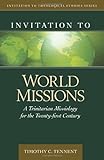
 If missiology is a puzzle, then Invitation to World Missions by Tim Tennent has helped me put more pieces in place than any other book. Perhaps this is due to the fact that I’ve read several books on missiology and things are beginning to come into focus for me. But Tennent’s missiology not only provides the corner pieces and the edges, it also fits several seemingly odd pieces that didn’t look compatible before (Tennent is an evangelical who loves to learn from other Christian traditions: the three most quoted missiologists in his book are Walls, Newbigin, and Sanneh). Before reading this book I felt like I was trying to put together the puzzle without referencing the picture on the box, but now I have a clearer view of the puzzle’s shape and image.
The four major features of Tennent’s missiology (provided in the conclusion of the book) are as follows. 1. The Missio Dei. Mission is primarily God’s, not ours. Mission is “God's redemptive, historical initiative on behalf of His creation.” Missiology must be articulated from a theological and theocentric framework. Social science and business-world insights are helpful, but the Bible still rules the day. 2. The Triune God. “The Father is the Sender, the "Lord of the harvest"; the incarnate Son is the model embodiment of mission in the world; and the Holy Spirit is the divine, empowering presence for all of mission” (Kindle Locations 722-723). 3. The New Creation. Missions is about the in-breaking of the future reign of King Jesus into the present. We minister in the “already but not yet” of the kingdom. 4. The Global Church. Most missiologies have been written from a mono-cultural perspective where the West has assumed to be the major player. But the rise of the majority-world church has changed the game and there is much to be learned.
If you want to develop your missiology and learn more about missional theology from a trusted guide, then Invitation to World Missions is a book that deserves careful study. Readers of Circumpolar will find his discussions on Islam and the “insider movement” helpful and interesting.
Below is the outline of the book along with brief chapter summaries.
PART ONE: INTRODUCTION
Section A: Megatrends That Are Shaping Twenty-first Century Missions
1. From Moratorium and Malaise to Selah and Rebirth
Seven megatrends that are shaping missions today: 1. The Collapse of Christendom. 2. The Rise of Postmodernism: Theological, Cultural, and Ecclesiastical Crisis. “The Western church has responded in very different ways to the collapse of Christendom and the emergence of postmodernity, but none has managed the transition without experiencing some form of crisis.” (176-178). 3. The Collapse of the "West-Reaches-the-Rest" Paradigm. “Western Christians have been slow to grasp the full missiological implications of the simultaneous emergence of a post-Christian West and a post-Western Christianity” (247-248). 4. The Changing Face of Global Christianity. Six sending and receiving continents! 5. The Emergence of a Fourth Branch of Christianity: “Independent” “Pentecostals”. 6. Globalization: Immigration, Urbanization, and New Technologies. 7. A Deeper Ecumenism. “The simultaneous emergence of postdenominational identity among many, as well as the emergence of thousands of new denominations, requires the forging of new kinds of unity that transcend traditional denominational and confessional identities” (426-427).
Section B: The Triune God and the Missio Dei
2. A Trinitarian, Missional Theology
We must maintain a difference between mission and missions. Mission belongs to God, missions is the church joining in God’s mission. “Maintaining the distinction between mission and missions enables the church to be both God-centered and church-focused” (606-607). “The only way to maintain the link between God's mission and missions in the church is to immerse the entire training in a thoroughly Trinitarian and ecclesial framework, so that everything is ultimately related to God (missio dei) and His church (missio ecclesiae)” (619-620). LESSLIE NEWBIGIN and KWAME BEDIAKO have been key thinkers to try to advance this in the past and their contributions are summarized.
3. A Trinitarian Framework for Missions
This chapter fleshes out what Tennent means by a Trinitarian missiology. Missions must be talked about in the context of the Missio Dei, where each person of the trinity has a distinctive role to play. God the Father is the source, initiator, and sender. God’s mission began with Abram in Genesis 12. Missions is the expression of God’s relational and holy love, and the trinity is the seminal relationship that lies behind all human relationships. God the Son is the embodiment of the Missio Dei. God the Holy Spirit is the empowerment of the Missio Dei.
PART Two: GOD THE FATHER: THE PROVIDENTIAL SOURCE AND GOAL OF THE MISSIO DEI
Section A: A Missional Perspective on the Bible
4. The God of Mission Reveals His Plan
The Abrahamic covenant reveals that God is the source and initiator of mission, that Yahweh is a sending God, and reveals God’s heart for all nations. The missio Dei focuses on communities and nations- it doesn’t stop with individuals. Tennent primarily looks at God’s blessing of the nations in the OT, and Wright is oft quoted. “There is, therefore, a grand narrative of mission unfolding in the Bible that will ultimately follow the broad contours of creation –> covenant –> Incarnation –> Cross –> Resurrection –> Pentecost –> return of Christ –> eschaton/New Creation. Missions must be understood as the driving purpose for this grand narrative, not as some optional auxiliary of it. In other words, the missio dei is the central message of the Bible. The Bible, like the missio dei, is the story of God's redemptive, historical initiative on behalf of His creation. Missions ultimately must derive its life from that source” (1289-1293).
5. The Sending Father and the Sent Church
This chapter reviews the “Great Commission” passages of each gospel writer. We must listen to all in context and together in order to understand the missio Dei. “Matthew emphasizes the role of discipleship and planting the church across ethnic and cultural boundaries among every people group in the world. Although we do not have the original words of Mark's commission, the received version is consistent with Mark's emphasis on perseverance in persecution and the central role of proclamation. Luke's commission emphasizes the importance of Spirit-empowered, holistic missions as we bear witness to the ongoing, mighty deeds of God. John's commission emphasizes the sending role of the church. Taken collectively, the commissions demonstrate the Father's initiative in missions. The Father imparts all authority to Jesus in Matthew's gospel. In Luke, the church fulfills only what the Father has promised. In John, the Father sends the Son, who, in turn, sends the church. Thus, all of the commissions are set within the larger context of the missio dei and God's original promise to Abraham that He would bless "all nations on earth" (Gen. 22:18) (1701-1706).
Section B: Creation, Revelation, and the Human Response to God's Rule
6. A Trinitarian, "New Creation" Theology of Culture
This chapter attempts to define a theology of culture. Richard Niebuhr’s famous Christ and Culture (Christ against Culture, Christ of Culture, Christ above Culture, Christ in Paradox with Culture, Christ the Transformer of Culture) was flawed in several ways: First, Niebuhr's understanding of culture was constructed on the foundation of secular anthropology… To create a barrier between Christ and culture is to relegate God to the supracultural category, which maybe acceptable to some Islamic theologians but can scarcely be accepted as a thoroughly Christian view” (1757-1765). Second, Niebuhr's entire perspective on culture assumes a Christendom framework. Third, the cogency of Niebuhr's argument requires a monocultural perspective and, therefore, is increasingly unpersuasive within the context of twenty-first-century multiculturalism. Fourth, “Niebuhr's conception of culture is not set within an eschatological framework that sees the future as already breaking in to the present order… his secularized view of culture, which puts God in a supracultural category, robs his entire project of the eschatological perspective that is so central to all Christian thinking” (1795-1800). Revelation is better described as transcultural, not supracultural.
There are four ways Christians differ from secular anthropology in regards to culture. First, Christians affirm that God is the source and sustainer of both physical and social culture. Second, Christians affirm the objective reality of sin, rooted in the doctrine of the Fall, which has both personal and collective implications for human society. “Human cultures, therefore, are simultaneously a sign of God's creative design as well as a manifestation of human sin, which stands in opposition to God's rule” (1865-1866). Third, Christians affirm that God has revealed Himself within the context of human culture. God's revelation does not occur in a cultural vacuum apart from the particularities of culture. And fourth, Christians affirm that a future, eschatological culture, known as the New Creation, already has broken into the present. “By relating the entire cultural process to the inbreaking of the New Creation, we are able to provide a vantage point from which to prophetically critique and enthusiastically celebrate as the gospel is embodied afresh in a potentially infinite number of new global contexts” (2094-2095).
7. An Evangelical Theology of Religions
(This identical chapter appeared in Encountering Theology of Mission.) Tennent renames the classic paradigms of exclusivism, inclusivism, pluralism, in addition to the postmodern acceptance model. He likes the hospitality of the pluralists, the inclusivist insistence that the missio Dei transcends the church, and the narrative emphasis of the postmoderns which reminds us that the gospel is primarily story and not simply doctrine. He renames exclusivism to “revelatory particularism.” Revelatory particularism should be articulated within a Trinitarian context. The Father is the source of all revelation. The Holy Spirit is the agent of the New Creation, and salvation is not simply justification but includes becoming a part of the New Creation. And the Son is the “apex of God's revelation and the ultimate standard by which all is judged. Rather than comparing and contrasting Christianity with other religions, we measure all religions, including Christianity, against the revelation of Jesus Christ” (2479-2480). Revelatory particularism embraces a canonical principle that asserts that the Bible is central to our understanding of God's self-disclosure, and positions an evangelical theology of religions within the context of the missio Dei where God desires to bless all nations.
PART THREE: GOD THE SON: THE REDEMPTIVE EMBODIMENT OF THE MISSIO DEI
Section A: Missions History as a Reflection of the Incarnation
8. Turning Points in the History of Missions before 1792
Seven snapshots of mission: 1. UNNAMED DISCIPLES FROM CYPRUS AND CYRENE in Acts 11:20. The first instance of cross-cultural evangelism that led to the Jerusalem Council in Acts 15. 2. ST. THOMAS PREACHES THE GOSPEL IN INDIA. Church history taught in the West misses the multidirectional spread of Christianity. 3. THE TALE OF TWO MONKS, ALOPEN AND AUGUSTINE. Two groups of monks in different parts of the world. Early examples of contextualization and missional ingenuity. 4. RAYMOND LULL AND THE CHALLENGE OF ISLAM. Lull understood the long-term ill effects of the Crusades before any other. He was also an effective apologist and mobilizer. 5. FROM PADROADO (1493) TO PROPAGANDA FIDE (1622). The difference between "missions as translation" and "missions as cultural diffusion" (Sanneh). 6. COUNT NICOLAS VON ZINZENDORF AND THE MORAVIAN MISSION. The Pietist missionary movement that occurred prior to William Carrey. 7. THE ODD ORIGINS OF KOREAN CHRISTIANITY. The church was born outside of Korea among prisoners in Japan, and the message was first heard from Chinese, not from western missionaries.
9. The "Great Century" of Missions, 1792-1910
Five defining themes that give shape and force to the “Great Century.” 1. HOLY "SUBVERSION": THE BIRTH OF THE PROTESTANT MISSIONARY SOCIETY. Protestants didn’t have a strucure for sending missionaries for a couple hundred years because they didn’t see the para-church structure in the Bible. 2. THE WORD MADE TEXT: VERNACULAR BIBLE TRANSLATIONS. “Christianity is the only world religion whose primary source documents are in a language other than the language of the founder of the religion.” Translation of the Bible was key. 3. PERPETUATING PERPETUA: THE LEGACY OF WOMEN MISSIONARIES. Women were mobilizers, professionals, pioneers. 4. INDIGENOUS INGENUITY: CHURCH PLANTING IN THE "GREAT CENTURY". Rufus Anderson and Henry Venn propose the three selfs: governing, supporting, and extending. 5. GLOBAL COLLABORATION: THE BIRTH OF "WORLD CHRISTIANITY". The famous Edinburgh World Missionary Conference in 1910.
10. The Flowering of World Christianity, 1910-Present
Seven portraits of twenty-first-century world Christianity. 1. PENTECOSTALISM IN LATIN AMERICA. 2. THE AFRICAN INDEPENDENT CHURCHES IN SUB-SAHARAN AFRICA. 3. MUSLIMS WHO ARE FOLLOWING CHRIST IN THE MOSQUE. “I see C-5 as a temporary, transitional bridge over which some Muslims will be able to cross into more explicit Christian identity” (Kindle Location 3407). 4. SOUTH INDIAN MISSIONARIES TO NORTH INDIA. 5. THE NON-REGISTERED HOUSE-CHURCH MOVEMENT IN CHINA. 6. THE KOREAN MISSIONARY MOVEMENT. 7. POST-CHRISTENDOM VIBRANCY IN EUROPEAN CHRISTIANITY.
Section B: Cross-Cultural Communication as a Reflection of the Incarnation
11. The Incarnation and the Translatability of the Gospel
Cross-cultural communication and contextualization. “This chapter has demonstrated that the Incarnation provides the theological foundation for effective missionary communication. It serves as the model for all the ways that we seek to contextualize or translate the universal gospel message into a potentially infinite number of particular settings. There is indeed much to be gained from insights from anthropology, ethnography, and communication theory. However, if the whole of the missionary enterprise is to be properly rooted in the missio dei, it is essential that the foundation arise out of the missional and incarnational heart of the triune God” (Kindle Locations 3969-3972).
12. Access and Reproducibility in Missions Strategy
Mobilization for church planting among the unreached. “The Incarnation makes the good news of God's redemptive love accessible. God, in Christ, relocates into our frame of reference and makes the inbreaking of God's rule intelligible in culturally understandable ways, summoning all cultures to the new realities of the kingdom of God. The themes of this chapter have been raised in order to help the church to better reflect the Incarnation as we seek to make the gospel accessible to every people group and as we nurture viable, reproducing churches in every people group in the world” (Kindle Locations 4358-4361).
13. Reflecting the Incarnation in Holistic Missions
The evangelism vs social action debate. Tennent’s position is that the incarnation teaches the fundamental unity of word and deed. “The emergence of a post-Western Christianity has finally liberated Christianity from what Kwame Bediako calls the "western possessiveness of it." The result is that a paradigm of evangelism that is focused on "saving souls" while closing our eyes and ears to human need is no longer tenable. For centuries most of the church has looked upon a world of need from the upper-side perspective of privilege and power. Today, most of the church reads the Bible from the "lower-side" perspective of poverty and powerlessness. In this respect, we may finally have come full circle to a global situation that is far closer to the vibrancy and holistic perspective of the first-century Christians” (Kindle Locations 4613-4617).
PART FOUR: GOD THE HOLY SPIRIT: THE EMPOWERING PRESENCE OF THE MISSIO DEI
Section A: Empowering the Church to Embody the Presence of the Future
14. The Holy Spirit, the Book of Acts, and the Missio Dei
“During the twentieth century, the Pentecostal movement served to reawaken the church to the normative aspect of the Holy Spirit's activity in the church and in our witness in the world. Ultimately the Spirit is the central agent in the ongoing unfolding of the missio dei, enabling the church to experience the realities of the New Creation in the present. Of course, there have been glaring inconsistencies and theological problems within Pentecostalism, as with any Christian movement. If, in this chapter, I have neglected the "mote" in the Pentecostal eye, it is only because I am so painfully aware of the "beam" in my own eye. In other words, I maintain that despite its problems, Pentecostalism remains an important corrective to the blind spots in the pneumatology and practice that have dominated the West for centuries. As Samuel Escobar has wisely stated, evangelical Protestantism emphasized the "continuity in truth by the Word," whereas Pentecostalism has emphasized the "continuity in life by the Spirit!'" To be faithful to Christ in the twenty-first century, the church desperately needs the dynamic union of both” (Kindle Locations 4880-4886).
15. The Church as the Embodiment of the New Creation
Highlights the importance of the church AND the mission agency. “This chapter has sought to examine the relationship between biblical ecclesiology and the emergence of various voluntary associations, parachurch ministries, and mission organizations that serve the church. Only the modality of the church infused with the Holy Spirit can embody the full realities of the New Creation in the present age. Sodalities exist only to further this goal. It has been argued that sodality structures are biblical and have historically served and assisted in the effective mobilization of the church in a wide variety of ways. However, it is essential that these organizations be held accountable to godly Christian leadership and that the individual members of the various societies be sent out from, and be held accountable to, a local church” (Kindle Locations 5196-5200).
Section B: Missionaries as Agents of Suffering and Heralds of the New Creation
16. The Suffering, Advancing Church
Chapter covers 5 perspectives on persecution. “Now that we stand at the end of the long legacy of Christendom, it is vital that Western Christians be given a more robust theological and missiological framework to help us understand persecution better” (Kindle Locations 5242-5243). “This chapter has provided a theological framework that places persecution and suffering within the larger context of the missio dei. Within this context, it is clear that persecution should not be viewed as an unfortunate bane in the life of the church or something that is experienced only by certain groups of Christians in history or only in a few parts of the world” (Kindle Locations 5501-5503). Persecution serves the church in various ways.
Conclusion: The Church as the Reflection of the Trinity in the World
Tennent concludes by using the “Insider Movement” as a case study to show his three step process for engaging new missiological questions. Interesting stuff. Read it for yourself.